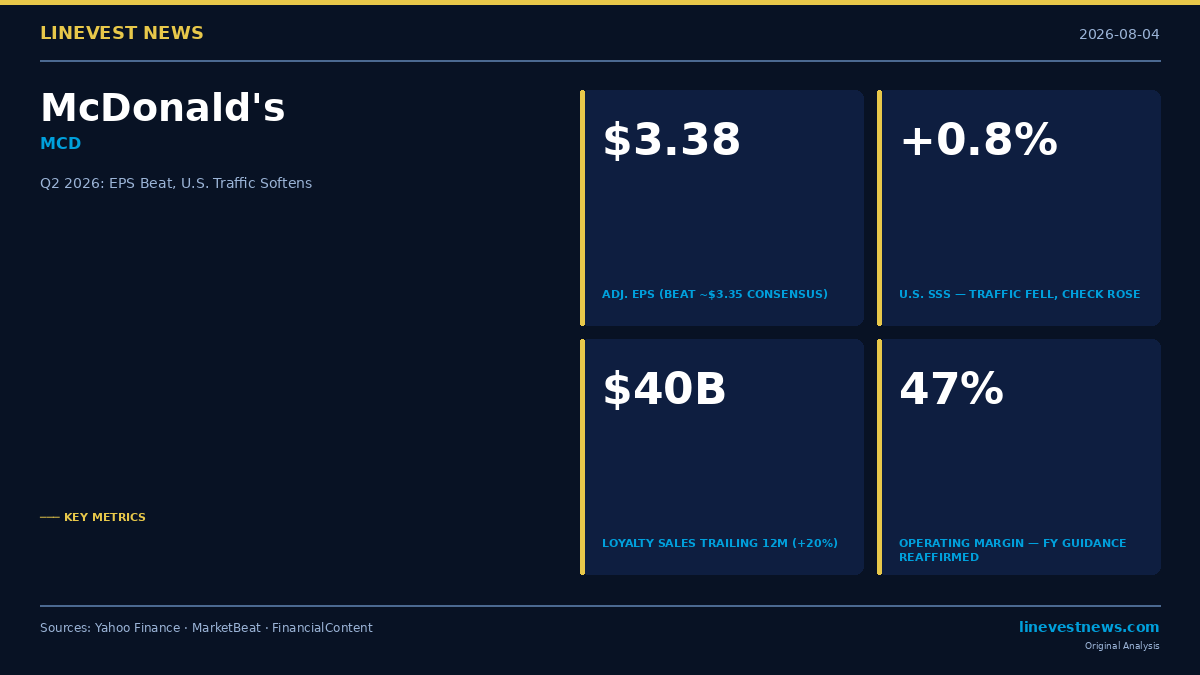
TL;DR - Adj. EPS $3.38 beat consensus (~USD 3.35); GAAP EPS $3.32 - Revenue USD 7.10B (+3.8% YoY), broadly in line vs ~USD 7.13B consensus (~0.4% shortfall) - U.S. same-store sales +0.8% — traffic fell, average check rose - Global same-store sales: +1.3% (vs +3.8% a year earlier) - Loyalty: USD 40B trailing-12-month systemwide sales; 220M active users (+13%) - Skye Anderson named President of McDonald's USA, replacing Joe Erlinger - MCD stock: ~USD 266, roughly flat in extended trading; market cap ~USD 188B - FY operating margin guidance: mid-to-high 40% range reaffirmed
Part A — Q2 2026 Results Snapshot
McDonald's Corporation (NYSE: MCD) reported second-quarter 2026 results on August 4, delivering a modest adjusted EPS beat alongside a slight revenue miss and a deceleration in U.S. comparable-store sales.
Revenue and Earnings
| Metric | Q2 2026 | Q2 2025 | Change | vs. Consensus |
|---|---|---|---|---|
| Total Revenue | USD 7.10B | ~USD 6.84B | +3.8% | Slight miss (est. ~USD 7.13B, ~0.4% gap) |
| GAAP EPS | USD 3.32 | USD 3.14 | +5.7% | In-line |
| Adj. EPS | USD 3.38 | — | — | Beat (~USD 3.35 est.) |
| Net Income | USD 2.36B | USD 2.25B | +4.9% | — |
| Operating Margin | 47% | 47% | Flat | — |
| Systemwide Sales | ~USD 37B | — | +5% | — |
The gap between GAAP EPS (USD 3.32) and adjusted EPS (USD 3.38) reflects restructuring charges excluded from the adjusted figure. On either measure, the earnings trajectory is positive: GAAP net income grew 4.9% year-on-year.
Same-Store Sales by Segment
| Segment | Q2 2026 | Q2 2025 | Consensus |
|---|---|---|---|
| U.S. | +0.8% | +2.5% | ~+1.1% |
| International Operated Markets | +1.5% | — | — |
| International Dev. Licensed | +1.9% | — | — |
| Global | +1.3% | +3.8% | ~+1.3% |
CEO Chris Kempczinski noted McDonald's "delivered positive comparable sales growth across every segment," while adding that management sees an "opportunity to raise the bar in the U.S. and accelerate performance in our largest market."
Leadership Change
McDonald's named Skye Anderson as President of McDonald's USA, effective August 4, 2026. Anderson, a 26-year McDonald's veteran who most recently served as Chief Operating Officer of McDonald's USA, succeeds Joe Erlinger. The announcement came alongside the earnings release, signaling a strategic emphasis on reigniting U.S. sales momentum.
Part B — What It Means for Investors
The U.S. Traffic Problem: Macro Softness or Structural Shift?
U.S. comparable-store sales growth of +0.8% in Q2 2026 marks a clear deceleration from +2.5% a year earlier, and missed the consensus estimate of approximately +1.1%. Critically, management disclosed that average check rose while restaurant traffic fell — a divergence that merits careful interpretation.
Rising check size without rising traffic usually signals pricing rather than volume-driven growth. McDonald's McValue program — notably the USD 5 Meal Deal bundle — was designed to rebuild traffic through value, but Q2 data suggests the strategy has not yet translated into meaningful foot-traffic recovery. In yesterday's earnings preview, KeyBanc's bear case of +0.5% U.S. SSS was flagged as a downside scenario. At +0.8%, the actual outcome came in below the consensus estimate of approximately +1.1%, landing between the bear case and consensus — consistent with the cautious-consumer thesis.
The key open question for investors: Is this a cyclical dip driven by cautious U.S. consumer spending, or is there structural share loss to competing quick-service chains or at-home meals? The fact that both international segments — IOM at +1.5% and IDL at +1.9% — held up better than the U.S. is consistent with, though not conclusive evidence for, the cyclical view: if the issue were global brand deterioration, all segments would likely be under pressure. That the drag is concentrated in the U.S. market at least narrows the diagnosis to U.S.-specific dynamics — whether macro-driven caution or competitive share shift.
Loyalty: A USD 40B Structural Moat
The loyalty program is the clearest long-term positive in Q2 2026. Trailing-12-month systemwide loyalty sales reached USD 40B (+20% across 70 markets), with approximately 220 million 90-day active users (+13% year-on-year). This is no longer a promotional experiment — it has become a scale asset.
Why does this matter for investors?
Pricing precision: With 220M active users generating identifiable purchase data, McDonald's can target promotions surgically rather than through broad-based discounting that compresses margin. This is the primary defense against the check-up/traffic-down dynamic showing up in U.S. SSS data.
Retention anchor: Loyalty users visit more frequently and spend more per year than non-members. In an environment where traffic is soft, a 13% growth in active users provides a structural floor on visit frequency for a meaningful portion of the customer base.
International tailwind: The 70-market footprint of the loyalty program means international markets — which outperformed the U.S. in Q2 — are increasingly anchored by the same digital engagement engine. As IDL markets continue at +1.9% SSS, loyalty may be one of the accelerants.
At USD 40B in trailing loyalty sales, the program now represents a substantial share of McDonald's total systemwide sales pool (approximately USD 37B in Q2 alone, implying roughly USD 140–150B in annual systemwide scale). Loyalty is not a side program — it is becoming the primary mechanism for demand management.
Margin Discipline: 47% and Holding
McDonald's maintained a 47% operating margin in Q2 2026, flat versus Q2 2025, and reaffirmed full-year guidance in the "mid-to-high 40% range." In an environment where labor and food costs remain elevated, holding a 47% operating margin while generating +3.8% revenue growth underscores the structural resilience of McDonald's franchise business model.
McDonald's generates the majority of its reported revenue from franchised royalties, rent, and licensing fees — not company-operated restaurant sales. This means the margin profile is insulated from direct restaurant-level cost inflation, which flows primarily to franchisees. The franchise model buffers margin but limits revenue upside during periods of rapid same-store sales growth.
The reaffirmed guidance is notably constructive given the U.S. SSS miss. It implies management expects either an H2 international acceleration, a U.S. traffic recovery under new leadership, or operational cost efficiencies — or some combination of all three.
Skye Anderson's Mandate: Fix the U.S.
The leadership change is the clearest forward-looking signal in the Q2 release. Appointing Anderson — the sitting COO of McDonald's USA — as U.S. President is an accelerationist move, not a transformation hire. Anderson knows the operational playbook, the franchise system, and the value program in granular detail.
Erlinger's tenure saw both the launch of McValue and the significant expansion of the loyalty program. Anderson inherits these platforms and must convert their strategic promise into traffic. The key execution risks include:
- Menu refresh: Can the McValue bundle be evolved to rebuild trip frequency without margin erosion?
- Digital conversion: Can the 220M loyalty users be more aggressively converted into higher-frequency visits specifically in the U.S.?
- Competitive pressure: Rivals including Burger King, Wendy's, and Chick-fil-A have also been running value campaigns. McDonald's must differentiate without triggering a race to the bottom.
Investors should watch Anderson's first full-quarter results (Q3 2026, reporting approximately October) as the first meaningful signal of whether the leadership change catalyzes operational improvement.
Three Watch Points for H2 2026
| Watch Point | Target / Signal | Why It Matters |
|---|---|---|
| U.S. SSS (Q3 2026) | Recovery to +1.5%+ | Confirms cyclical, not structural, softness |
| Loyalty active users | Growth toward 240M+ (vs. current 220M, +13% YoY pace) | Validates retention moat |
| Operating margin | Holding 46%+ in H2 | FY guidance credibility |
Analyst Consensus and Valuation
Heading into Q2, McDonald's carried ratings from 15 analysts at Buy and 12 at Hold, with a consensus price target of approximately USD 340 — implying roughly 28% upside from the ~USD 266 extended-trading price on August 4. The mixed Q2 report (adjusted EPS beat, revenue and U.S. SSS miss) is unlikely to materially shift that consensus in the near term.
At approximately USD 266, McDonald's trades at roughly 20x annualized run-rate earnings — a valuation level that reflects the defensive durability of the franchise cash flow model. Whether the ~28% gap to the analyst consensus target (approximately USD 340) represents a buying opportunity or continued overhang from U.S. traffic softness will depend primarily on the pace of Q3 comparable-sales recovery.
Sources - McDonald's Q2 2026 Earnings — Yahoo Finance - McDonald's Q2 CY2026 Results: Revenue In Line With Expectations — FinancialContent/StockStory - McDonald's Q2 2026 Earnings Report — MarketBeat - McDonald's (MCD) Releases Q2 2026 Earnings — Quiver Quantitative
This article is for informational purposes only and does not constitute investment advice. LineVest News is not a registered investment adviser.