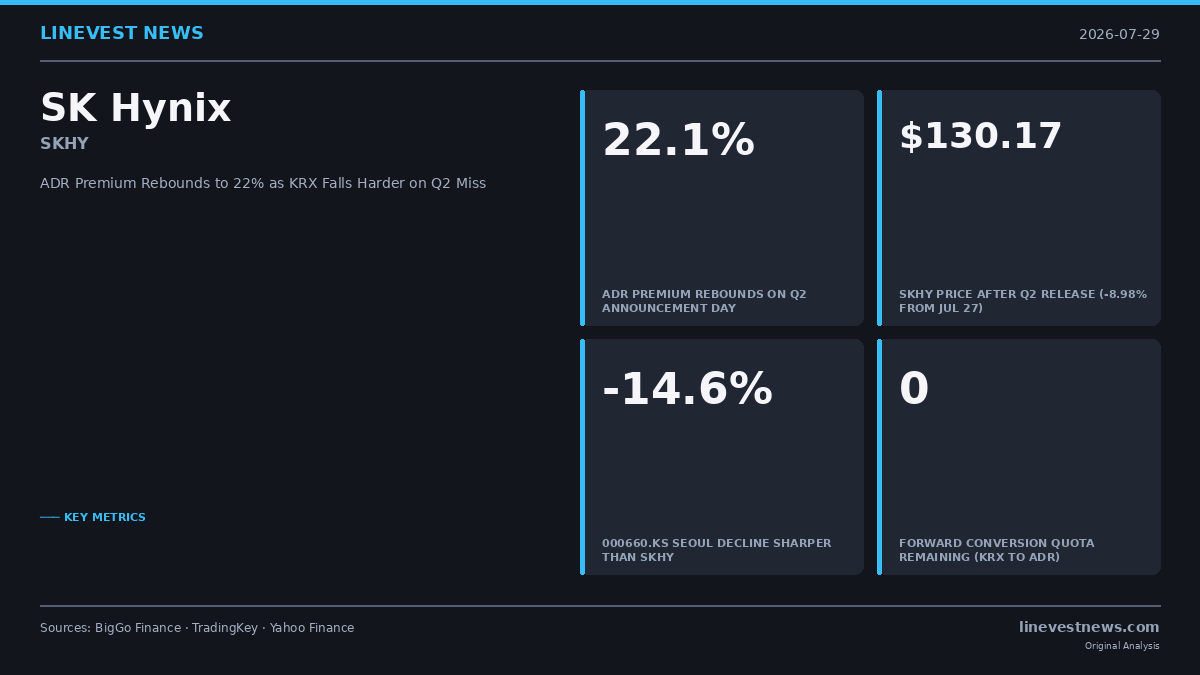
TL;DR - SKHY fell to $130.17 in reaction to the Q2 earnings release, while Seoul-listed 000660.KS dropped more sharply to 1,550,000 won - The ADR premium rebounded from a recent low of ~14.5% (July 27) to 22.1% because KRX sold off disproportionately harder than Nasdaq - July 29 marked the first day of two-way conversion between ADRs and Korean shares---but the forward quota (KRX to ADR creation) is exhausted at zero, and reverse conversion at a 22% premium is economically irrational for ADR holders - Average analyst target for SKHY stands at $281.67, implying ~116% upside from current levels
Three Weeks After IPO: The Running Premium Scoreboard
SK Hynix's Nasdaq debut on July 10, 2026---among the largest U.S. equity offerings in recent years at $26.5 billion raised---created an unprecedented dual-market dynamic. Each SKHY American Depositary Share (ADS) represents one-tenth of one 000660.KS ordinary share. The per-ADS USD equivalent of the Seoul-listed share is:
Per-ADS USD equivalent = KRX price (won) / 10 / KRW-per-USD rate
The ADR premium = (SKHY price / per-ADS USD equivalent) - 1.
| Date | SKHY (Nasdaq) | 000660.KS (KRX) | Per-ADS equiv. (USD) | Premium |
|---|---|---|---|---|
| Jul 10 (IPO) | $149.00 | 1,842,000 won | ~$126.71 | ~+18% |
| Jul 14 (peak) | $193.92 | --- | --- | ~51% |
| Jul 17 (Week 2) | $152.31 | ~1,842,000 won | ~$126.71 | ~+20% |
| Jul 24 | --- | --- | --- | ~29.5% |
| Jul 27 | $143.02 | 1,816,000 won | ~$124.92 | ~14.5% |
| Jul 29 (Week 3) | $130.17 | 1,550,000 won | $106.62 | ~22.1% |
Exchange rate: 1,453.72 KRW/USD (July 29). All per-ADS equivalents are rounded.
What Happened on July 29: The Q2 Miss
SK Hynix released its Q2 2026 results at 9:00 AM KST on July 29 (July 28 in U.S. Eastern time). The figures were historically large---but missed sell-side estimates:
| Metric | Q2 2026 Actual | Consensus | Miss |
|---|---|---|---|
| Revenue | 79.32T won | 84.1T won | -5.7% |
| Operating Profit | 60.54T won | 64.22T won | -5.7% |
| OP Margin | 76% | ~76% | in-line |
| YoY OP Growth | +557% | --- | --- |
Net income reached 93.92T won, substantially above operating profit. The 33.38T won gap between operating and net income is attributable primarily to a non-cash mark-to-market gain on SK Hynix's 14% stake in Kioxia Holdings, which surged dramatically after its December 2024 Tokyo IPO. Because this revaluation remains unrealized, its effective tax impact is de minimis under applicable Korean accounting rules---consistent with the arithmetic (operating profit plus mark-to-market gain approximates net income). Kioxia gains should be excluded when evaluating operating performance.
Management attributed the revenue miss to an HBM3e-to-HBM4 product transition that temporarily constrained shipment volumes. Q3 guidance: DRAM bit shipments approximately +10% QoQ. HBM4 entered mass production in Q2; HBM4E samples shipped to select customers.
Part B: Why the Premium Rebounded on Conversion Day
The Premium Trajectory
Understanding July 29 requires the full arc:
- Peak of ~51% on July 14, when SKHY reached $193.92
- Compressed to ~14.5% by July 27, after a 26.2% decline from peak to $143.02 (below IPO price)
- Rebounded to 22.1% on July 29, as 000660.KS fell harder (-14.6%) than SKHY (-8.98%)
The rebound is measured relative to the July 27 low. On a broader view (versus 29.5% on July 24), 22.1% is actually a narrowing. The headline story is: even the conversion mechanism's opening on July 29 could not offset the asymmetric sell-off that widened the spread from its pre-results level.
The Structural Trap
Two-way conversion should allow arbitrage: buy cheap 000660.KS, convert to ADRs, sell the premium-priced SKHY. The premium should theoretically disappear.
Forward conversion (000660.KS to new SKHY ADR): The Korea Securities Depository (KSD) manages the operational cap on ADR creation, set at approximately 2.5% of total outstanding shares (~17.79 million shares backing 177.9 million ADS). This quota was fully exhausted shortly after the IPO. No new ADRs can be created from Korean shares until additional quota is authorized.
Reverse conversion (SKHY to 000660.KS): This direction is unrestricted. However, at a 22% ADR premium, it is economically irrational: an ADR holder surrenders a $130.17 SKHY ADS to receive approximately 155,000 won of KRX stock (= $106.62 at current rates), immediately crystallizing a ~18% loss. Rational SKHY holders at a premium will not initiate reverse conversion. The mechanism is available but unused at current price levels.
Both formal conversion pathways are therefore effectively blocked---forward by policy, reverse by economics.
Why KRX Fell Harder
| Market | Change from Jul 27 close | Close |
|---|---|---|
| 000660.KS (KRX) | -14.6% | 1,550,000 won |
| SKHY (Nasdaq) | -8.98% | $130.17 |
Contributing factors to the asymmetry:
Domestic leverage effect. South Korea's domestic leveraged semiconductor ETF market amplifies directional moves in 000660.KS. A Q2 miss triggers forced deleveraging that SKHY's Nasdaq investor base does not experience symmetrically.
Conversion-recovery bet unwind. Domestic investors had priced in a 000660.KS recovery driven by conversion-related demand. The Q2 miss eliminated that catalyst, prompting unwinding of long-KRX positions.
SKHY's prior compression. SKHY had already declined 26.2% from peak to $143.02 before earnings. Nasdaq selling pressure was partially absorbed in prior sessions, leaving fewer marginal sellers on results day.
What Would Actually Close the Gap
1. FSC increases the forward conversion quota. South Korea's Financial Services Commission (FSC) sets the regulatory policy governing ADR creation limits. The KSD implements the mechanics. If the FSC authorizes an increase above the current approximately 2.5% cap, true arbitrage becomes possible. No announcement as of this writing.
2. Soft (off-conversion) market arbitrage. Institutional investors with cross-market access can sell SKHY on Nasdaq and separately purchase 000660.KS in Seoul---two distinct trades that collectively compress the spread without formal ADR conversion. Transaction costs, FX hedging, and settlement timing reduce the tradeable profit, but the mechanism is available and does create gradual pressure over time.
3. Organic 000660.KS recovery. If the Seoul share price rises on its own---driven by Samsung Q2 results (July 30), broader chip sector sentiment, or a resolution to near-term HBM inventory concerns---the per-ADS Seoul equivalent rises and the premium narrows mechanically.
Investor Implications
Holding SKHY: You are paying a 22% structural premium for Nasdaq liquidity. Your return depends on SKHY price appreciation, not on premium convergence narrowing in your favor. If the premium compresses while SKHY stays flat, you underperform versus 000660.KS holders.
Premium arbitrage: The forward quota is zero. Reverse conversion at a premium is irrational. The only actionable play is cross-market soft arbitrage, which requires institutional infrastructure.
Long-term bull case: Analyst consensus remains constructive. Average 12-month target: $281.67 (high: $355; low: $160), implying approximately +116% upside from the July 29 close. Q2 miss reflects product mix timing; HBM4 ramp commentary was affirmative.
What to Watch Next
- Samsung Q2 Full Results (July 30): A Samsung memory miss would add further pressure to 000660.KS and amplify ADR premium volatility.
- FSC/KSD announcements on forward quota: Any expansion of the ADR creation cap is the primary catalyst for meaningful premium compression.
- SKHY short interest: Rising short interest in SKHY signals institutional bets on ADR premium compression via soft arbitrage. The options market put/call ratio provides additional directional read.
Sources
- SK Hynix ADR Falls Below IPO Price, BigGo Finance
- SK Hynix ADR Premium Hits 33% Arbitrage Constrained, BigGo Finance
- SK Hynix ADR Premium Narrows Two-Way Conversion Imminent, TradingKey
- SK Hynix Falls Below $130 Premium ~22%, TradingKey
- SK Hynix ADR Premium Drops to 22% Ahead of July 29, ts2.tech
- SK Hynix 51% Arbitrage Trade Stymied by Strict Conversion Cap, Yahoo Finance
- SK Hynix ADR Conversion Quota Exhausted, TradingKey
This article is journalism, not investment advice. LineVest News is an independent publication and is not a registered investment adviser. Nothing here constitutes a buy or sell recommendation.