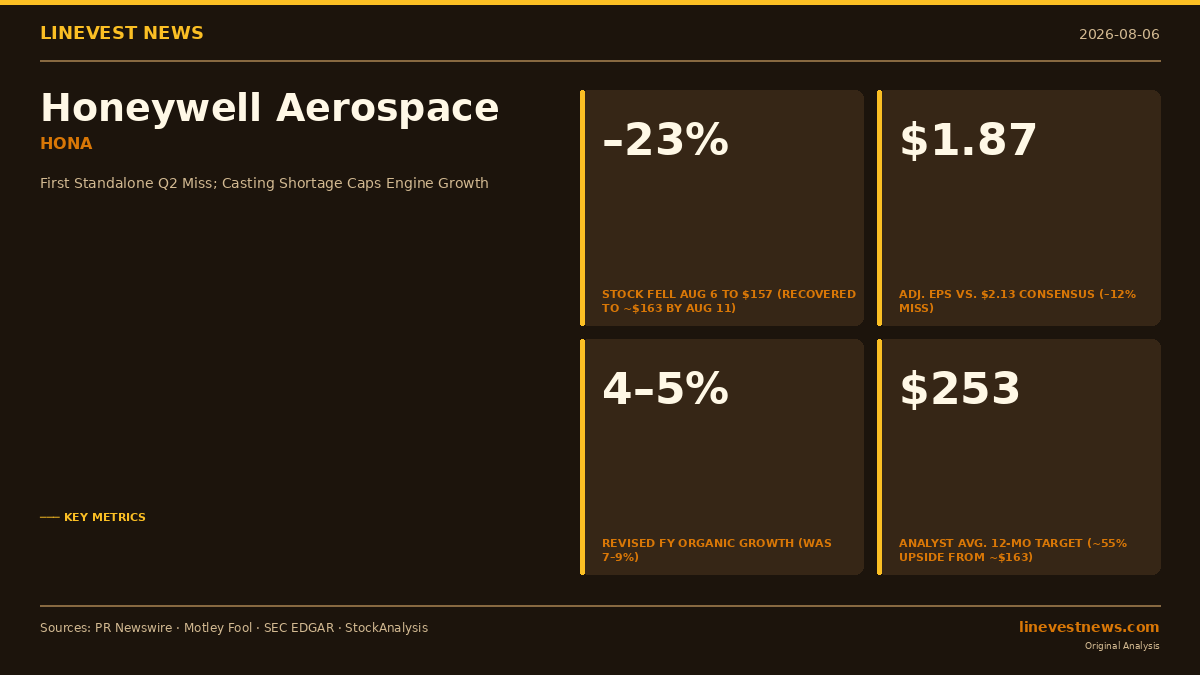
TL;DR - Honeywell Aerospace (NASDAQ: HONA) missed Q2 2026 adjusted EPS by 12% ($1.87 vs. $2.13 consensus) — its first earnings report as a newly independent company - A casting shortage is capping total output growth: the Engines & Power Systems segment posted only +1% revenue despite strong demand, while implied segment costs rose approximately $96M against only $14M of additional revenue — driving a 32% EBIT decline - Full-year guidance cut from 7–9% organic growth to 4–5%; management's revised $4.35–4.45B EBIT target embeds a significant H2 margin recovery predicated on qualifying 50 additional suppliers and reducing supply chain premiums - HONA closed August 6 at $156.83 (–22.99%); by August 11 the stock partially recovered to approximately $163. Against that level, 15 analysts hold an average 12-month target of $253.17, implying roughly 55% upside
Background: One Month as a Public Company
Honeywell Aerospace Inc. (NASDAQ: HONA) completed its separation from Honeywell International — which simultaneously rebranded as Honeywell Technologies (NASDAQ: HON), a pure-play automation company — on June 29, 2026. Just 37 days later, on August 5, HONA delivered its first quarterly earnings report.
Because the separation was completed on June 29 and Q2 ended June 30, the reported Q2 results reflect operations that were essentially entirely within the former Honeywell International for the full quarter. HONA presents these on a pro forma standalone basis to give investors a comparable operating baseline.
The result disappointed: shares closed on August 6 at $156.83, down 22.99% from the prior session's close. By August 11, HONA had partially recovered to approximately $163.
Q2 2026 Results
All comparisons are pro forma organic versus the same period one year earlier.
| Metric | Q2 2026 (Reported) | vs. Prior Year / Estimate |
|---|---|---|
| Revenue | $4.52B | +5% organic YoY |
| Adj. EBIT | $995M | –7% vs. prior year |
| Adj. EPS (pro forma) | $1.87 | –12.2% vs. $2.13 consensus |
| GAAP Net Income | $256M | — |
| GAAP EPS | $0.78 | — |
| Backlog | — | +9% YoY |
Revenue and adjusted EBIT by segment:
| Segment | Revenue | Rev. YoY | Adj. EBIT | EBIT YoY |
|---|---|---|---|---|
| Electronic Solutions | $1.77B | +8% | $459M | –3% |
| Engines & Power Systems | $1.41B | +1% | $174M | –32% |
| Control Systems | $1.34B | +7% | $389M | +8% |
Note: Segment Adj. EBIT ($459M + $174M + $389M = $1,022M) exceeds consolidated Adj. EBIT of $995M by approximately $27M; the difference reflects unallocated corporate items not separately disclosed.
Revenue by end market:
| End Market | Revenue | YoY |
|---|---|---|
| Commercial Aftermarket | $2.03B | +8% |
| Commercial OEM | $679M | +6% |
| Defense & Space | $1.82B | +3% |
Note: End-market figures sum to approximately $4.529B versus the reported $4.52B segment total; the $9M difference reflects rounding in the press release.
Revenue grew across every segment and every end market. The problem was entirely on the profitability line — costs rose faster than revenue in the Engines & Power Systems segment, compressing consolidated EBIT despite positive top-line momentum across the business.
The Casting Shortage: A Cost and Capacity Problem
Castings — precision metal components produced by pouring molten metal into molds — are a critical input for aircraft engines, turbine hardware, and airframe structural parts. The global casting supply chain has been slow to recover from the COVID-era production freeze, while demand has accelerated as Boeing and Airbus push narrow-body output back toward pre-pandemic rates.
For Honeywell Aerospace, the casting shortage created two distinct problems in Q2:
Revenue ceiling: The Engines & Power Systems segment managed only +1% revenue growth despite the company reporting strong end-market demand. The implied shortfall suggests HONA could not deliver all the product its customers wanted because casting supply was the binding constraint.
Cost inflation: When preferred casting suppliers cannot meet demand, manufacturers must source from alternative, often higher-cost suppliers on spot terms or pay premiums to accelerate delivery. Implied cost analysis for the Engines & Power Systems segment suggests costs rose approximately $96M against only $14M of additional revenue — indicating substantial procurement premiums being absorbed at the segment level. The Electronic Solutions segment (revenue +8%, EBIT –3%) also showed cost growth outpacing revenue, consistent with similar supply-chain pressures.
CEO Jim Currier acknowledged the constraint without characterizing the underlying cost dynamic in detail: "Supply constraints limited output growth in the quarter" despite "significant customer demand" and strong secular trends across end markets.
Noteworthy: aftermarket revenue (+8%) outpaced OEM revenue (+6%) this quarter, confirming that HONA has not mechanically prioritized lower-margin OEM over aftermarket. Both end markets felt the ceiling; aftermarket, which carries stronger pricing, grew the fastest.
What Management Is Doing
Honeywell Aerospace has outlined an aggressive multi-year program to expand casting supply:
- New supplier qualifications: 50+ completed in H1 2026; 50 more targeted for H2 2026 (maintaining the H1 pace)
- Tooling investment: Increasing 20% in H2 2026 vs. H1 2026
- 2025–2027 commitment: Doubling total tooling spend over the period; approximately 70% directed at castings
- Multi-sourcing: Expanding multi-sourced parts by 15%+ annually to eliminate single-source dependencies
"We are taking the strategic and tactical actions necessary to position Honeywell Aerospace for accelerating growth," CEO Currier said.
Updated Full-Year 2026 Guidance
| Metric | Prior Guidance | Revised Guidance |
|---|---|---|
| Organic Sales Growth | 7–9% | 4–5% |
| Pro Forma Adj. EBIT | $4.65–4.75B | $4.35–4.45B |
| Adj. EBIT Growth | +7% to +10% | Flat to +3% |
| Adj. EPS (pro forma) | — | $7.60–7.90 |
| H2 Free Cash Flow | $1.0–1.5B | $1.0–1.5B (unchanged) |
The revised $4.35–4.45B full-year EBIT target implies a meaningful H2 improvement. If H1 pro forma EBIT tracked near 2 × $995M ≈ $1.99B, then H2 must deliver approximately $2.36–2.46B — a roughly 19–24% sequential improvement over H1. Critically, the FY guidance for organic sales growth (4–5%) implies H2 revenue growth need not materially exceed H1 levels. The entire H2 EBIT ramp is therefore predicated on margin recovery: as new casting suppliers qualify and procurement premiums decline, the EBIT compression that plagued H1 should partially reverse. This is the key execution test for the rest of the year.
The maintained H2 FCF guide of $1.0–1.5B suggests that despite the revenue and margin headwinds, working capital management and cost discipline remain intact.
Part B — What It Means for Investors
The Bear Case
HONA's first independent earnings report immediately required a material guidance cut. At the revised adj. EPS midpoint of $7.75 and the current price of approximately $163, HONA trades at roughly 21× the current fiscal-year adj. EPS guidance — a meaningful premium for a company guiding to flat-to-3% full-year EBIT growth.
More importantly, the revised guidance embeds aggressive H2 margin recovery. If the new casting suppliers do not qualify on schedule, or if procurement premiums remain elevated through year-end, the H2 EBIT improvement will fall short and a second guidance revision becomes possible.
The Engines & Power Systems segment is the watch point: its –32% EBIT on +1% revenue is the signature of a segment absorbing significant supply chain cost premiums, and recovery depends directly on how quickly those new casting sources can come online and reduce spot procurement costs.
The Bull Case
The 9% backlog growth confirms that demand remains robust. The casting shortage is an industrial cost and capacity problem — one that management is investing aggressively to solve — rather than a competitive displacement or end-market demand shift. Honeywell Aerospace holds established positions in aerospace propulsion, auxiliary power units, and avionics that generate long-duration aftermarket revenue streams.
Management's guidance implies their supply chain investments ARE expected to reduce casting premiums and improve margins within H2 2026. The unchanged FCF guide signals confidence in the business's underlying cash generation capacity.
The secular backdrop is also supportive: aging global fleets, sustained commercial air traffic recovery, and expanding defense budgets across NATO and the Indo-Pacific all underpin long-term demand for HONA's products.
Analyst View
Among 15 analysts covering HONA, 5 rate it Buy and 10 Hold (0 Sell). The average 12-month price target of $253.17 implies approximately 55% upside from the current level of ~$163. The price target range spans $213 (low) to $306 (high).
Multiple firms, including BMO Capital and Wells Fargo, revised estimates following the results. The majority-Hold stance reflects near-term execution uncertainty, while the sizeable gap between current price and consensus target suggests analysts view the casting cost issue as transitory rather than permanent. Note that many of these targets were set in the days following the post-earnings close of $156.83 (August 6, 2026) and some may not yet fully reflect updated post-decline models.
Key Dates
- H2 2026: Progress on 50 new supplier qualifications (management's key commitment)
- Q3 2026 Earnings (expected October): First read on whether H2 margin recovery is on track
- Full-year: Whether revised $4.35–4.45B EBIT guidance is achieved determines whether HONA's standalone credibility is intact or faces a second cut
This article is for informational purposes only and does not constitute investment advice. All financial figures are pro forma unless otherwise noted. Past performance does not guarantee future results.
Sources: - Honeywell Aerospace Q2 2026 Press Release — PR Newswire - Honeywell Aerospace Form 8-K — SEC EDGAR (CIK 0002089271) - Honeywell Technologies Launches as Independent Company — Honeywell Press Release - Why Honeywell Aerospace Stock Just Crashed — Motley Fool - Honeywell Aerospace Cuts 2026 Forecast — Global Banking & Finance - Honeywell Aerospace Shares Plunge 24% — AskTraders - HONA Stock Forecast — StockAnalysis - HONA Analyst Price Targets — MarketBeat