TL;DR - Bristol Myers Squibb (NYSE: BMY) will build a USD 2.3 billion multi-modal manufacturing campus at Generation Park, Houston, TX. - The ~600,000 sq-ft facility will produce small molecules, biologics, and antibody-drug conjugates (ADCs) — the fastest-growing oncology modality. - Project creates ~500 permanent jobs and ~2,000 construction/indirect positions between 2027 and 2030. - Investment is part of BMS's previously announced USD 40 billion, five-year U.S. commitment to R&D, technology and domestic manufacturing. - U.S. Commerce Secretary Howard Lutnick voiced public support; Texas state incentives are under discussion.
Part A — The Announcement
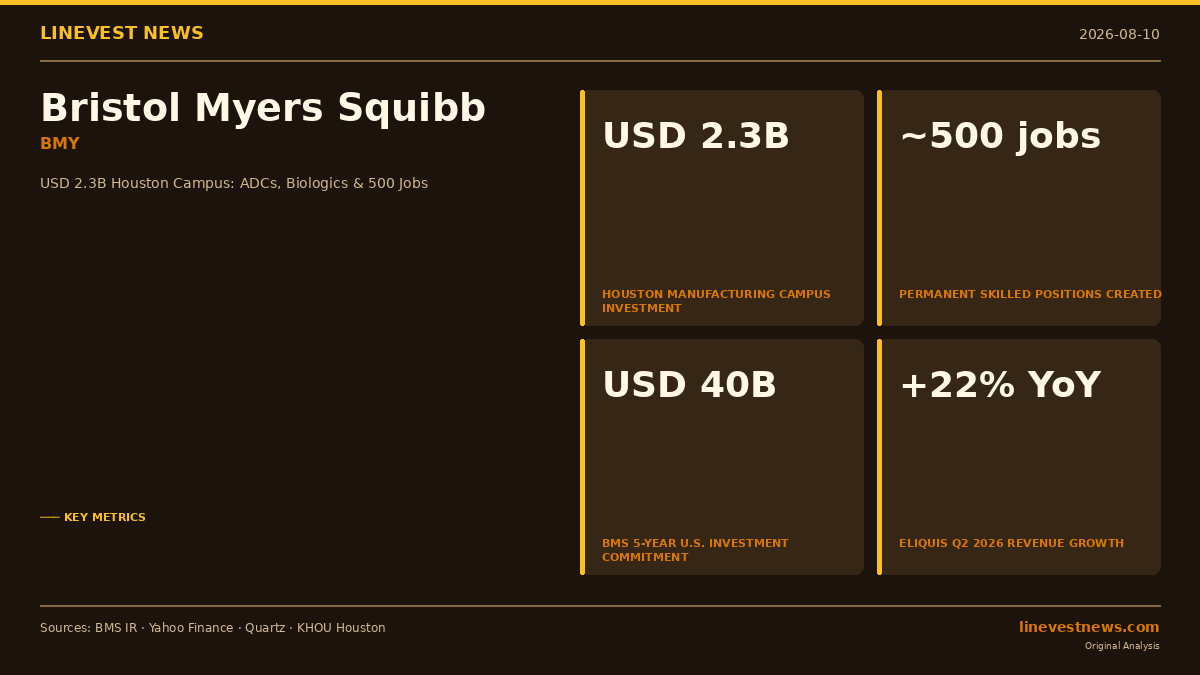
Bristol Myers Squibb announced on August 10, 2026 that it will invest approximately USD 2.3 billion to construct a new drug-manufacturing campus at Generation Park — a 4,300-acre master-planned hub in northeast Houston, Texas.
The roughly 600,000 square-foot complex is designed as a modular, multi-modal facility capable of producing: - Small-molecule oral drugs - Biologics (large-molecule injectable therapies) - Antibody-drug conjugates (ADCs) — engineered oncology agents that pair a tumor-targeting antibody with a cytotoxic payload - Drug product and finished-goods manufacturing
Its modular architecture allows BMS to reconfigure capacity as the pipeline and commercial requirements evolve — a deliberate hedge against product-mix uncertainty in a post-patent-cliff environment.
Jobs and timeline: Construction is expected to begin in 2027, with the campus coming online progressively through 2030. Total employment impact is estimated at nearly 500 permanent skilled positions — including operations technicians, quality control experts, and engineering professionals — plus approximately 2,000 construction and indirect jobs over the build-out period.
Broader investment context: The Houston campus is the latest milestone in BMS's commitment to invest USD 40 billion across the United States over five years, spanning R&D, technology and domestic manufacturing. The company already maintains 250 clinical-trial sites in Texas and works with Texas-based contract manufacturers for commercial and clinical supply.
Government support: U.S. Commerce Secretary Howard Lutnick publicly endorsed the announcement, a signal of alignment with the administration's onshoring agenda. Texas state incentives are under active discussion.
CEO Christopher Boerner, Ph.D. stated: "This investment reflects our confidence in America's continued leadership in biopharmaceutical innovation."
Part B — Why This Matters for BMY Investors
BMS's Financial Position Supports the Outlay
The USD 2.3 billion pledge comes after BMS delivered a strong Q2 2026, with total revenues of USD 12.97 billion (+6% YoY) and non-GAAP EPS of USD 2.04 — decisively above the USD 1.60 analyst consensus. Full-year 2026 revenue guidance was raised to a range of approximately USD 49–50 billion, up from a prior range of USD 46–47.5 billion.
| Metric | Q2 2026 | Q2 2025 | Change |
|---|---|---|---|
| Total Revenue | USD 12.97B | USD 12.24B | +6% |
| Non-GAAP EPS | USD 2.04 | est. USD 1.60 (beat) | — |
| Growth Portfolio Revenue | USD 7.56B | — | +15% YoY |
| Eliquis Revenue | USD 4.48B | — | +22% YoY |
| Revlimid Revenue | USD 0.43B | — | -49% YoY |
Eliquis — the blood-thinner BMS co-owns with Pfizer — grew 22% in Q2 and is now expected to expand 20–25% for full-year 2026, a significant upward revision from prior guidance of 10–15%. Eliquis alone accounts for roughly one-third of total BMS revenue and funds much of the company's capital allocation.
Revlimid's ongoing decline (-49%) due to generic competition has been the headline drag for years, but Q2 demonstrated that the Growth Portfolio — Reblozyl, Breyanzi, Camzyos, Opdualag, Opdivo Qvantig — is absorbing that erosion. Growth Portfolio revenue at USD 7.56 billion now represents nearly 60% of total company revenue.
The ADC Angle Is the Strategic Centerpiece
ADCs are among the most capital-intensive therapies to manufacture. The precision required to conjugate an antibody to a cytotoxic linker-payload — under strict conditions to control drug-to-antibody ratio and aggregate formation — demands specialized infrastructure that most legacy pharmaceutical plants were not built to handle.
BMS has multiple ADC and targeted-delivery assets in late-stage development. Building owned, flexible ADC capacity in the United States reduces dependence on a small number of global contract development and manufacturing organizations (CDMOs) that are already supply-constrained. For context, the global ADC market is forecast to surpass USD 25 billion by 2030 as the modality expands beyond oncology.
Reshoring as a Structural Theme
The Houston announcement joins a wave of U.S. domestic pharmaceutical manufacturing investments driven by a combination of policy pressure (tariff exposure on imported API and finished drugs) and supply-chain lessons from the COVID-19 pandemic. Peers including Eli Lilly, AbbVie, and Johnson & Johnson have each announced multi-billion-dollar U.S. facility expansions in the past 18 months.
For BMS, the Texas footprint also diversifies geographic concentration away from the company's primary New Jersey and New York manufacturing cluster, and gives it access to Texas's deep life-sciences talent pool, now enlarged by relocations from other states.
Pipeline Watch Points Ahead of 2027
BMS has several binary catalysts on the near-term horizon that could materially affect whether this capital commitment looks prescient or premature:
| Asset | Indication | Regulatory Milestone |
|---|---|---|
| Mezigdomide | Multiple myeloma | NDA PDUFA: May 13, 2027 |
| Reblozyl sNDA | MDS expansion | sNDA PDUFA: March 11, 2027 |
| Milvexian | Atrial fibrillation (anti-thrombotic) | Phase 3 readouts expected 2026–2027 |
| Iberdomide | Autoimmune / lupus | Pivotal readouts 2026–2027 |
A Mezigdomide approval in 2027 would add a third commercial myeloma franchise alongside Revlimid's successor positioning, and could be among the first therapies manufactured at the Houston campus once it is operational.
Stock and Valuation
BMY shares were trading near USD 57–61 in August 2026, representing a year-to-date gain of approximately 18% — outpacing the S&P 500's roughly 8–9% gain over the same period. The consensus analyst rating remains Neutral (Hold), with an average 12-month price target of approximately USD 63–65 across roughly 29 analysts. Piper Sandler raised its target to USD 66 ahead of the Q2 print.
The valuation case for BMS has historically turned on (1) the pace of Revlimid generic erosion against Growth Portfolio ramp, and (2) the late-stage pipeline probability-weighted value. The Houston announcement does not change near-term earnings per share, but signals management's conviction that the pipeline will require substantial commercial-scale domestic manufacturing over the next half-decade.
Risks
- Long lead time: The facility is not expected to be online until 2030. Capital is committed well before the pipeline catalysts that would justify it.
- Cost overruns: Large pharma facility projects have a history of schedule slippage and budget escalation.
- Eliquis cliff: BMS co-owns Eliquis through a collaboration with Pfizer; U.S. exclusivity begins eroding with first generics possible in 2028 under the current patent landscape, which could compress cash generation precisely when the Houston plant needs commissioning investment.
- Policy dependency: The Texas incentives and federal support hinge on political continuity; a shift in trade or manufacturing policy could alter the economics.
Sources
- BMS Press Release — Aug. 10, 2026
- Yahoo Finance / Healthcare — BMS Houston Campus
- Quartz — BMS Houston Manufacturing
- KHOU Houston — BMS 500 Jobs
- StockTitan — BMY Q2 2026 10-Q
- Yahoo Finance — BMY Q2 2026 Earnings Call Summary
- Seeking Alpha — KBR wins Army contract (peer reference)
This article is for informational purposes only and does not constitute investment advice. Bristol Myers Squibb (NYSE: BMY) is a publicly traded company. Investors should conduct their own due diligence before making any investment decision.