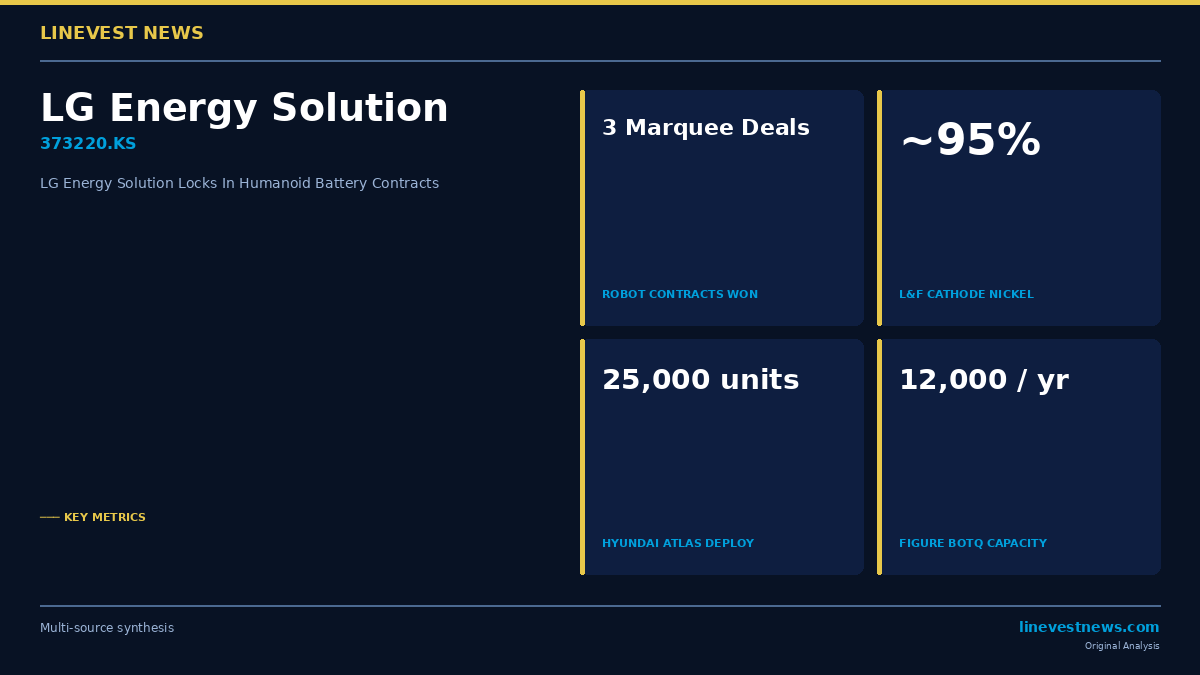
LG Energy Solution Ltd. (373220.KS) has secured battery supply contracts with three of the leading US humanoid robotics developers — Tesla Inc., Boston Dynamics Inc. and Figure AI — positioning the South Korean battery maker to capture an early and potentially valuable share of a market that is still scaling its commercial footprint.
The agreements, confirmed by KED Global on July 2, extend to ongoing negotiations with Unitree Robotics and additional Chinese robot manufacturers, signaling that LG Energy is pursuing a broad supply chain role across humanoid robotics rather than limiting itself to established US anchor relationships.
High-Nickel Advantage Fills the Robotic Footprint
The commercial logic rests on chemistry. Humanoid robots impose a harder engineering constraint than electric vehicles: a torso typically 170–180 centimeters tall and weighing 50–60 kilograms must accommodate a battery capable of powering joint actuators, AI processors and sensors continuously for several hours. With internal volume at a premium, energy density becomes the gating specification.
LG Energy Solution's high-nickel ternary lithium cells hold substantially more energy per kilogram than the lithium iron phosphate (LFP) chemistry that has dominated Chinese EVs. The gap, relatively modest in an automobile, becomes decisive inside a humanoid frame. Chinese suppliers CATL and BYD have historically led on LFP cost efficiency, but humanoid robot developers appear to be converging on Korean high-nickel suppliers for their first commercial deployments, where performance requirements outweigh unit cost.
Tesla's Optimus Gen 3 is currently ramping production. Boston Dynamics electric Atlas has already shipped to Hyundai Motor Company (005380.KS) Metaplant in Bryan County, Georgia, for active factory use, with Hyundai planning to extend the deployment to roughly 25,000 Atlas units across its plants starting in 2028. Figure AI BotQ facility is tooled to produce 12,000 Figure 03 units annually.
Supply Chain Extends to L&F
A parallel development reinforces the supply chain narrative. In March, LG Energy Solution selected L&F Co. (066970.KS) as its primary cathode material supplier for Tesla battery cells — the first time LG Energy has passed over its corporate parent, LG Chem Ltd. (051910.KS), for this role. L&F ultra-high-nickel NCM cathodes carry a nickel content of approximately 95%, near the upper boundary of current industrial capability. Higher nickel content reduces cobalt requirements and improves energy density within a comparable cell form factor.
The move was widely interpreted as LG Energy reinforcing supply chain independence from the LG Chem relationship while meeting Tesla increasingly stringent specifications for both premium electric vehicles and Optimus. L&F had previously signed a roughly USD 2.9 billion cathode supply agreement directly with Tesla, which was subsequently reduced by Tesla; routing supply through LG Energy reinstates L&F as a critical materials partner through a different contractual path.
Context for Korean Battery Sector
The humanoid robot battery market is nascent but growing faster than early analyst projections. Goldman Sachs and Morgan Stanley have each estimated that the addressable humanoid battery opportunity could reach the tens of billions of USD by the early 2030s, driven by factory automation demand from automakers, logistics operators and service-sector players.
LG Energy Solution shares rose roughly 11% on January 28, 2026 when initial discussions with Tesla and Chinese robot makers were first reported by Korea Economic Daily. The subsequent confirmation of signed contracts with three leading US robotics names may validate that early market enthusiasm.
For Hyundai Motor, which owns Boston Dynamics and is integrating Atlas units at its Georgia manufacturing site, the emerging supply chain is largely Korean in character: LG Energy cells, L&F cathode materials, and Hyundai own production base.
The pivot toward humanoid robots comes as EV demand growth has moderated in major Western markets. LG Energy, competing globally with CATL, BYD, Panasonic and Samsung SDI Co. (006400.KS), needs new volume growth vectors to justify the capital intensity of its cell manufacturing infrastructure. Winning preferred supplier status at the inception of the humanoid robot battery market — before the eventual OEM base consolidates — is a structurally different opportunity than competing for existing EV share.
Sources: LG Energy wins battery supply deals with top humanoid robot makers · LG Energy Solution picks L&F over parent LG Chem for Tesla battery cathodes · LG Energy Solution pursuing battery deal for Tesla Optimus