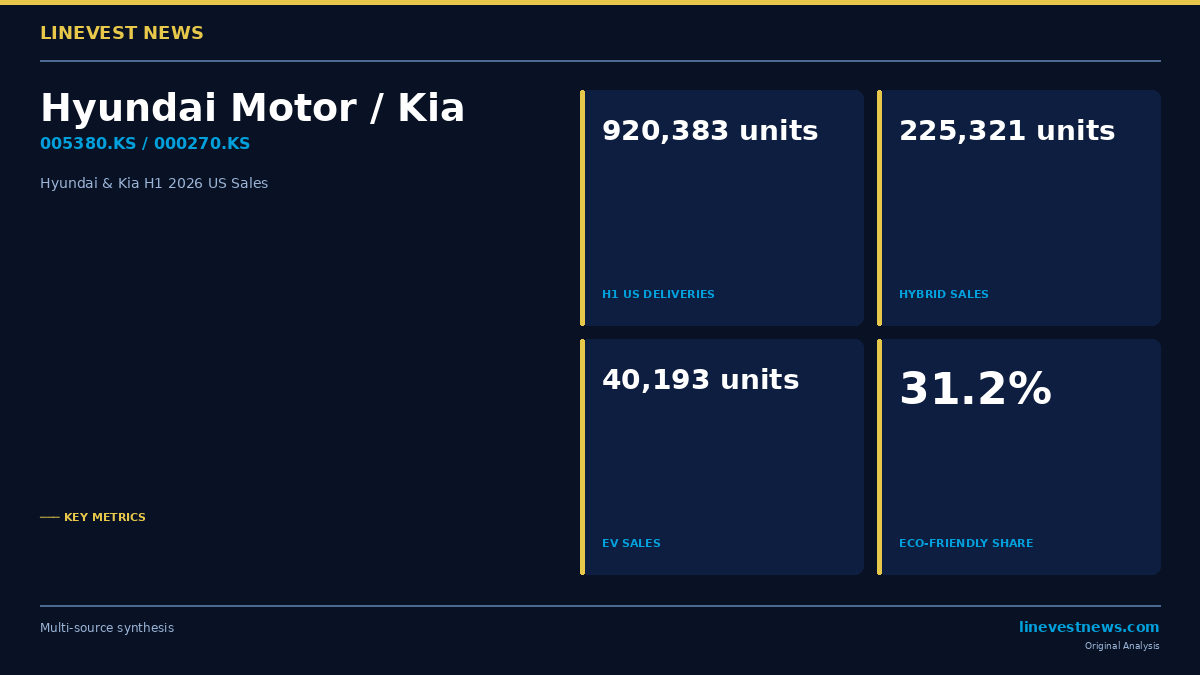
Hyundai Motor and Kia delivered a combined 920,383 vehicles in the United States during the first half of 2026, setting a new record for the January-to-June period and outpacing the broader industry's flat-to-declining trend.
The figure represents a 3% year-over-year gain, with both brands posting growth: Hyundai Motor (including Genesis) rose 2.7% to 489,656 units while Kia climbed 3.4% to 430,727. Genesis alone advanced 4.6% to 39,088 units, cementing its foothold in the premium segment.
Hybrids Carry the Load; EVs Retreat
The headline story inside the numbers is a sharp bifurcation between powertrain types. Hybrid sales surged 65.5% year-on-year to 225,321 units, accounting for 24.4% of total deliveries. Eco-friendly vehicles as a whole — hybrids plus battery-electric models — reached 265,514 units, or 31.2% of the group's H1 volume.
Electric vehicle deliveries, however, moved in the opposite direction: 40,193 units marked a 9.7% decline from the same period in 2025. The contrast underscores a market-wide pattern in which US consumers are embracing electrification through the lower-commitment hybrid format even as pure-EV adoption pauses.
"Our swift response to change by maintaining a balanced portfolio of internal combustion engines, hybrids and electric models was key," a Kia executive said in a statement.
Top Sellers
Hyundai's best-performing nameplates were the Tucson (117,612 units), Elantra (79,839) and Santa Fe (64,003). Kia's lineup was led by the Sportage (94,907), Telluride (73,602) and K4 (73,579).
Context: Market Share Gains Against Rivals
Against the wider competitive backdrop, General Motors led the US market in H1 2026 with 1,335,461 units, though that figure represented a 6.8% decline. Toyota delivered 1,243,390 units (+0.5%), and Honda sold 756,920 (+2.4%). With Hyundai-Kia Group's 3% advance bucking the GM downtrend, the Korean automakers extended their US market-share gains that have been building since 2021.
Investment Context
The strong H1 performance comes as Hyundai Motor Group deepens its US manufacturing bet. The group's new Ulsan EV plant — slated for launch later in 2026 — is part of a broader KRW 42 trillion, decade-long investment announced Thursday in the Yeongnam region, encompassing AI-defined vehicle platforms, advanced air mobility and hydrogen infrastructure.
Sources: Korea Herald · [Hyundai Motor Group press release]