Chip Boom Vaults South Korea Into the $100 Billion Monthly Export Club, Fourth Country in History
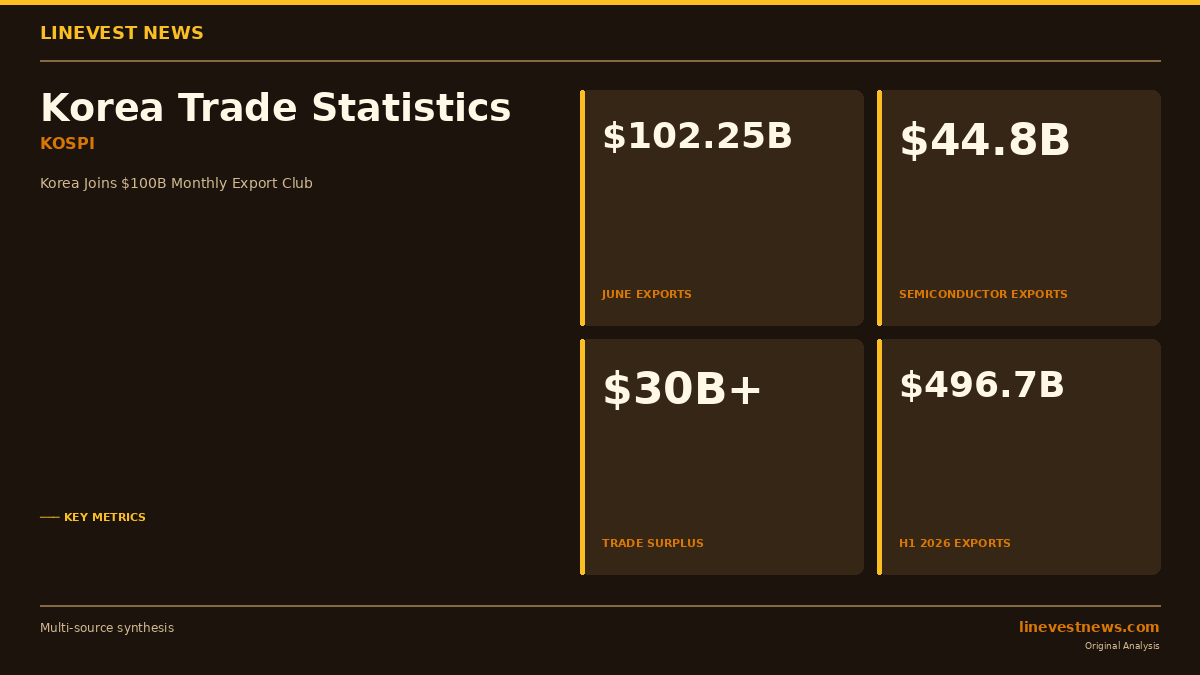
South Korea crossed a threshold few economies have reached in June 2026, posting $102.25 billion in goods exports — making it only the fourth country ever to surpass $100 billion in a single calendar month. Germany achieved the milestone first in October 2006, followed by China in June 2007 and the United States in October 2007. Nearly two decades on, Korea has joined that exclusive cohort, driven almost entirely by an unprecedented surge in semiconductor demand.
Semiconductors Carry 44 Cents of Every Export Dollar
Chip exports accounted for $44.8 billion of the June total — 43.8% of the headline figure — and expanded 199.5% year-on-year, the steepest pace recorded for any major export category. It was also the first time monthly semiconductor shipments from Korea alone exceeded $40 billion, a sub-milestone that underscores how concentrated the country's export thesis has become around AI-server memory and advanced logic.
Industry Minister Kim Jung-kwan attributed the breakout to the AI investment supercycle: "South Korea was able to post a record export performance in the first half on the back of robust semiconductor exports driven by demand for AI servers."
The primary beneficiaries among KOSPI-listed names are Samsung Electronics (005930.KS), whose High-Bandwidth Memory and NAND lines feed hyperscaler buildouts in North America and Asia, and SK Hynix (000660.KS), the dominant HBM3E supplier to Nvidia. Both companies have reported record shipment volumes in recent quarters.
Broadening Beyond Chips
Encouragingly for investors concerned about single-sector dependency, 18 out of 20 major export categories registered growth during the month. Automobiles and shipbuilding — perennial pillars of Korea's industrial export base — both advanced, pointing to underlying demand resilience across Hyundai Motor Group (005380.KS) and the nation's three large shipyards, including Hanwha Ocean (042660.KS) and HD Korea Shipbuilding & Offshore Engineering (329180.KS).
The trade surplus surpassed $30 billion, setting a new record and extending Korea's positive trade balance to a 17th consecutive month, a streak that dates to early 2025.
H1 2026 Sets the Stage for Possible $1 Trillion Year
First-half 2026 exports reached $496.7 billion, up 48.4% from the same period a year earlier. Semiconductor shipments in the first six months rose 163%, providing a highly visible anchor for the full-year trajectory. Officials have flagged the potential to cross $1 trillion in annual exports for the first time if current momentum holds, though second-half conditions — including tariff uncertainty in major markets and potential demand normalization in AI hardware — remain sources of caution.
Market Takes a Breather
Despite the milestone data, the KOSPI pulled back sharply on Tuesday, falling more than 2% to close at 8,303 — retreating from Monday's record close near 8,476. Analysts attributed the correction to profit-taking after the index's recent record-setting run and uncertainty surrounding the status of a prospective US-Iran nuclear deal, which has injected volatility into global energy markets and broad risk assets.
The divergence between the export headline and the equity market reaction illustrates a familiar pattern: backward-looking trade data, however strong, can be overshadowed by forward-looking macro fears in a market that has already priced in substantial optimism.
Context and Comparisons
Korea's achievement is particularly striking given the country's GDP. Germany, China and the United States are, respectively, the world's third-, second-, and first-largest economies by nominal GDP — all significantly larger than Korea. Reaching the $100 billion export threshold with a smaller economic base speaks to the extraordinary export-intensity of Korea's industrial structure, especially in semiconductors, where the country commands roughly 60% of the global DRAM market and approximately 50% of NAND supply.
Sources: Korea Herald · Korea Ministry of Trade, Industry and Energy (June 2026 trade statistics)