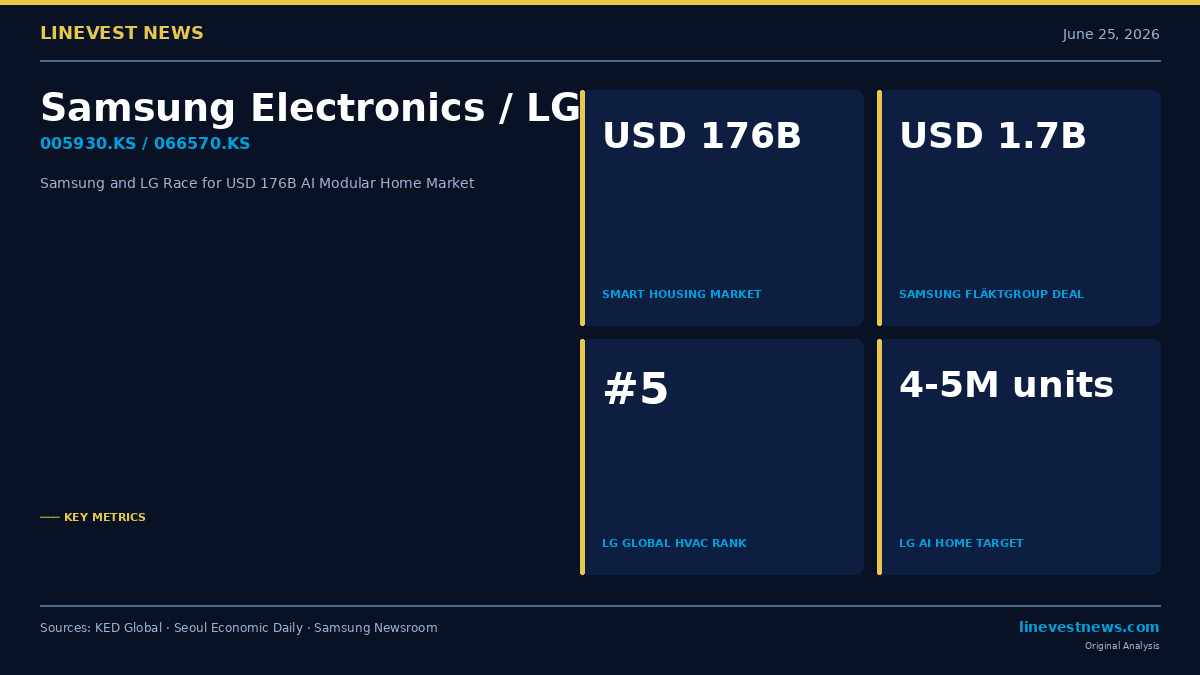
Samsung Electronics (005930.KS) and LG Electronics (066570.KS) are competing to turn South Korea's two strongest appliance brands into integrated smart-housing providers, targeting a USD 176 billion global market that neither has owned — until now.
Separate Strategies, Same Destination
Samsung has taken the acquisition route. In May 2025 the company closed its EUR 1.5 billion (USD 1.7 billion) takeover of FläktGroup, Europe's largest HVAC equipment provider, integrating industrial-grade climate control into its AI Modular Home product line. The deal gives Samsung a commercial real estate, data center, and cleanroom channel across Europe alongside its SmartThings consumer platform.
LG Electronics has pursued a partnership-first path. The company launched its LG Smart Cottage modular home concept in late 2024 and signed framework agreements with Sweden's SIBS and Australia's Greater Homes in 2026 to supply AI-enabled appliances, energy management systems, and HVAC into large-scale prefabricated developments. In January 2026, LG opened a permanent experience space at the Juksan Morak cultural complex in Gimje, North Jeolla Province, where paying guests can now stay overnight in Smart Cottage units — transitioning from showroom to real-estate product.
A Market Bigger Than Traditional Appliance Revenue
The USD 176 billion smart-housing addressable market represents a structural shift: from selling individual refrigerators or air conditioners at KRW 1–3 million per unit to delivering whole-building solutions that bundle hardware, software, and recurring service contracts. Both companies see modular housing as a platform to lock in customers at the point of construction rather than competing on retail shelves.
LG Electronics ranks fifth globally in HVAC — a position the company aims to climb by packaging its ThinQ AI platform with residential modular deals. The company is separately targeting 4–5 million AI Home retrofit installations in South Korean apartments built after 2018, creating a domestic subscription base before scaling internationally.
Samsung, now armed with FläktGroup's European distribution network, is positioning its HVAC and SmartThings stack toward commercial and mixed-use developments, where project values per site can exceed KRW 10 billion.
Shared Stage at MCE 2026, Competing on Differentiation
Both companies exhibited at MCE 2026 in Milan in March — the world's largest HVAC and building-systems fair — in the clearest signal yet that the appliance giants are repositioning as infrastructure suppliers to the construction industry. The shared exhibition space underscored how the two companies have migrated from consumer electronics rivals to competitors in a sector historically dominated by Carrier, Daikin, and Bosch.
Investor Takeaway
For KOSPI investors, the modular home pivot matters because it could expand total addressable revenue per household from a one-time appliance sale to a multi-year contractual relationship — a trajectory analysts compare to Apple's shift from iPhone hardware margins toward services revenue. Samsung Electronics and LG Electronics together represent approximately KRW 400 trillion in combined market capitalisation; if the B2B modular model delivers even a 3–5% revenue contribution within three years, the structural re-rating case strengthens materially.
Near-term risks include execution complexity (modular home partnerships require deep integration with property developers), longer B2B sales cycles versus retail, and margin uncertainty before FläktGroup synergies are fully realised. LG's fifth-place global HVAC rank also means it must invest heavily to close the gap on Daikin and Carrier before modular deals generate meaningful operating leverage.
Sources: KED Global, Seoul Economic Daily, Samsung Global Newsroom, Digital Today Korea, Korea Tech Today