Kakao (035720.KS), operator of KakaoTalk, South Korea's near-ubiquitous mobile messenger, said on June 16, 2026 that users can now summon a ChatGPT chatbot directly inside KakaoTalk chat rooms—without leaving the app. The feature works in both group and one-on-one chats: users add the bot from the chat-room menu, then type "@ChatGPT" followed by a prompt, according to Korea Economic Daily (Hankyung). It handles text prompts and image generation (the example given was "@ChatGPT draw a seascape"), and offers a quick-command toolbar for news, fortunes and popular questions, with the bot tagging whoever asked the question in busy group rooms (Hankyung).
The number that matters: distribution
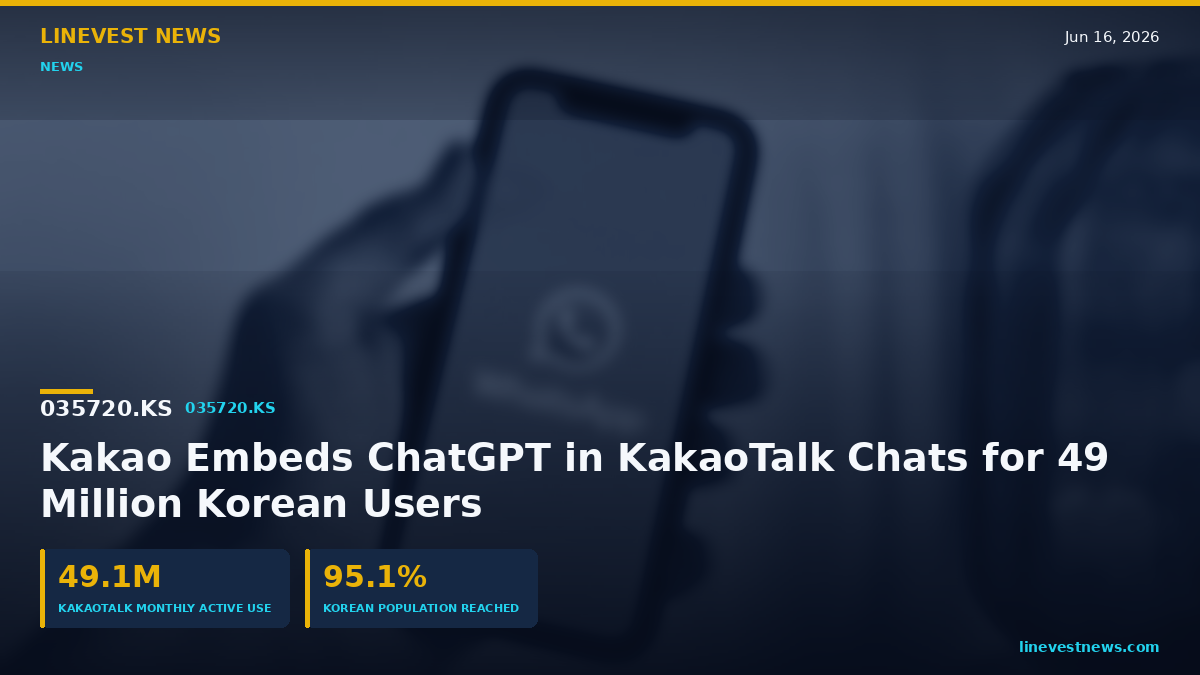
The strategic weight here is not the feature—it is the funnel behind it. KakaoTalk reached 49.1 million monthly active users in South Korea, equal to 95.1% of the country's population, according to DataReportal, a global digital-usage research firm, in its Digital 2026 South Korea report. Embedding ChatGPT inside that channel hands OpenAI's model native placement in front of nearly every Korean smartphone user, inside the conversations they already have all day. For Kakao, the question a portfolio manager asks first is whether this monetizes that dominance or simply rents it out: Kakao did not disclose any pricing for the in-chat bot.
What the eight-month track record shows
This is an extension, not a debut. Kakao and OpenAI began cooperating in October 2025, launching "ChatGPT for Kakao," and that paid service surpassed 11 million cumulative subscribers as of May 2026, per Korea Economic Daily (Hankyung) and DigitalToday, following the October 2025 launch reported by Korea Herald and KED Global. Extended conversations in the new chat-room bot route users into that same "ChatGPT for Kakao" service—so the in-chat feature functions partly as a top-of-funnel acquisition channel for the subscription product that already has traction. "Users can now leverage AI more conveniently through KakaoTalk conversations," said Yoo Yong-ha, a performance leader at Kakao AI Connect, the company's AI services unit (DigitalToday; Hankyung).
Why Kakao is comfortable handing OpenAI the front door
Kakao has split its AI stack deliberately. CEO Chung Shin-a has said the company is "collaborating with Google on device experiences and with OpenAI on B2C AI services" to avoid duplication, according to The Investor. On the device side, Kakao's own Kakana AI assistant entered beta in October 2025; on the consumer side, it leans on OpenAI rather than building a rival foundation model. The bet is that ChatGPT pulls engagement—and eventually subscription and advertising revenue—back through KakaoTalk's commercial layer.
That commercial layer is where any payoff would show. Kakao reported 2025 consolidated revenue of ₩8.09 trillion (about USD 5.90 billion), up 2.9%, with operating profit of ₩732 billion (about USD 534 million), up 59.1%, and its KakaoTalk-centric "Talk Biz" segment posting Q4 revenue of ₩627.1 billion (about USD 458 million), up 13% year over year, per The Investor. The open question is whether weaving ChatGPT into the chat surface lifts that Talk Biz line—through more engagement and ad inventory—or merely deepens user reliance on OpenAI without a clear toll booth.
What to watch
The confirming data point is Kakao's next quarterly report. Watch the Talk Biz revenue trajectory and any update to the 11-million ChatGPT for Kakao subscriber figure: accelerating subscriber adds after a free, frictionless in-chat entry point would support the funnel thesis; flat Talk Biz revenue alongside rising AI usage would suggest Kakao is absorbing the engagement without converting it. Kakao has said it will roll out further AI features inside KakaoTalk in phases through 2026 (The Investor).
This article is for informational purposes only and does not constitute investment advice. Figures are sourced from company disclosures and the cited publications; currency conversions use an approximate rate of 1 USD = 1,370 KRW unless a source specified otherwise. Readers should conduct their own research before making any financial decisions.