Samsung SDI Q1 2026 Operating Loss Narrows to ₩155.6 Billion, Beats Street Forecasts
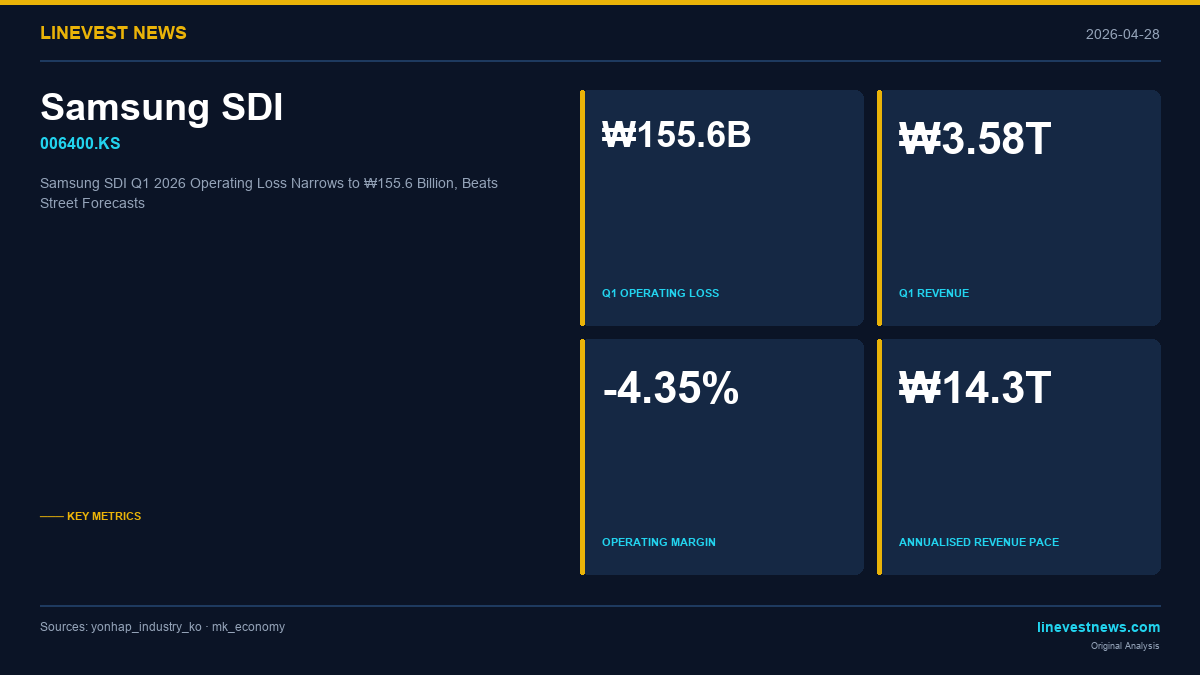
Lead Samsung SDI (006400.KS) reported a first-quarter 2026 operating loss of ₩155.6 billion on revenue of ₩3.5764 trillion, a sharply smaller deficit than analysts had penciled in. Management told investors on April 28 that quarterly profitability is targeted in the second half of 2026, signalling that the EV battery cycle trough is being worked off faster than the sell-side consensus assumed.
What Happened Samsung SDI disclosed Q1 2026 results before the market open on April 28, posting consolidated revenue of ₩3.5764 trillion and an operating loss of ₩155.6 billion, according to Maeil Business Newspaper. The loss came in well inside the range Korean brokerages had flagged ahead of the print, with Yonhap reporting that the figure was "much smaller than the market expected" and characterising the quarter as a continuation of an earnings-improvement trajectory. Both outlets reported that the company guided to a return to quarterly operating profit in the second half of 2026.
The same April 28 reporting window included Hanwha Solutions, which Maeil noted swung to an operating profit, underscoring that selective parts of the Korean energy-materials complex are clearing the bottom of the cycle alongside Samsung SDI. Samsung SDI did not, in the cited reporting, break out segment profitability for its small-cell, automotive, or ESS battery lines; the headline figures published April 28 are the company's own consolidated disclosure.
Sources for this section: Yonhap News Agency, Maeil Business Newspaper, Samsung SDI IR disclosure (April 28, 2026).
Business Impact The headline operating margin works out to roughly −4.35% (₩155.6 billion loss ÷ ₩3.5764 trillion revenue), a level that, while still negative, is shallow enough to be absorbed by working-capital movements rather than by a structural cash drain. On an annualised run-rate, Q1 revenue of ₩3.5764 trillion implies a ₩14.3 trillion top-line pace if the order book holds — a baseline against which any second-half operating-profit recovery can be sized by foreign investors building 2026 models. The "smaller-than-expected" character of the loss, flagged by both Yonhap and Maeil, is the operative variable: consensus revisions on Samsung SDI typically follow the direction of the surprise, and the surprise on April 28 was positive in magnitude even though the absolute number remained a loss.
For institutional readers benchmarking Samsung SDI against Korean battery peers, the relevant read-across is that a sub-5% negative margin in Q1 leaves a much narrower gap to break-even than the prior consensus implied. Reaching the company's stated H2 quarterly-profit target requires only a few hundred basis points of margin recovery from the Q1 base — achievable through utilisation gains and pricing pass-through if EV order intake stabilises. LineVest's analysis treats the −4.35% Q1 margin as the explicit anchor for that gap.
Industry & Historical Context The April 28 release lands in a quarter when the broader Korean battery sector has been working through inventory adjustments at downstream EV OEMs in Europe and North America, a dynamic that has compressed cell pricing across the K-battery trio. The fact that two distinct earnings stories — Samsung SDI's narrower loss and Hanwha Solutions' return to profit — printed on the same morning is consistent with a sector in which the worst of the demand digestion is being lapped, rather than a generalised re-acceleration. Both Yonhap and Maeil framed the day's prints around the word "improvement," and the synchronicity of the two disclosures is itself a data point.
[Chart: see article cover image]
What to Watch Three concrete items will validate or invalidate the H2 profitability path Samsung SDI committed to on April 28. First, the company's Q2 2026 print, due in late July under the standard KOSPI reporting calendar, must show further sequential narrowing of the operating loss to keep the H2 break-even claim credible. Second, monthly Korean battery-export data published by the Ministry of Trade, Industry and Energy (MOTIE) will indicate whether downstream OEM pull-through is firming. Third, any DART filing updating capex guidance or customer-specific supply agreements would materially reshape the 2026 EBIT bridge that today rests on the −4.35% Q1 margin and the company's own H2 break-even guidance.
Sources: - Yonhap News Agency — https://www.yna.co.kr/view/AKR20260428030252527 - Maeil Business Newspaper — https://www.mk.co.kr/news/business/12029797 - Samsung SDI Investor Relations (Q1 2026 earnings disclosure, April 28, 2026) — https://www.samsungsdi.com/ir/
By LineVest Markets Desk — 2026-04-28 This article is for informational purposes only and does not constitute investment advice.
[Chart: see article cover image]