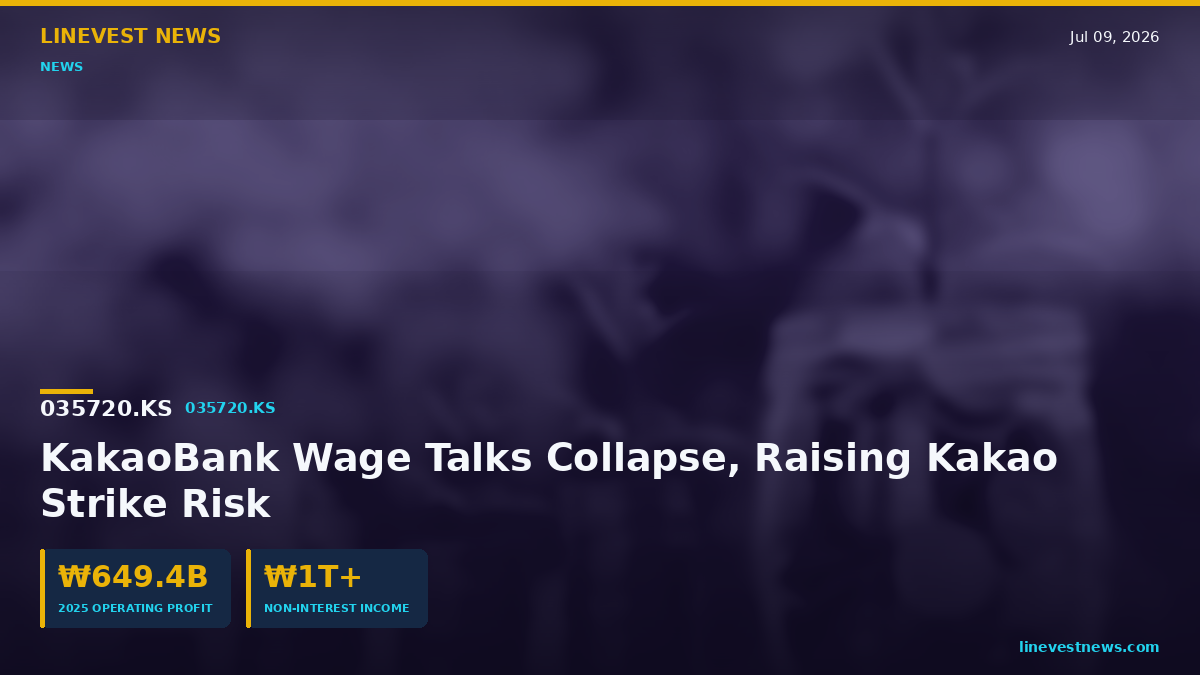
KakaoBank (323410.KS), Korea's largest internet-only bank by customer count, saw its 2026 wage and collective-bargaining negotiations break down after talks that ran from January, its union told Chosunbiz on July 9. At issue is a bonus-pool gap: management has offered a pool unions calculate at roughly 10% of annual operating profit, while the union is demanding 13–15%. The failure clears a path for KakaoBank to join the broader industrial action already under way across parent Kakao Corp (035720.KS), Korea's dominant mobile-messaging and fintech group.
How close is an actual strike?
A collapsed negotiation is not a strike. KakaoBank sits several steps up the escalation ladder. A union official told Chosunbiz that a conciliation (mediation) procedure still remains; only if that also fails does the union move to a strike-authorization ballot, and a walkout begins only if a majority of participating members vote yes. As of July 9 no first mediation date had been set, per the same report — so any KakaoBank stoppage is weeks away at the earliest, not imminent.
That matters because KakaoBank is a licensed deposit-taking bank, not a manufacturer. It obtained its final banking license from the Financial Services Commission (Korea's top financial regulator) in April 2017 and opened to customers in July 2017. A strike at a bank raises the prospect of disruption to app-based transfers, loan processing and customer service rather than a factory line — a reputational and operational risk that gives both sides an incentive to settle in mediation.
The dispute is about profit-sharing, and it is group-wide
The fight is over how bonuses are calculated. Across the Kakao group, management has offered a compensation pool that unions calculate at roughly 10% of annual operating profit, blending cash and stock units, while the union side is demanding 13–15%, according to Chosunbiz and Seoul Economic Daily. The Kakao union, known as the Crew Union, also wants restricted stock units paid separately rather than folded into the bonus figure, Seoul Economic Daily reported.
Five Kakao entities — the headquarters, KakaoPay, Kakao Enterprise, DK Techin and XL Games — now hold legal dispute rights and have been bargaining under the threat of industrial action, per Chosunbiz and Digital Today. KakaoBank had, until recently, stayed out: the union told Chosunbiz early last month that a walkout was "not something to discuss" while talks continued. The collapse of its own negotiations changes that calculus.
Precedent: Kakao already crossed the line once
The reference point is fresh. On June 10, 2026, the Crew Union staged Kakao's first-ever strike — a four-hour partial walkout in Pangyo. More than 1,000 headquarters employees took half-day or full-day leave in support, with about 1,500 union members across the group participating, The Korea Times and The Elec reported. On June 29 the union followed with a one-day "log-out day" of collective annual leave, according to The Korea Times and Etnews. A second mediation round for the group had already failed on May 27 at the Gyeonggi Regional Labor Relations Commission (Korea's provincial labor-dispute mediator), per Etnews. In other words, the group has demonstrated it will act; KakaoBank joining would widen an existing conflict rather than start a new one.
Sizing the stake
KakaoBank is the group's profit engine and can absorb a richer bonus more easily than most affiliates. It posted record 2025 results — operating profit of ₩649.4 billion ($474 million) and net profit of ₩480.3 billion ($351 million), up 7.0% and 9.1% respectively, with non-interest income topping ₩1 trillion ($730 million) for the first time, per The Korea Times and The Asia Business Daily. The gap between a 10% and a 15% profit-linked bonus pool is therefore financially manageable at the bank level; the harder question for management is precedent, since conceding a fixed profit share at one flagship affiliate resets expectations across the group.
The market has already registered the friction. Etnews noted Kakao Corp shares have been setting successive new lows during the dispute, and Seoul Economic Daily reported the stock broke below ₩40,000 ($29) around the late-May strike-vote period. A KakaoBank stoppage would add a fresh headline to an already pressured group narrative.
The open question
The next concrete signal is the scheduling and outcome of KakaoBank's first mediation session — still unset as of July 9 per Chosunbiz. If that mediation fails and a strike-authorization ballot passes, KakaoBank would gain the legal right to strike, drawing the group's profit engine into a conflict that has so far spared it. Until then, the collapse is best read as an escalation in leverage, not a confirmed walkout.
This article is journalism, not investment advice. LineVest is not a registered investment adviser. All figures are attributed to the sources cited; readers should verify against primary disclosures before making any decision.