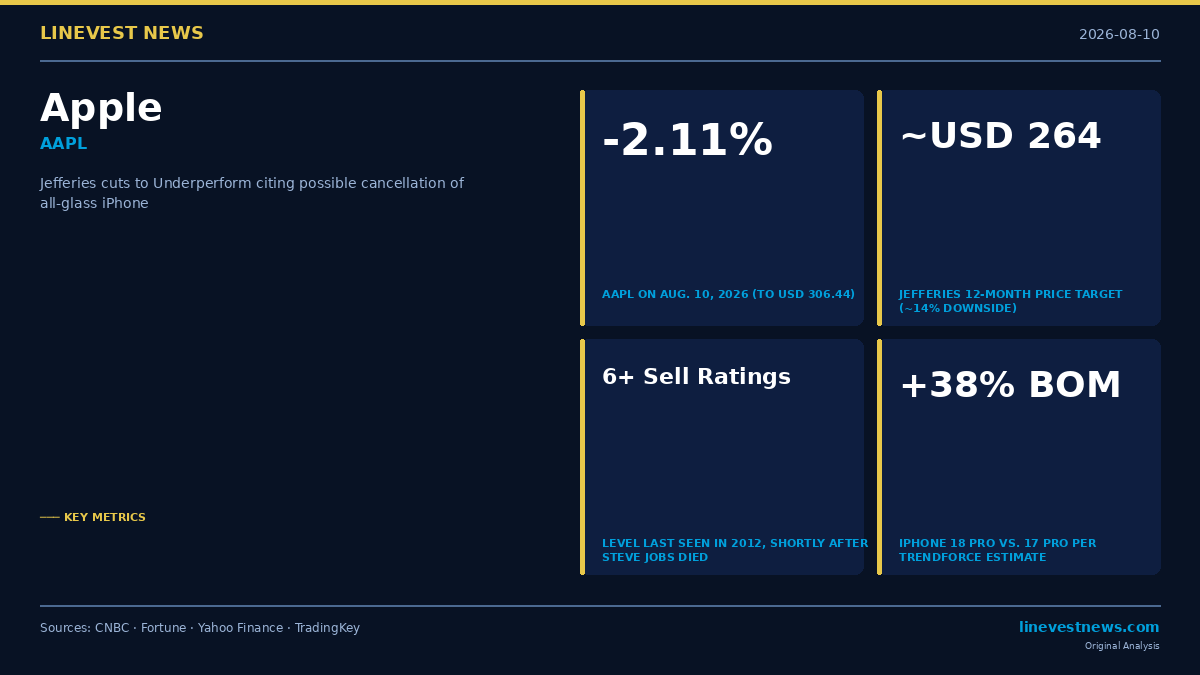
TL;DR - Jefferies analyst Edison Lee cut Apple (AAPL) from Hold to Underperform on Aug. 10, lowering the price target from approximately USD 286 to approximately USD 264 — about 14% below Monday's USD 306.44 close. - Supply chain checks indicate the all-glass 20th-anniversary iPhone (planned for ~2027) may have been canceled due to poor manufacturing yields; the model was projected at a retail average selling price of approximately USD 2,060 per unit across storage configurations. - Memory cost inflation is squeezing the iPhone BOM: TrendForce estimates iPhone 18 Pro components cost ~38% more than the iPhone 17 Pro, with DRAM and NAND prices as the primary driver. - Apple now carries at least 6 sell-equivalent ratings, a level last seen in 2012 shortly after Steve Jobs died — though Wall Street consensus remains Moderate Buy with an average target of approximately USD 322.
Part A: Jefferies Downgrade — What Was Reported
On Monday, August 10, 2026, Jefferies analyst Edison Lee lowered his rating on Apple Inc. (NASDAQ: AAPL) from Hold to Underperform — the equivalent of a sell — and cut his 12-month price target from approximately USD 286 to approximately USD 264 (figures reported to the cent by multiple news outlets). At AAPL's August 10 close of USD 306.44, the new target implies approximately 14% downside.
Note: August 10 was also an ex-dividend date for Apple's USD 0.27 quarterly dividend, which contributes a minor mechanical effect to the day's price movement.
The downgrade rests on two findings from Jefferies' supply chain checks:
1. The all-glass 20th-anniversary iPhone may have been canceled. Apple had been developing a next-generation device made almost entirely of glass — targeting a ~2027 launch to mark the iPhone's 20th anniversary. Jefferies says supply chain checks indicate the project has been halted due to unacceptably poor manufacturing yields. Had it launched, the device was projected to carry a retail average selling price of approximately USD 2,060 per unit across storage configurations — a figure that would have been the centerpiece of Apple's premium pricing strategy.
2. Memory cost inflation is widening the bill-of-materials gap. TrendForce estimates the BOM for a 256GB iPhone 18 Pro will run approximately 38% higher than the equivalent iPhone 17 Pro from 2025, driven primarily by surging DRAM and NAND prices rather than TSMC's 2-nanometer process adoption. The multi-year cost escalation extends further: Jefferies estimates the iPhone 19 Pro Max (the expected 2027 model) could see DRAM increase from 12GB to 16GB — a 4GB addition that Jefferies calculates would add approximately USD 60–70 to that model's BOM.
Jefferies' revised financial estimates
| Metric | Before downgrade | After downgrade |
|---|---|---|
| iPhone ASP CAGR (FY2026–2031) | 9.0% | 6.8% |
| 2028 EPS estimate | Baseline | Cut by 2.1% |
| 2029 EPS estimate | Baseline | Cut by 3.4% |
AAPL fell 2.11% to USD 306.44 on Monday, shedding about USD 97 billion in market value on the day.
Part B: What This Means for AAPL Investors
The sell-rating milestone and what history says
The Jefferies cut brings Apple's tally of sell-equivalent ratings to at least six, per Fortune — a level last seen in 2012, shortly after Steve Jobs died in October 2011. The current list includes Jefferies (Underperform, August 10) and KeyBanc Capital Markets (Underweight, July 2026), among others.
The historical reference is sobering by analogy alone — not a causal verdict. What matters structurally is whether the concerns behind the current cluster are durable. The crucial difference today is that the broader Wall Street consensus has not broken. Among equity analysts tracked by research aggregators, Apple still carries a Moderate Buy consensus with a mean 12-month target of approximately USD 322 — roughly 5% above Monday's close. Jefferies' approximately USD 264 target sits roughly USD 58 below that consensus average, representing one of the larger single-analyst divergences from the Street on a mega-cap name.
The ASP trajectory risk
Apple's premium pricing story has always depended on continued average selling price expansion — the idea that each iPhone generation commands incrementally more revenue per device, even as unit volume growth moderates. A supply-chain-indicated cancellation of the all-glass model would remove the most powerful near-term lever in that strategy.
Jefferies' core revision is a 220-basis-point reduction in its iPhone ASP CAGR — from 9.0% to 6.8% annually over five years. That gap compounds materially. When Apple's next premium product anchor is unclear — foldable device? extended-reality hardware? — a slower ASP trajectory also means slower earnings growth, which justifies a lower valuation multiple on a stock already trading at a substantial premium to the broader market.
Gene Munster of Deepwater Asset Management remains on the opposite side of this debate. In a note released Monday, Munster called the next 12 months "strong" for AAPL, arguing that Apple can push through meaningful iPhone price increases — on the order of 15% — with manageable demand impact. Munster's bull thesis rests on a mid-to-late 2027 inflection where personalized, on-device AI capabilities drive the most significant consumer hardware upgrade cycle in a decade.
The AAPL stock chart has tracked closer to Munster's narrative so far: the stock has gained 13% year-to-date and 34% over the trailing 12 months.
The memory cost squeeze: pass-through or margin compression?
Rising DRAM and NAND costs present Apple with an uncomfortable binary. If the company raises iPhone prices to recover the ~38% BOM increase on the iPhone 18 Pro, it risks demand destruction at a time when replacement cycles are already lengthening. If Apple absorbs the cost increase to protect market share, gross margin takes the hit.
Jefferies' revised EPS estimates (cut by 2.1% in 2028 and 3.4% in 2029) reflect precisely this dynamic: the lower iPhone ASP trajectory — driven primarily by the apparent cancellation of the all-glass model and the resulting loss of pricing power — flows through to earnings in subsequent years. TrendForce warns that if DRAM prices continue rising, the iPhone BOM in 2027 could face further pressure beyond the 38% already estimated for 2026.
The CEO transition adds an execution variable
Monday's downgrade arrives as Apple navigates a widely reported leadership transition, with John Ternus expected to succeed Tim Cook as CEO. Ternus, Apple's longtime head of hardware engineering, would inherit a product roadmap in flux — with the all-glass model widely reported to have been canceled and AI software features still developing. Investors will pay close attention to whether Ternus articulates a revised premium device strategy at Apple's upcoming September product event.
Three watch points for investors
| Event | Timing | Key question |
|---|---|---|
| iPhone 18 launch pricing | September 2026 | Does Apple pass on DRAM costs with a price hike above USD 100 vs. iPhone 17 Pro? |
| FY2026 Q4 earnings | October 2026 | What does gross margin guidance say about the DRAM headwind trajectory? |
| 2027 product roadmap | 2027 | Is there a replacement premium anchor (folding device, AR hardware) for the reported glass-model cancellation? |
This article is for informational purposes only and does not constitute investment advice. LineVest is an independent financial news publisher and is not a registered investment adviser.
Sources - Jefferies downgrades Apple, says supply chain checks indicate planned all-glass iPhone is canceled (CNBC, Aug. 10, 2026) - Apple may scrap its all-glass iPhone. Wall Street hasn't been this alarmed since Steve Jobs' death (Fortune, Aug. 10, 2026) - AAPL Falls After Jefferies Downgrades Stock — But Gene Munster Sees 'Strong Next 12 Months' (Yahoo Finance, Aug. 10, 2026) - Apple Cut at Jefferies on iPhone Worries as Sell Ratings Pile Up (Yahoo Finance, Aug. 10, 2026) - Apple Stock Price Forecast: Jefferies Downgrades Rating as iPhone 18 Pro Component Costs Rise Around 38% (TradingKey, Aug. 10, 2026) - Apple (AAPL) Sheds About USD 97 Billion in Market Cap After Jefferies Cuts Rating (ts2.tech, Aug. 10, 2026) - Don't let a Wall Street analyst's downgrade of Apple scare you out of the stock (CNBC, Aug. 10, 2026)