Kyle Shanahan, head coach of the San Francisco 49ers, revealed at an August 8, 2026 press conference that his Tesla was running on Autopilot when it crashed in early July. The accident left him with a concussion, broken ribs, a broken nose, a broken hand, and more than 40 stitches to a facial gash. Shanahan accepted full responsibility: "It is always your fault, whether you're on autopilot or not. You can't take your eyes off the road."
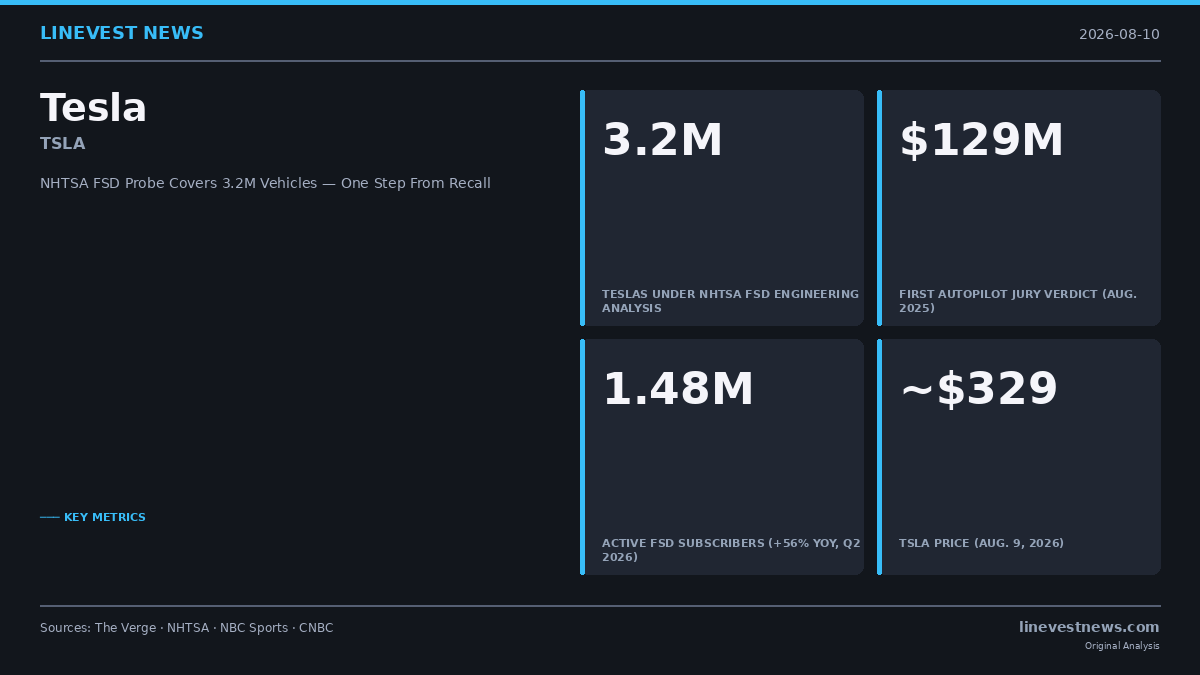
For investors, the timing of the disclosure matters more than the incident itself. In March 2026, the National Highway Traffic Safety Administration escalated its investigation into 3.2 million Tesla vehicles equipped with Full Self-Driving technology from a preliminary evaluation to an engineering analysis — the final investigative stage from which the agency may pursue a recall. The Shanahan disclosure, made public August 8, arrives while that process is still open.
TL;DR - 49ers head coach Kyle Shanahan disclosed August 8 that his Tesla was on Autopilot during a July 2026 crash; he suffered serious injuries but accepted full responsibility - NHTSA escalated to engineering analysis in March 2026 — covering 3.2 million FSD-equipped Teslas — citing camera failures in glare and dust; this is the final investigative stage from which NHTSA may pursue a recall — though the agency may also close with no action - Tesla lost its first Autopilot jury trial in August 2025 (a verdict awarding $129M compensatory + $200M punitive); a June 2026 Houston wrongful-death suit adds to mounting legal exposure - FSD is now Tesla's fastest-growing revenue driver: 1.48 million active subscribers (+56% YoY), Robotaxi live in seven U.S. cities, Services & Other revenue +50% YoY to $4.58 billion in Q2 2026 - TSLA closed at $328.58 on Friday, August 7, 2026; Tesla's SEC filings state the company cannot estimate total Autopilot litigation exposure
Part A: The Incident and the Regulatory Context
Shanahan's Tesla was traveling at approximately 20 mph in Autopilot mode when his phone slid from his lap into the back seat. He turned to retrieve it. The vehicle crossed the center line and struck an oncoming SUV. Palo Alto Police confirmed that an initial state database entry blaming the other driver was a clerical error; Shanahan was determined to be at fault.
At his August 8 media availability — his first public appearance since the accident — Shanahan said he had used Autopilot for nine years. He acknowledged uncertainty about the exact sequence: "Who knows what happened when I turned around? Whether it malfunctioned or whether I knocked it off?" He added: "You can't ever have zero worries" about relying on Autopilot.
Shanahan is not pursuing legal action against Tesla and his incident is not related to the NHTSA investigation. What the high-profile disclosure does is reignite public attention on Autopilot behavior at a moment when regulators are actively building a record.
The NHTSA Probe in Detail
| NHTSA FSD Engineering Analysis | Detail |
|---|---|
| Probe stage | Engineering analysis (step preceding recall) |
| Vehicles covered | 3.2 million (expanded from 2.4M in Oct. 2024) |
| Models affected | Model S/X (from 2016), Model 3 (from 2017), Model Y (from 2020), Cybertruck (from 2023), through 2026 |
| Core finding | Camera fails to detect glare, dust — no alert until just before crash |
| Incidents linked | 9 total, including 1 fatal crash and 2 injury crashes; 6 additional crashes under investigation |
| Escalated | March 2026 |
NHTSA found that the FSD system "did not detect common roadway conditions like glare, dust or other airborne obstructions that impaired camera visibility, or provide alerts when camera performance deteriorated until immediately before a crash." The agency also found that "FSD also lost track of or never detected a lead vehicle in its path." An engineering analysis has no statutory deadline; NHTSA must either close the probe with no action or require a remedy — which may include a recall.
Part B: Why the Regulatory Trajectory Matters to Tesla's Valuation
FSD Is Now a Tangible Revenue Engine
For most of Tesla's history, Autopilot and Full Self-Driving represented a technology promise embedded in the stock's premium. That has shifted materially. In Q2 2026, Tesla reported 1.48 million active FSD subscribers, up 56% year-over-year. North American attach rates exceeded 55% of new deliveries. Tesla's Services and Other revenue — which encompasses Supercharging, insurance, and other services — grew 50% year-over-year to $4.58 billion in Q2 2026. At current pricing and adoption rates, Tesla's subscriber base represents approximately $1.8 billion in potential annual recurring revenue.
Tesla's Robotaxi program is live in seven U.S. metropolitan areas — Austin, Dallas, Houston, Miami, Orlando, Tampa, and the San Francisco Bay Area — and has logged approximately 2.4 million cumulative paid miles through June 30, 2026, operating on early versions of FSD V15 (unsupervised).
| FSD and Robotaxi Metrics — Q2 2026 | Value |
|---|---|
| Active FSD subscribers | 1.48 million |
| YoY subscriber growth | +56% |
| North America new-delivery attach rate | >55% |
| Services & Other revenue (Q2 2026) | $4.58 billion (+50% YoY, includes Supercharging, insurance, services) |
| Estimated FSD potential ARR | ~$1.8 billion |
| Robotaxi cities (U.S.) | 7 |
| Robotaxi cumulative paid miles (through June 30) | ~2.4 million |
A regulatory action that forces Tesla to restrict or deactivate FSD capabilities — even temporarily — would directly impair this growth trajectory. Tesla spent $5.79 billion in Q2 2026 capital expenditures (more than double the year-ago level of $2.39 billion), driving free cash flow to negative $1.1 billion — the first FCF-negative quarter since early 2024. The bet is that AI-driven autonomous services will pay back that investment; a material regulatory setback changes the payback math.
A Worsening Legal Precedent Landscape
For years, Tesla defended Autopilot litigation by arguing that the system's documented limitations placed responsibility squarely on drivers who disengaged attention. That defense held in court until August 2025, when a jury in the U.S. District Court for the Southern District of Florida returned a verdict awarding $129 million in compensatory damages and $200 million in punitive damages in a case arising from a 2019 Autopilot crash — Tesla's first lost jury trial on an Autopilot matter.
In June 2026, a Houston-area family filed a wrongful-death lawsuit in Harris County state court after a Tesla Model 3 allegedly operating on Autopilot left a roadway on June 19, 2026, and struck a home, killing a 76-year-old woman standing inside. The complaint seeks more than $1 million in compensatory damages plus punitive damages, alleging Tesla demonstrated "reckless disregard for a substantial risk of severe bodily injury." NHTSA opened a separate special investigation into that crash as well.
In its most recent SEC filings, Tesla discloses it "is unable to reasonably estimate the possible loss or range of loss" associated with Autopilot and FSD litigation, and intends to "vigorously defend" these matters. That standard legal hedge has appeared in Tesla filings for years; the delta now is that plaintiffs carry a $129 million precedent and an active NHTSA engineering analysis as a foundation for arguing the company knew of systemic defects.
The OTA Recall Playbook — and Its Limits
For software-based safety remedies, Tesla has generally moved quickly. When NHTSA identified phantom braking complaints in 2022 and problematic FSD intersection-stop behavior in 2024, Tesla issued over-the-air updates within weeks. The stock absorbed both episodes without lasting damage.
The March 2026 engineering analysis presents a structurally harder problem. The alleged defect is hardware-adjacent: the camera systems that serve as FSD's sole sensor input perform inadequately in specific ambient conditions — glare, dust, airborne particulates. An OTA update can alter how the software responds when camera input degrades, but cannot improve the cameras themselves. If NHTSA concludes that software-side responses are insufficient and that the camera hardware needs physical augmentation, the cost and operational disruption would be categorically different from a prior OTA recall.
That outcome is not the base case. NHTSA may accept behavioral constraints — such as limiting FSD availability in adverse weather conditions — as sufficient. But the engineering analysis removes the worst-case scenario from speculation and places it in active regulatory review.
Stock and Broader Context
TSLA closed at $328.58 on Friday, August 7, 2026. Tesla's Q2 2026 total revenue reached a record $28.24 billion (+26% year-over-year), but operating income fell 57% to $398 million as operating expenses rose 47% year-over-year. The gap between top-line growth and compressed operating margins reflects the scale of Tesla's bet on AI and autonomous services. Analysts maintaining premium multiples on TSLA based on Robotaxi and FSD monetization must now price in a regulatory environment that is meaningfully less benign than it was 12 months ago.
Shanahan's comment — "you can't ever have zero worries" about Autopilot reliance — distills a behavioral reality that NHTSA engineers, plaintiff attorneys, and Congressional staff are each building their own record around. The 49ers coach put Autopilot back on the front page. Regulators, in March 2026, had already started the clock.
Tesla (TSLA) is traded on Nasdaq. This article is informational and does not constitute investment advice. Consult a qualified financial advisor before making investment decisions.
Sources - The Verge: 49ers coach says his Tesla was on Autopilot when he crashed - NBC Sports: Kyle Shanahan says his Tesla was on autopilot before accident - NBC Sports Bay Area: Kyle Shanahan provides health update and key car crash detail - Insurance Journal: NHTSA Upgrades Probe into 3.2M Teslas Over Self-Driving Crashes - CNBC: Tesla faces federal probe after Model 3 crash that killed 76-year-old - EVwire: Tesla Q2 2026 earnings recap: record $28.2B revenue - EV Research: Tesla FSD Subscriptions Reach 1.48 Million, Up 56.0%