LG Chem (051910.KS) Ships First Semiconductor Stripper to Amkor
South Korean chemical giant LG Chem announced on July 5 that it has entered the semiconductor stripper market for the first time, beginning mass-production supply of the process chemical to Amkor Technology (AMKR), one of the world's largest outsourced semiconductor assembly and test (OSAT) providers.
Strippers are critical process chemicals used to remove photoresist and residue from semiconductor wafers after circuit patterning. As chip geometries shrink and packaging architectures grow more complex — driven by artificial intelligence and high-bandwidth memory demand — process chemical performance has become a key differentiator in manufacturing yield and reliability.
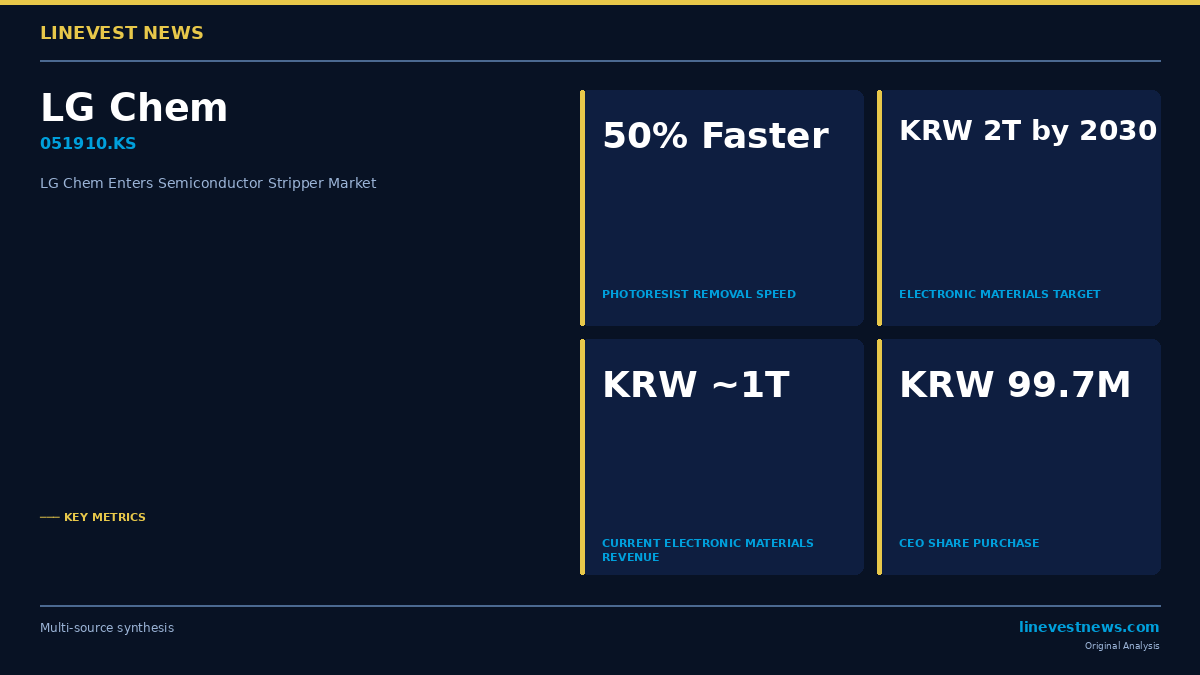
LG Chem's semiconductor stripper formulation, customized for Amkor's new production lines, reduces photoresist-and-residue removal time by 50% compared to existing products. The company transferred technology and process know-how from its established display stripper business — where it already serves flat-panel manufacturers — into the higher-margin semiconductor segment.
"Our partnership with Amkor will further strengthen our competitiveness in customized materials optimized for our customers' processes," said CEO Kim Dong-chun.
Part B — Why This Matters for Korea's Semiconductor Materials Sector
A Strategic Pivot Away from Commodity Chemicals
The Amkor deal is the latest step in LG Chem's structural pivot from low-margin petrochemicals toward advanced materials. The company has set a target to double its electronic materials revenue from KRW 1 trillion (USD 720M) to KRW 2 trillion by 2030, with semiconductor, automotive-electronics, and display segments as the three growth pillars.
To support that goal, LG Chem consolidated hundreds of researchers into a new Advanced Materials Research Institute in early 2026 and expanded its semiconductor packaging materials portfolio to include copper clad laminates (CCL), die attach films, photosensitive dielectric (PID) materials — and now, process strippers. The company said it is also collaborating with an undisclosed "top global semiconductor maker" on PID materials for fine-pitch circuit interconnects.
Amkor's Role in the AI Packaging Race
Amkor Technology is a critical node in the global AI chip supply chain. The company packages chips for Intel, Qualcomm, Apple, and leading AI accelerator designers, and operates Korea's largest private semiconductor test facility in Ansan, Gyeonggi Province. By winning a supply agreement with Amkor — rather than waiting for a domestic win first — LG Chem gains a direct channel into advanced packaging volumes tied to AI server and HBM roadmaps.
Demand for process chemicals with tighter performance tolerances is accelerating as the industry transitions to advanced packaging formats such as fan-out wafer-level packaging (FOWLP), 2.5D interposers, and chiplet integration. Lead times for proven stripper formulations have tightened, creating an opening for domestic Korean suppliers to displace incumbent Japanese and US chemical vendors.
Korea's Semiconductor Materials Localisation Push
Japan's 2019 export controls on photoresists, fluorinated polyimides, and hydrogen fluoride — all key semiconductor process chemicals — exposed South Korea's dependence on Japanese suppliers and spurred a government-backed materials-parts-equipment (sobuljang) localisation drive. Strippers, while not subject to those specific controls, fall into the broader category of process chemicals where Korean producers have historically lagged Japanese peers such as Tokyo Ohka Kogyo (TOK) and Stella Chemifa.
LG Chem's entry with a commercially validated product already accepted by a Tier-1 OSAT provides evidence that the localisation effort is producing tangible results. For investors, the move also signals that LG Chem's advanced materials segment is finding customer traction beyond Korea's borders.
Investment Considerations
LG Chem's share price has been under pressure in 2026 amid a prolonged downturn in the battery materials cycle, with cathode material volumes lower and NMC pricing still soft. The semiconductor materials push represents a deliberate attempt to decouple earnings from battery cycle risk by growing a segment with different end-market timing. CEO Kim Dong-chun reinforced that conviction in early 2026 by purchasing 336 LG Chem common shares at a personal outlay of approximately KRW 99.7 million (USD 71,900).
However, the strategic direction carries execution risk. The semiconductor process chemicals market is dominated by entrenched suppliers with deep customer qualification histories. LG Chem will need to replicate its Amkor win across additional OSAT and integrated device manufacturer (IDM) customers to reach the revenue targets embedded in its 2030 roadmap. Progress on that customer pipeline — rather than any single supply deal — will be the key variable to watch.
Sources: The Korea Herald · Electronic Times · Seoul Economic Daily