
StarbucksSBUX
About Starbucks
Starbucks Corporation operates the world's largest chain of specialty coffee retailers, selling handcrafted espresso beverages, brewed coffee, teas under the Teavana brand, refreshers, and a rotating slate of food items through more than thirty thousand stores globally. Revenue divides between company-operated stores, which generate the bulk of sales and profit, and a smaller but higher-margin licensed store channel where partners run locations inside airports, grocery chains, and hotels. A third stream, Channel Development, encompasses packaged coffee, single-serve K-Cup pods, and ready-to-drink beverages sold through the Global Coffee Alliance with Nestlé. Company-operated stores in North America typically drive the majority of segment profit, with international operations, led by China, providing the principal growth vector.
Serious holders track same-store sales composition — the split between traffic and ticket — because it reveals whether growth comes from more customers or from price and mix. China exposure is a structural question given geopolitical risk, local competition from Luckin and Cotti, and consumer sentiment swings. Labor relations receive close attention following unionization drives at U.S. company stores and the associated bargaining and NLRB proceedings. Mobile app and Rewards program engagement, which anchors a large share of tickets and float from stored value cards, is watched as a proprietary channel. Capital allocation historically favors dividends and buybacks alongside store growth, and commodity exposure to arabica coffee and dairy shapes gross margin cadence.
Founded in 1971 in Seattle's Pike Place Market as a whole-bean coffee retailer, Starbucks was transformed after Howard Schultz joined in 1982 and, following a trip to Milan, pushed the company toward the Italian espresso bar model; he acquired the chain in 1987 and took it public on the Nasdaq in 1992. Subsequent decades brought aggressive domestic and international expansion, the 1999 acquisition of Tazo, the 2011 purchase of Evolution Fresh, the 2012 Teavana deal, and the 2018 global licensing agreement with Nestlé for consumer packaged goods. The company assumed full ownership of its East China business in 2017 and remains headquartered in Seattle.
Mechanically, revenue accrues transaction by transaction at store counters and drive-thrus, with a growing share flowing through mobile order-and-pay and delivery partnerships; licensed partners remit royalties and product sales while Nestlé pays for the perpetual rights to market Starbucks-branded packaged goods. Competitive position rests on brand equity, real estate density, the Rewards loyalty ecosystem, vertically integrated roasting and supply chain, and consistency of the store experience. Principal rivals include Dunkin' and independent third-wave roasters in the United States, Costa and JAB-owned chains in Europe, and fast-growing value-priced chains in China. The Americas segment produces most consolidated revenue, with international operations, particularly China, forming the second pillar.
Company profile by LineVest editorial. Journalism, not investment advice.
Order a report on Starbucks — $15Starbucks coverage
2 articles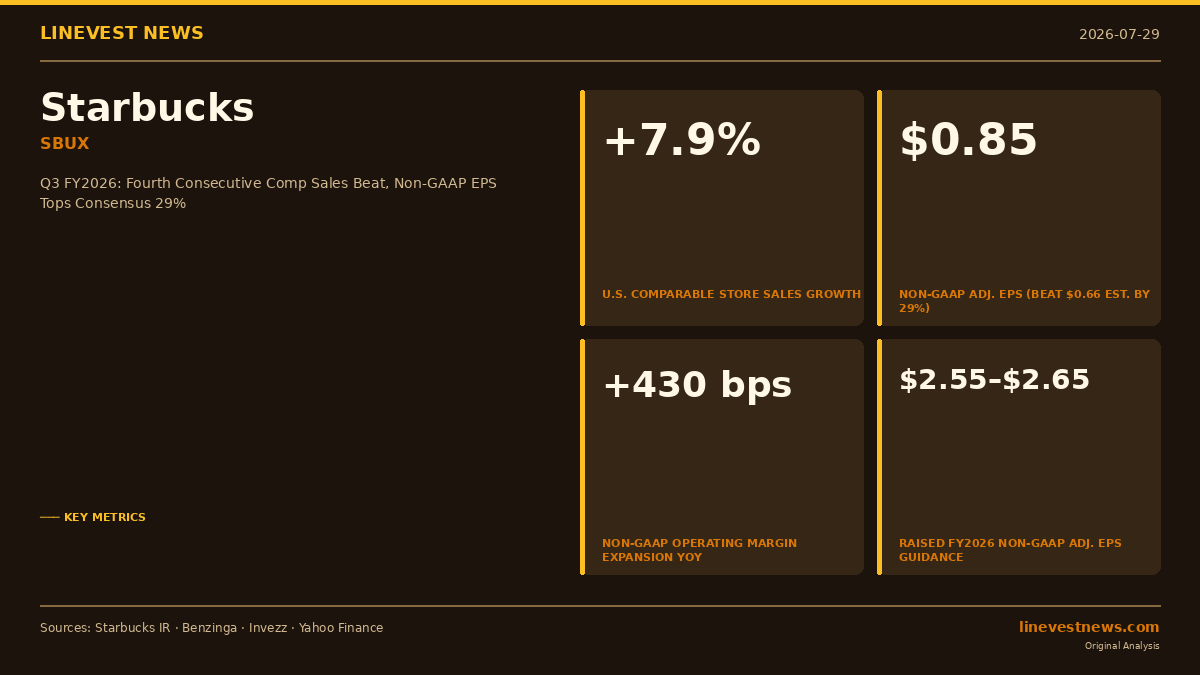
Starbucks (SBUX) Q3 FY2026: Comp Sales +7.9%, Adj. EPS Beats by 29%, Niccol Raises Full-Year Guidance
Starbucks Q3 FY2026 (ended June 28): U.S. comp sales +7.9%, non-GAAP EPS $0.85 beat $0.66 consensus by 29%, non-GAAP margins +430 bps. Niccol raises FY26 EPS to $2.55–$2.65.
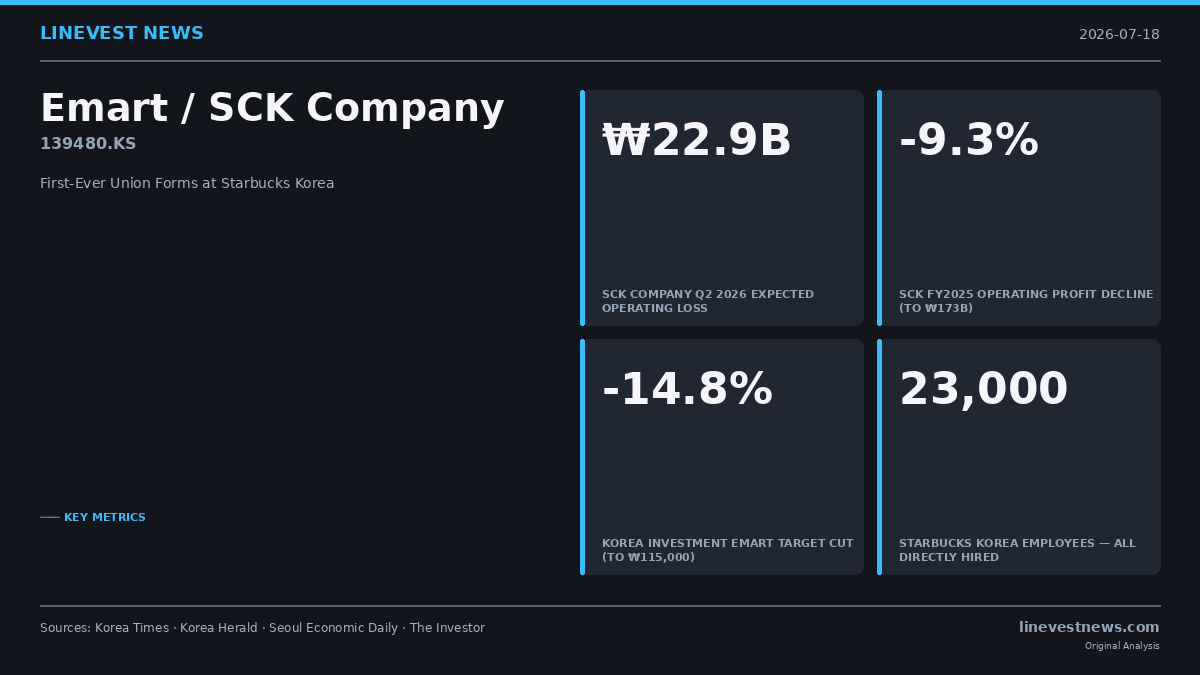
Starbucks Korea's First Union Forms as Q2 Operating Loss Looms — Emart (139480.KS) Faces Compounding Risk
Korea's first coffee-chain union forms at Starbucks Korea as Q2 2026 brings an expected ₩22.9B operating loss — a dual shock for Emart (139480.KS), which owns 67.5% of SCK.
Go deeper than the headline
You just read what happened. Here's how to read what it means.
The day's reports, every morning — free
LineVest Daily lands in your inbox before the opening bell with the reports we published that day — what each company's latest 10-K or 10-Q actually says about the numbers, in plain English. Free, no card required.
This report, on any company you name
What you just read on Starbucks is the format. Name any U.S.-listed company and we do the same for it — its latest SEC filing read in full, financials under US GAAP, governance, and what it means for the stock. PDF in your inbox within 3 hours.
Which company should we read?
$15 · one-time · PDF within 3 hours
Pick a company to continueIndependent journalism based on primary SEC filings — not investment advice. No brokerage affiliation.