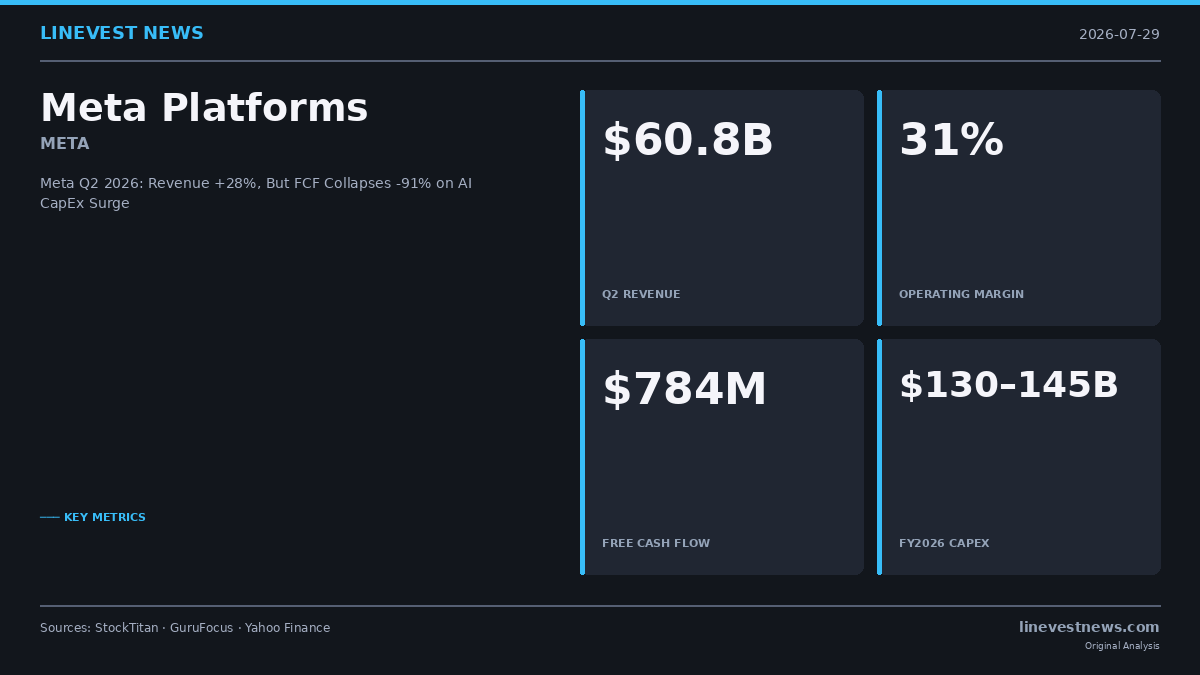
Meta Platforms (NASDAQ: META) reported second-quarter 2026 revenue of USD 60.80 billion, up 28% year-over-year, beating the Wall Street consensus of approximately USD 60.26 billion. However, a 55% surge in costs erased nearly all profit growth, with GAAP diluted EPS of USD 6.18 missing the USD 7.22 consensus by 14% — snapping a six-quarter streak of beats. Meta stock fell approximately 11% in after-hours trading, erasing roughly USD 15 billion from CEO Mark Zuckerberg's personal net worth.
TL;DR - Revenue USD 60.80B (+28% YoY), beat consensus; ad impressions +14%, avg price per ad +12% - GAAP EPS USD 6.18, missed USD 7.22 consensus by 14% — first miss in six quarters - Operating margin: 31% (vs 43% in Q2 2025), a 12 percentage-point collapse - Free cash flow: USD 784M (vs USD 8.55B YoY), down 91% as Q2 CapEx hit USD 31.1B - Q3 2026 guidance: USD 61B–USD 64B revenue (midpoint below Street consensus ~USD 63.2B) - FY2026 CapEx guidance raised to USD 130B–USD 145B (floor lifted from USD 125B) - META fell ~11% after-hours from close of USD 593.87
Part A — Q2 2026 Financial Results
Meta Platforms (NASDAQ: META) posted quarterly revenue of USD 60.80 billion for Q2 2026, up 28% year-over-year. Growth was driven by 14% higher ad impressions and 12% gains in average price per ad across Facebook, Instagram, and WhatsApp — a testament to continued strength in the core digital advertising business.
| Metric | Q2 2026 | Q2 2025 | YoY |
|---|---|---|---|
| Revenue | USD 60.80B | USD 47.5B | +28% |
| Operating Income | USD 18.8B | USD ~20.4B | -8% |
| Operating Margin | 31% | 43% | -12pp |
| Net Income | USD 15.8B | USD 18.4B | -14% |
| Diluted EPS | USD 6.18 | USD 7.14 | -13% |
| Total Costs & Expenses | USD 42.03B | USD ~27.1B | +55% |
| Q2 CapEx | USD 31.1B | — | — |
| Free Cash Flow | USD 784M | USD 8.55B | -91% |
Total costs and expenses surged 55% to USD 42.03 billion, driven by three distinct items: USD 31.1 billion in capital expenditures for AI infrastructure, USD 2.4 billion in legal charges related to ongoing regulatory proceedings, and USD 1.18 billion in severance costs tied to a May 2026 workforce reduction.
Operating margin collapsed 12 percentage points to 31%, from 43% in Q2 2025. Q2 capital expenditures of USD 31.1 billion consumed virtually the entirety of USD 31.86 billion in operating cash flow, leaving free cash flow of just USD 784 million — down 91% from USD 8.55 billion in the year-ago period.
CEO Mark Zuckerberg stated: "AI is accelerating our core business today, powering our next generation of products, and opening the door to entirely new enterprise opportunities."
Forward Guidance
| Item | Guidance |
|---|---|
| Q3 2026 Revenue | USD 61B–USD 64B |
| FY2026 CapEx | USD 130B–USD 145B (raised from USD 125B–USD 145B) |
| FY2026 Total Expenses | USD 165B–USD 169B |
| FY2026 Operating Income | Expected to exceed 2025 |
| FY2026 Tax Rate | 15–17% (remaining quarters) |
Meta raised the floor of its 2026 capital expenditure guidance by USD 5 billion to USD 130 billion while keeping the ceiling at USD 145 billion. The company attributed the increased capital commitment to accelerating AI data center construction and GPU infrastructure procurement.
Part B — Market Impact and Investor Analysis
Stock Drops 11% After Hours
Meta shares fell approximately 11% in after-hours trading following the July 29 earnings release, from a regular-session close of USD 593.87. The move erased an estimated USD 15 billion from Zuckerberg's net worth in a single session. The after-hours decline reflected a three-pronged disappointment: a 14% EPS miss versus consensus, near-zero free cash flow of USD 784 million, and Q3 revenue guidance whose midpoint of USD 62.5 billion fell below the Street's USD 63.2 billion estimate.
Analyst consensus price targets stood at USD 825.84 before the print — a 39% premium to the pre-earnings close — suggesting the longer-term bull case remains intact for many on the Street.
Dissecting the EPS Miss: One-Time Items vs Structural Pressure
The disconnect between a 28% revenue beat and a 14% EPS miss requires decomposition. Two items in Q2 — the USD 2.4 billion legal reserve and USD 1.18 billion severance — represent approximately USD 1.50 per diluted share of after-tax drag. Adjusting for these, normalized EPS would have been closer to USD 7.50–7.60, comfortably above the USD 7.22 consensus.
The legal charges relate to ongoing regulatory proceedings Meta has not individually itemized. The severance cost reflects a strategic headcount adjustment in May 2026. Whether investors treat these as genuinely non-recurring will largely determine how quickly post-earnings target resets stabilize the share price.
The Free Cash Flow Problem
Q2 free cash flow of USD 784 million against USD 8.55 billion a year earlier is the sharpest signal that Meta's AI buildout has entered a full-burn phase. If the pace of capital expenditure holds — the FY guidance implies H2 CapEx could run in the range of USD 65–70 billion — full-year free cash flow generation will be minimal at best, negative at worst.
For investors who valued Meta on a free cash flow yield basis, this changes the model. Sustained near-zero free cash flow constrains buyback and dividend capacity. The return-on-capital inflection that would justify the spending level requires AI-powered ad yield expansion or new enterprise revenue streams to materialize on a visible timeline. Zuckerberg's public position is that this inflection arrives in 2027.
Q3 Guidance: Soft at the Midpoint
The Q3 revenue range of USD 61B–USD 64B brackets the consensus at its upper end but misses at the midpoint by roughly USD 700 million. For a company that has historically guided conservatively, the slight midpoint shortfall is read by some investors as a signal that the ad market is encountering incremental friction — or that the company lacks high conviction on the near-term revenue trajectory.
The Strategic Stakes of USD 130–145B CapEx
Meta's FY2026 capital expenditure guidance of USD 130–145 billion dwarfs its USD 72.2 billion in 2025. The investment is overwhelmingly directed at AI data centers and the compute stack underlying Meta AI, the company's consumer-facing assistant, and the AI inference layers powering Reels, feed ranking, and ad targeting.
The bull case holds that this infrastructure creates a durable competitive moat. The bear case is that today's GPU clusters face obsolescence risk before they are fully monetized. With Alphabet and Microsoft also sustaining multi-hundred-billion CapEx cycles, the structural trajectory of AI spending is now an industry-wide variable that equity markets are pricing in real time.
This article is for informational purposes only and does not constitute investment advice. Past performance is not indicative of future results.