Apple on July 28, 2026, officially launched Apple Upgrade, a lease-to-own device program developed in partnership with Klarna. The program covers iPhone, Apple Watch, Mac, and iPad, and is available at Apple Store locations, the Apple Store app, and apple.com in the United States. It replaces both the iPhone Upgrade Program and iPhone Payments, which Apple is discontinuing.
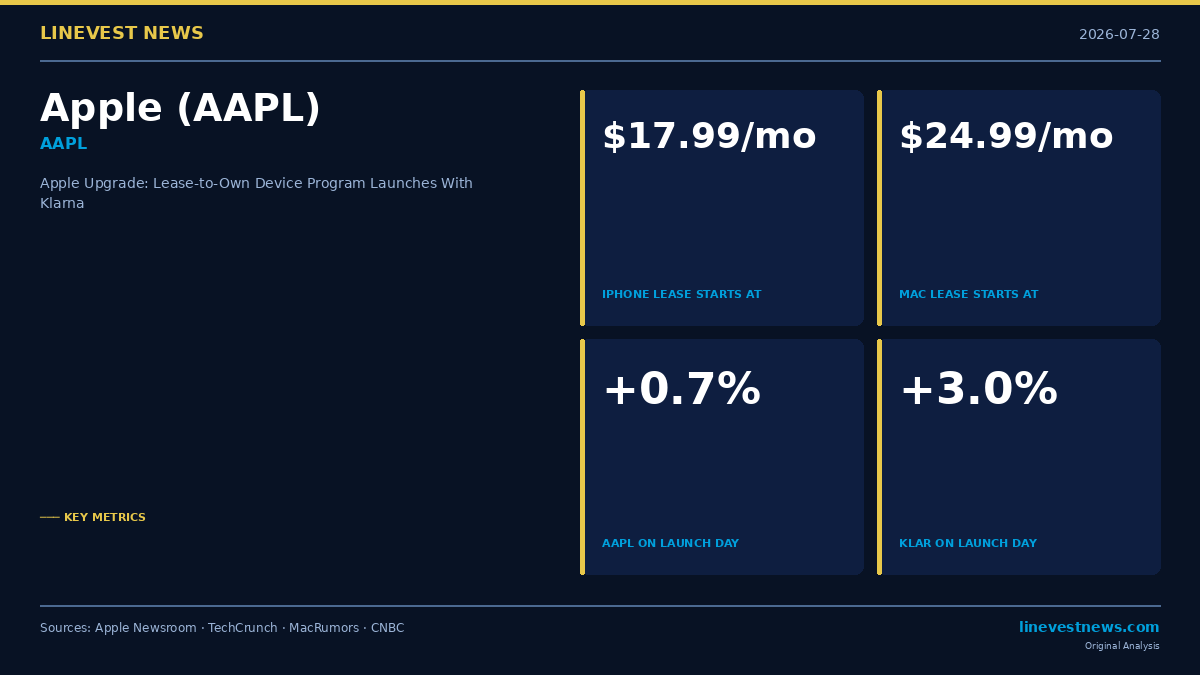
| Device | Starting Monthly | Term Options | Representative Example |
|---|---|---|---|
| iPhone | USD 17.99/mo | 12 or 24 months | iPhone 17 Pro 256GB (USD 1,099): USD 31.99/mo x 24m, or USD 45.99/mo x 12m |
| Apple Watch | USD 11.99/mo | 12 or 24 months | Watch Series 11 GPS 42mm (USD 399): USD 11.99/mo x 24m |
| Mac | USD 24.99/mo | 24 or 36 months | 14-in. MacBook Pro 16GB (USD 1,999): USD 38.99/mo x 36m, or USD 53.99/mo x 24m |
| iPad | USD 11.99/mo | 24 or 36 months | 11-in. iPad Pro 256GB (USD 1,199): USD 24.99/mo x 36m |
Klarna charges no financing fee: customers who lease and later purchase their device pay no more than the retail price. Approval requires a Klarna account and a soft credit inquiry that does not impact credit scores. Apple Card holders earn 3% Daily Cash on lease payments.
At the end of the lease, customers may: (1) upgrade to the newest generation by returning the device and starting a new lease; (2) purchase the device with a one-time payment; or (3) return it and exit the program. Customers who take no action roll into a month-to-month arrangement for up to six months (payments may increase).
Karen Rasmussen, VP of Apple Store Online, said: "We're thrilled that Apple Upgrade offers our customers, both online and in-store, a more flexible way to pay for the products they love."
Excluded models at launch: iPhone 16, iPhone 16 Plus, Apple Watch SE, MacBook Neo, Mac mini, iPad (A16), and Studio Display.
Part B -- Investment Implications
1. A Recurring-Revenue Play Dressed as Hardware
Apple's shift from one-time purchases to monthly lease payments mirrors its broader services strategy. Lease programs generate predictable monthly cash flow and anchor customers to upgrade cycles. An analyst cited by PYMNTS noted the program is "mildly bullish for AAPL, broadening consumer financing distribution without taking credit risk." Klarna, not Apple, assumes BNPL credit exposure; Apple retains device-as-collateral and can recirculate returned hardware through its certified-refurbished channel.
Analysts writing before launch estimated that converting even 10-15% of U.S. iPhone buyers to lease arrangements could add USD 2-3 billion annually to services-adjacent revenue. AAPL edged +0.7% on launch day. Keefe Bruyette maintained an Outperform rating on Klarna (KLAR; price target: USD 26), and Klarna shares climbed +3% on the partnership validation.
2. The "RAMageddon" Context
Apple raised Mac and iPad prices in recent months in response to the industry's DRAM and NAND supply crunch -- widely labelled "RAMageddon." LPDDR5X DRAM prices rose roughly 20% in H1 2026 on tight supply from SK Hynix (000660.KS) and Samsung Semiconductor (005930.KS). NAND prices climbed similarly as Kioxia -- now partly owned by SK Hynix after Bain Capital's full exit -- ramps post-IPO production amid surging AI datacenter demand.
Leasing converts a one-time price barrier into a manageable monthly commitment (USD 38.99/month over 36 months for a USD 1,999 MacBook Pro), preserving unit volume without sacrificing ASP growth.
3. Samsung Galaxy Under Pressure
Samsung launched the Galaxy Z Fold 8 and Z Fold 8 Wide this month, intensifying premium-segment competition. Apple's leasing program introduces financial stickiness that reduces churn risk: a customer paying USD 32/month on a 24-month iPhone lease is effectively committed through mid-2028.
For Samsung's Mobile Experience (MX) division -- which posted Q1 2026 operating profit of KRW 2.8 trillion (USD 1.89B) amid rising component costs -- Apple's direct-to-consumer lease bypasses the carrier-subsidy ecosystem and creates a switching barrier difficult to replicate without similar BNPL infrastructure.
4. Klarna as the Strategic Winner
The partnership gives Klarna access to Apple's estimated one billion active device users at effectively zero customer-acquisition cost, validating its enterprise B2B pivot. Klarna holds no credit risk under the arrangement; Apple controls the device and bears residual-value risk. In exchange, Klarna earns processing fees and gains brand halo supporting its post-IPO growth narrative.
5. Near-Term Caution
The exclusion of iPhone 16, Mac mini, and MacBook Neo limits the program's immediate addressable universe. Early termination fees and month-to-month payment escalation create friction for budget-sensitive consumers. Investors should watch September 2026: iPhone 18 series inclusion would represent the program's real volume ramp trigger.
Sources
- Apple Newsroom: https://www.apple.com/newsroom/2026/07/apple-upgrade-launches-in-the-united-states/
- TechCrunch (Jul 28, 2026): https://techcrunch.com/2026/07/28/apple-launches-upgrade-device-leasing-program-in-partnership-with-klarna/
- MacRumors pricing (Jul 28, 2026): https://www.macrumors.com/2026/07/28/apple-upgrade-program-pricing/
- CNBC (Jul 28, 2026): https://www.cnbc.com/2026/07/28/apple-plans-to-lease-iphones-for-17point99-a-month-through-klarna-deal.html
- PYMNTS (Jul 28, 2026): https://www.pymnts.com/apple/2026/apple-teams-with-klarna-to-debut-device-lease-to-own-program/
- Yahoo Finance/Motley Fool (Jul 22, 2026): https://finance.yahoo.com/markets/stocks/articles/apple-reportedly-launching-device-leasing-013400947.html
This article is for informational purposes only and does not constitute investment advice. LineVest News is not a registered investment advisor.