Samsung SDI (006400.KS), South Korea's third-largest battery maker, is converting stalled and underused electric-vehicle battery lines in the United States and Hungary into energy-storage (ESS) and new-customer production, with the first U.S. storage line now set to begin manufacturing in September — a quarter earlier than originally planned, South Korean technology daily ETNews reported on July 3.
The question for anyone watching the stock is not whether Samsung SDI can move a line from cars to storage — it is whether this pivot is large enough, and fast enough, to repair the utilization and losses left by the North American EV slowdown. The early evidence is that the company is trading a shrinking EV order book for a storage market that is growing far faster, but it is doing so from a position of financial strain.
What is actually changing
At StarPlus Energy — Samsung SDI's U.S. battery joint venture with automaker Stellantis in Kokomo, Indiana — three of the four lines at the first plant are being converted to ESS output, according to ETNews. The first of those lines will produce 273Ah-class lithium iron phosphate (LFP) storage cells starting in September, pulled forward from a previously guided fourth-quarter start, ETNews said.
In Hungary, Samsung SDI is reconfiguring the four existing lines at its Göd complex (the company's European battery site near Budapest) into prismatic cells for Volkswagen, ETNews reported. The trade daily said utilization on those lines is expected to recover to above 70 percent in the second half, up from roughly 40 percent in the fourth quarter of last year — the clearest quantitative sign the conversions are meant to solve an idle-capacity problem, not add fresh capacity. A separate Göd line for Samsung SDI's first 46-series cylindrical cells is under construction, with production targeted for October 2027 after BMW reliability testing, per ETNews.
Sizing the prize against the hole
The pull toward storage is a demand story. ETNews cited projections that the North American ESS market will expand from 88 gigawatt-hours (GWh) to 976 GWh by 2035, a trajectory driven in large part by AI data-center power needs.
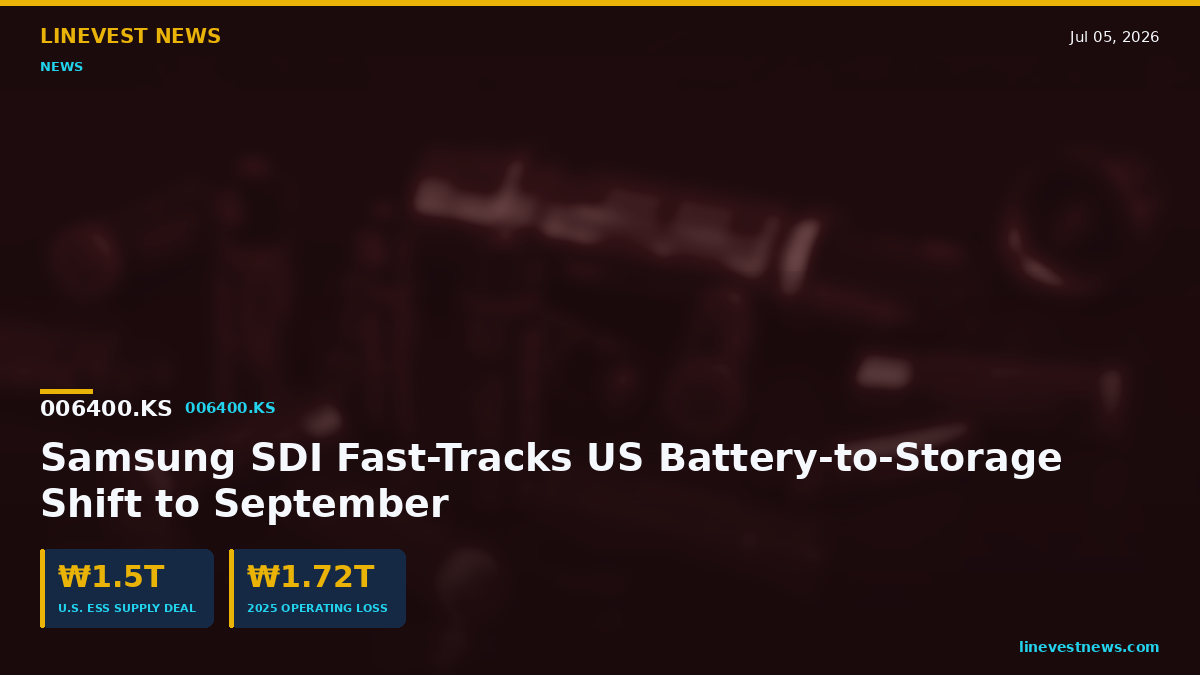
Samsung SDI has already begun converting that demand into contracts. In a deal reported by Energy-Storage.News, the company secured a roughly ₩1.5 trillion (approximately $1.1 billion) U.S. ESS cell supply agreement running four years from 2026, with cells to be made at the Kokomo site through its Michigan-based Samsung SDI America unit — starting with NCA chemistry before expanding to LFP. The customer was undisclosed, though Energy-Storage.News noted 2025 reports of Samsung SDI negotiating a multi-year storage supply agreement with Tesla.
Against that opportunity sits the hole the pivot must fill. Samsung SDI reported ₩13.27 trillion ($9.7 billion) in 2025 sales but a ₩1.72 trillion ($1.26 billion) operating loss, a deterioration the Korea Herald attributed to slowing North American EV demand. StarPlus's first plant was originally targeted to start in 2025 at about 23 GWh of annual capacity, with a second Kokomo plant of roughly 34 GWh slated for early 2027, per StarPlus and Stellantis disclosures — capacity that was scoped for EVs and now partly needs a new home in storage.
The funding and partnership overhang
The strategy carries two complications a fund manager should weigh. First, Samsung SDI is funding the ESS shift under balance-sheet pressure: after shareholders rejected a ₩1.65 trillion ($1.2 billion) rights offering in March 2026, the company moved to sell its 15.22 percent stake in Samsung Display — the Samsung Group flat-panel affiliate — for about ₩10 trillion ($7.3 billion, as the Korea Herald reported) to fund storage investment. That divestment sequence is the clearest measure of how much capital the pivot requires.
Second, the U.S. joint venture's future is unsettled. Stellantis is likely to withdraw from the StarPlus Energy battery venture with Samsung SDI, industry reporting including electrive indicated in February 2026, as the automaker pulls back from electric mobility. How the ESS conversion is governed — and who offtakes the output — depends partly on how that exit is resolved.
What confirms or refutes the thesis
The next hard data point is Samsung SDI's second-quarter earnings, due in late July, and the third-quarter figures that will first capture the September U.S. ramp. If the Hungary utilization recovery toward the stated 70-percent-plus level and the initial storage volumes show up as an improving ESS revenue mix and a narrowing operating loss, the conversion thesis holds. If utilization and margins stay depressed while EV volumes keep falling, the pivot will look more like managing stranded capacity than capturing the storage boom.
This article is journalism, not investment advice. LineVest is not a registered investment adviser. Figures are drawn from ETNews, Energy-Storage.News, the Korea Herald, electrive, and StarPlus/Stellantis disclosures as cited; won-to-dollar conversions use approximately 1,370 won per dollar except where a source provided its own dollar figure. Verify all data against primary filings before making any decision.