Samsung Electronics (005930.KS) flashed preliminary second-quarter earnings guidance showing record group results this week — and brokerages now say the same memory-chip boom driving that record is about to push its smartphone business into the red for the first time ever.
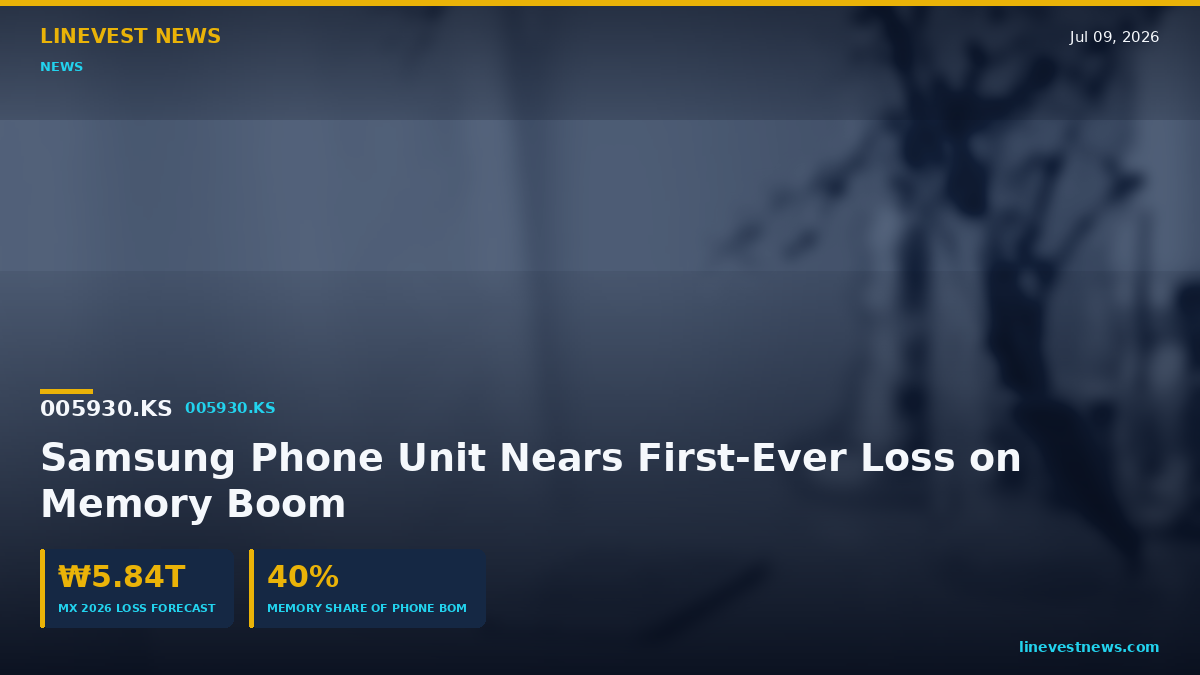
In a July 8 note, Samsung Securities (a brokerage affiliate of the Samsung group) tore up its full-year forecast for the MX (Mobile eXperience) and Network division — the unit that houses Samsung's Galaxy phone business — swinging it from a projected ₩3.41 trillion ($2.23 billion) operating profit to a ₩5.84 trillion ($3.82 billion) operating loss for 2026, as reported by ChosunBiz. The brokerage estimates the MX unit alone lost about ₩1.4 trillion ($915 million) in the second quarter; Yujin Investment & Securities pegs the divisional loss near ₩1 trillion ($654 million), while IBK Investment & Securities flipped its Q2 call for the combined MX·Network unit from a ₩342 billion profit to a ₩526 billion ($344 million) loss (ChosunBiz). A separate insider-based estimate cited by tech outlet gagadget puts the mobile division's Q2 deficit at roughly $740 million. (Figures here use a rate of about 1,530 won to the dollar, derived from The Korea Times' USD conversions of Samsung's Q2 guidance.)
If confirmed, it would be the MX division's first quarterly operating loss since its formation. As ChosunBiz notes, the unit stayed profitable even through the Galaxy Note 7 recall of the third quarter of 2016, when it still booked about ₩100 billion ($65 million) in operating profit. MX accounts for 96–98% of the combined division's revenue, so the swing is effectively a phone-business story.
The paradox: a record quarter that the market didn't like
The warning lands days after Samsung's July 7 preliminary guidance for a record quarter. The company flagged consolidated sales of about ₩171 trillion ($111.8 billion) and operating profit of about ₩8.94 trillion ($5.84 billion) — its highest ever, a third straight record quarter, and up roughly 91% year-on-year, according to Samsung's earnings guidance and The Korea Times. Yet the stock fell about 6.9% at the Seoul close on the day, per The Korea Times, on a revenue figure that came in below consensus.
The reason the print unsettled investors is the same reason MX is bleeding: surging prices for DRAM and NAND memory, fueled by AI data-center demand, have lifted the Device Solutions (DS, Samsung's chip business) division to extraordinary profits while sharply raising the cost of the memory that goes inside Galaxy phones. Counterpoint Research (a technology market-research firm) estimates that memory's share of the bill of materials for a roughly $800 smartphone jumped from about 14% in the first quarter of last year to 40% in the second quarter of 2026 (ChosunBiz).
Crucially, DS and MX operate as separate profit centers, and MX buys memory at market prices rather than at a preferential internal rate, gagadget reports — so the chip division's windfall shows up directly as the phone division's cost. Samsung Securities analyst Lee Jong-wook wrote that higher DRAM prices began flowing into costs in the second quarter, pulling the projected loss-transition forward from the fourth quarter of 2026 (ChosunBiz).
Sizing the drag — and the offset
Samsung Securities projects the MX·Network loss widening to ₩15.21 trillion ($9.9 billion) in 2027 before narrowing to ₩3.24 trillion ($2.12 billion) in 2028 — a cumulative ₩24.29 trillion ($15.9 billion) over 2026–2028 (ChosunBiz). The 2027 figure would exceed the ₩14.88 trillion ($9.7 billion) annual loss the DS chip division booked during the 2023 memory downturn, the brokerage notes — a striking reversal, since it is now chips subsidizing the group while phones absorb the pain.
For a fund manager, the offset is the point: the memory cycle that threatens a multi-trillion-won phone loss is simultaneously driving group operating profit into record territory. The MX drag is real but small against ₩8.94 trillion in quarterly group profit.
Samsung's defensive lever is pricing. It launched the Galaxy S26 in March at about ₩100,000 (~$65) above its predecessor on the 256GB model and raised prices on high-capacity Z Flip7, Fold7 and S25 Edge variants in April (ChosunBiz). But with replacement cycles lengthening and Chinese rivals Huawei and Xiaomi competing hard in the mid-to-low tier, ChosunBiz notes that passing on memory costs risks denting unit sales.
What to watch
Samsung has not yet disclosed its divisional breakdown; the detailed second-quarter results, due later in July, are the first hard data point that will confirm or refute whether MX actually crossed into loss. Major research houses expect the memory shortage to persist into 2027 (ChosunBiz), so the durability of Galaxy pricing power — and how long the DS windfall keeps dwarfing the MX shortfall — is the variable to track.
This article is journalism, not investment advice. LineVest is not a registered investment adviser. Figures are drawn from cited primary and secondary sources as of July 9, 2026; currency conversions are approximate.