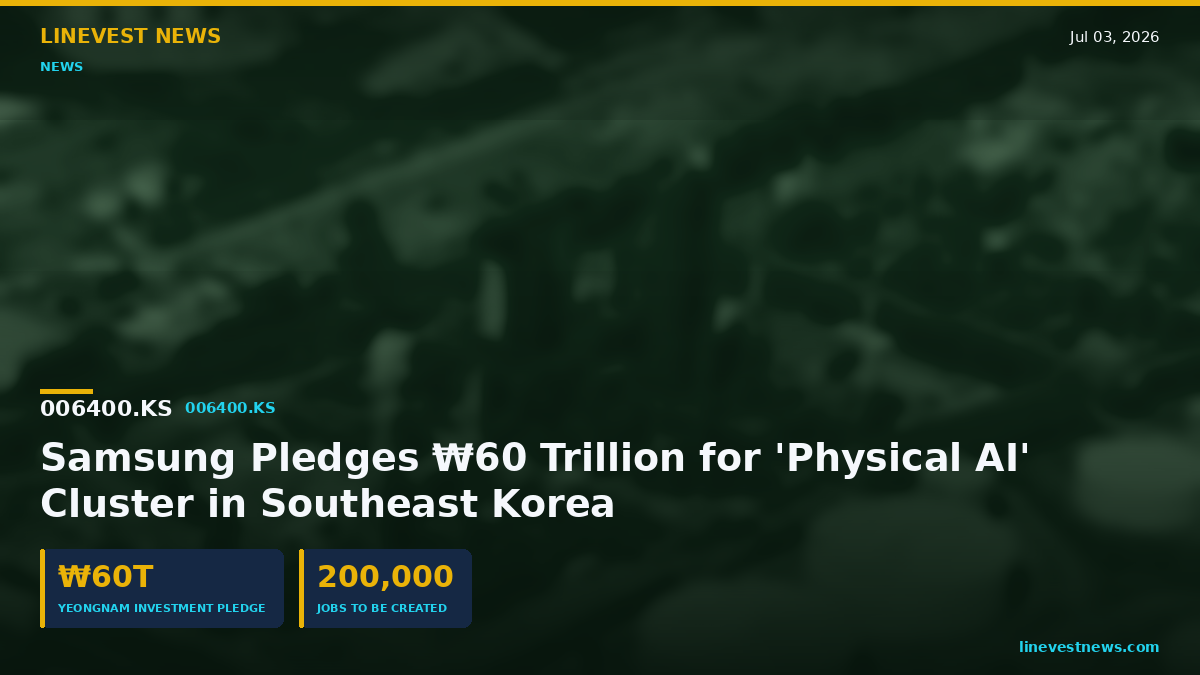
Samsung on July 3 pledged to invest ₩60 trillion ($43.8 billion) in the Yeongnam region — the industrial belt of southeastern Korea centered on Busan, Ulsan and North and South Gyeongsang provinces — to build what it calls a "global physical AI innovation cluster." Roh Tae-moon, president of Samsung Electronics (005930.KS, Korea's largest company by market value), announced the plan at a national policy report meeting on advanced-industry strategy held at Gyeongsang National University in Jinju, South Gyeongsang Province, according to Seoul Economic Daily. Samsung said the buildout would create 200,000 jobs (Seoul Economic Daily; Electronic Times).
Who actually pays: five separately-listed affiliates, split by city
The first question for anyone pricing this is which balance sheets carry the spending — because ₩60 trillion is not one company's bill. It is split across five Samsung affiliates, most of them separately listed, each anchored to a different city (Seoul Economic Daily):
- Gumi — ₩19 trillion ($13.9 billion): Samsung Electronics and Samsung SDS (018260.KS) jointly, for a humanoid-robot mass-production system, an AI-driven factory and an AI data center linked to manufacturing robots.
- Ulsan — ₩16 trillion ($11.7 billion): Samsung SDI (006400.KS, Samsung's battery arm), to build what Samsung describes as the world's first all-solid-state battery mass-production base, aimed at humanoid robots and EVs alongside energy-storage-system cells.
- Busan — ₩15 trillion ($11.0 billion): Samsung Electro-Mechanics (009150.KS, Samsung's components maker), for AI server package substrates and multilayer ceramic capacitor (MLCC) lines.
- Geoje — ₩10 trillion ($7.3 billion): Samsung Heavy Industries (010140.KS, Samsung's shipbuilder), for high-value ships and offshore infrastructure.
The single largest affiliate-level commitment falls on Samsung SDI, making this cluster's primary financial exposure a battery story, not a chip story.
New money, or a repackaging?
The more important question is whether this is incremental capex or a re-labeling of pledges already on the books. It is largely the latter, presented at regional granularity. The ₩60 trillion is the Yeongnam leg of Samsung's broader national blueprint, which frames the region as the "physical AI and robotics" corner of an "AI triangle" — with semiconductor investment concentrated in the Honam region and AI data centers and advanced packaging in Chungcheong (Seoul Economic Daily). It also lands inside a government-coordinated wave: Korean conglomerates collectively announced roughly ₩312 trillion (about $228 billion) of Yeongnam-directed investment on the same platform, per Let's Data Science. For a fund manager, that means the ₩60 trillion is best read as a spending envelope tied to a policy push, not a fresh, near-term capex surprise.
The Ulsan leg has a paper trail — and a hard date
The Ulsan battery base is the part with the clearest history, which makes it the cleanest read-through. Ulsan's plan to host a Samsung SDI all-solid-state battery complex dates to at least 2024: in April that year the city approved an amended industrial-complex plan for the site, compressing an approval process initially expected to take three years into about nine months, with Samsung SDI targeting all-solid-state mass production by 2027 (Asia Business Daily, April 2024). The ₩16 trillion pledge scales up that existing groundwork rather than starting from zero.
That 2027 commercialization target is also the datapoint that will confirm or undercut the announcement. Regional investment pledges in Korea are typically framed as decade-long envelopes, and this one carries no published spending schedule (Seoul Economic Daily noted no production timeline for the wider package). What can be checked against reality is narrower: whether Samsung SDI holds to solid-state mass production by 2027, and whether groundbreaking dates and capex guidance at the affiliate level — Samsung SDI, Samsung Electro-Mechanics and Samsung Heavy Industries each report separately — begin to reflect the Gumi, Ulsan, Busan and Geoje commitments in upcoming quarterly results.
Until those affiliate-level numbers move, the ₩60 trillion headline sizes the ambition, not yet the cash out the door.
This article is for informational purposes only and does not constitute investment advice. Figures are converted at approximately ₩1,370 per U.S. dollar. Won amounts and event details are attributed to the sources named inline.