TL;DR - Samsung (005930.KS) targets year-end mass production of CMM-D 3.0, its CXL 3.2 memory module; schedule may slip into 2027 if Intel/AMD server platforms lag - SK Hynix (000660.KS) unveiled second-gen CMM-DDR5 (256 GB, CXL 3.2) at HPED 2026, clocking a 35.7% inference efficiency gain; no production timeline disclosed - CXL slots between conventional DRAM and solid-state storage — complementary to HBM, not a replacement for it - Eugene Investment analyst: CXL "really takes off from 2026" and server platforms "should be mainstream by 2028" - SK Hynix posts Q2 2026 results Wednesday, July 22; CXL is the next growth narrative analysts will probe
Part A: A New Rung on the Memory Ladder
South Korea's two dominant memory chipmakers are pushing competing CXL (Compute Express Link) 3.2 products toward market, targeting a new tier in the AI server memory hierarchy that sits above solid-state storage and below conventional DRAM.
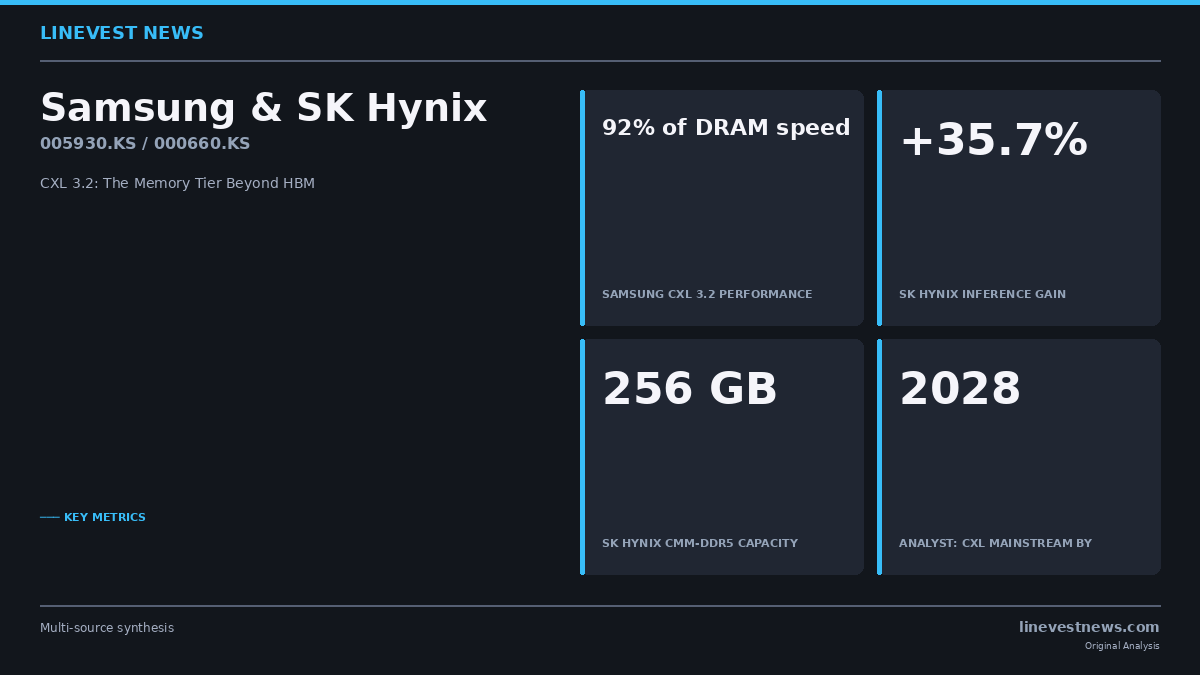
Samsung Electronics (005930.KS) is targeting year-end mass production of its CMM-D 3.0 module, the third generation of its CXL product line after CXL 1.1 (2022) and CXL 2.0 (2023). The latest version implements CXL 3.2 and introduces the CXL Hot Page Monitoring Unit (CHMU), which monitors data-access frequency to optimise traffic across multiple memory devices in real time. Samsung claims a 1-terabyte CXL memory pool achieved approximately 92% of local DRAM-level inference performance across eight GPUs while supporting substantially larger caches — a critical metric for large language model operators running multi-trillion-parameter models.
Internal reports in early July cited possible slippage into 2027, contingent on Intel and AMD finalising their next-generation server platforms. Samsung has stated it is "preparing to begin production on schedule."
SK Hynix (000660.KS) demonstrated its second-generation CMM-DDR5, also implementing CXL 3.2, at the HPED 2026 exhibition and at HPE Discover in Las Vegas in June 2026. The module doubles capacity from the first generation to 256 GB and uses the company's Inference Memory Tier Expansion (IMTE) architecture. SK Hynix recorded a 35.7% improvement in AI inference throughput by placing the CXL pool between DDR DRAM and SSD in a tiered hierarchy. The first-generation CXL 2.0 product (launched 2024) completed enterprise customer certification in 2025. A mass-production schedule for the second generation has not been announced.
US rival Micron also has a CXL 2.0 module in market from 2023 and is developing a next-generation product, meaning both Korean chipmakers face competition beyond each other.
Part B: Korea Market Implications
A Revenue Layer That HBM Cannot Fill
HBM has been the defining story of Korea's semiconductor bull run, but it has a structural limitation: its stacked-die architecture is engineered for bandwidth per GPU, not total pool size. As AI model sizes grow and inference operations multiply across distributed GPU clusters, the bottleneck increasingly becomes capacity, not throughput alone.
CXL addresses this by pooling DRAM across multiple servers via the PCIe bus, offering latency in the hundreds-of-nanoseconds range — slower than local DRAM but dramatically faster than NVMe storage, and without the cost of purchasing additional GPUs to host the memory.
That value proposition targets the same hyperscaler customers buying HBM by the petabyte. In Q1 2026, Samsung held a 38.6% DRAM market share; SK Hynix held 28.8% (Counterpoint Research). CXL introduces a volume product above the commodity DRAM floor but below HBM's premium tier, potentially improving both companies' blended average selling prices over time.
Race-to-First Calculus
Samsung is openly racing to be the first to ship CXL 3.2 at scale. The CHMU innovation is designed to outperform generic pooled-memory approaches by intelligently directing hot data to faster local DRAM and colder data to the CXL pool. Being first-to-market in a new memory tier gives Samsung control over reference server designs and early customer integrations — an advantage it wielded effectively when it shipped the first HBM for Nvidia's predecessor-generation GPU.
SK Hynix is protecting its Q2 earnings narrative ahead of Wednesday's results. Its demonstration of a working 256 GB CXL 3.2 module signals technical readiness without committing to a production ramp that might conflict with HBM4 capacity allocation. The company has every incentive to highlight CXL as a post-HBM growth vector when analysts probe the 2027-2028 outlook on the earnings call.
The Platform Dependency Risk
The central risk is platform readiness, not chipmaker readiness. CXL 3.2's pooled-memory features require server CPUs and operating-system software to recognise and address the expanded pool. Intel's next-generation Xeon and AMD's post-EPYC Turin platform are the primary gating factors. Industry reports indicate Intel's timeline has slipped — directly explaining Samsung's potential 2027 delay. If both platforms ship on schedule in H1 2027, the first full CXL 3.2 production clusters could reach AI workloads in H2 2027, consistent with analyst projections.
Comparison Table
| Samsung (005930.KS) | SK Hynix (000660.KS) | |
|---|---|---|
| Product | CMM-D 3.0 | CMM-DDR5 Gen 2 |
| CXL Version | 3.2 | 3.2 |
| Module Capacity | Not disclosed | 256 GB |
| Mass-Production Target | Year-end 2026 (risk: 2027) | TBD |
| Key Benchmark | 92% of DRAM inference speed (1 TB pool, 8 GPUs) | +35.7% inference throughput gain |
Eugene Investment & Securities analyst Yim So-jung told Seoul Economic Daily: "As AI expands, so will the market's appetite for CXL, and that really takes off from 2026. By 2028, CXL-capable server platforms should be the mainstream."
Investors following SK Hynix's July 22 earnings call should listen for any management guidance on CXL commercialisation timelines and customer qualification progress. A concrete production schedule or confirmation that Samsung's year-end 2026 target remains intact would be a positive catalyst for both stocks as a new memory revenue tier takes shape.
This article is editorial journalism, not investment advice. LineVest News is not a registered investment adviser.
Sources: - Korea Herald - Samsung, SK hynix push new memory layer as AI outgrows HBM - Seoul Economic Daily - Samsung, SK Hynix Race to Mass-Produce CXL 3.2 Memory - Seoul Economic Daily - CXL Memory War Erupts as Next Memory Battle Heats Up - ANI News - Samsung, SK Hynix advance new memory layer to tackle AI scaling limits - Tribune India - Samsung, SK Hynix advance new memory layer to tackle AI scaling limits