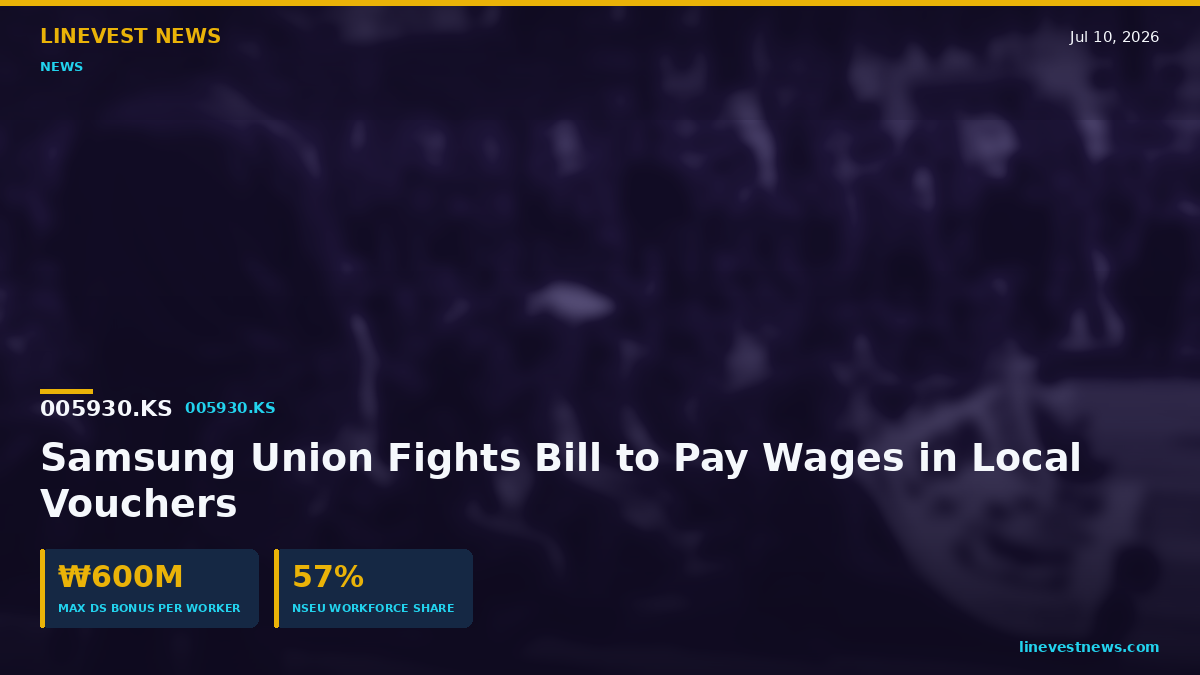
Samsung Electronics (005930.KS), the world's largest memory-chip maker, saw its biggest labor union—representing roughly 73,000 members, or about 57 percent of its Korean workforce—move into open conflict with a ruling-party lawmaker on Friday, demanding the withdrawal of a bill that would let employers pay part of workers' wages, including performance bonuses, in local gift certificates instead of cash.
What the bill actually changes
The measure, introduced Wednesday by Rep. Park Min-kyu of the Democratic Party of Korea (South Korea's governing party), would amend the Labor Standards Act—the country's core labor statute—to allow wages, including bonuses, to be paid in local gift certificates or other non-cash forms, provided workers give explicit consent or a collective bargaining agreement permits it, according to the Korea Times. Local gift certificates, or jiyeok hwapye, are municipally issued vouchers that can only be spent at small businesses inside the issuing region; Korean governments have long promoted them to channel spending toward local merchants.
The Samsung Electronics Labor Union (SELU)—the company's largest, which reached majority-union status this year with roughly 73,000 members, about 57 percent of Samsung's near-129,000 domestic workforce, per industry reporting—said the change "undermines the principle that wages should be paid in legal currency," the Korea Times reported. The union challenged lawmakers to accept their own salaries in vouchers before experimenting with worker pay, a line echoed in Korean-language coverage by Maeil Business Newspaper (MK), whose headline paraphrased the union as saying "apply it to lawmakers first." The Federation of Korean Trade Unions (FKTU) and the Korean Confederation of Trade Unions (KCTU)—the two national labor umbrella bodies—also called for the bill to be scrapped, per the Korea Times.
Why the money at stake is large
The fight lands weeks after Samsung's chip employees secured some of the biggest incentive figures in Korean corporate history. Under a wage agreement reached in May, employees in Samsung's Device Solutions (DS) Division—its semiconductor business—could receive performance incentives of up to ₩600 million ($438,000, per the Korea Times) each if earnings meet expectations, while workers in the Device eXperience (DX) Division, its consumer-electronics arm, are set to receive company shares worth about ₩6 million (roughly $4,400). The Korea Herald reported the DS deal ties a special bonus pool to 10.5 percent of the chip division's operating profit, with much of it paid in shares.
That structure explains the union's alarm: bonuses of this scale are effectively deferred, non-cash compensation already, and SELU sees the voucher bill as a further step away from cash it can freely spend or save. The sums are not marginal to Samsung. The Korea Times cited projections that the DS Division and rival SK hynix—the world's second-largest memory maker—will generate roughly ₩40 trillion (about $29 billion) and ₩30 trillion (about $22 billion) in operating profit respectively this year, with semiconductor staff expected to see bonuses averaging several hundred million won in early 2027.
The precedent that gives this teeth
Labor peace at Samsung's fabs is newly fragile. The May wage deal was ratified by 73.7 percent of the 62,616 union members who voted, on 95.5 percent turnout among 65,593 eligible voters, and it was signed just before a walkout planned for May 20, narrowly averting a strike, according to the Korea Herald. That followed Samsung's first-ever strike in its then-55-year history, staged by the National Samsung Electronics Union (NSEU) in mid-2024, when the union mobilized members at the Hwaseong chip complex, as reported by IndustriALL and Wikipedia's account of Samsung labor actions.
Against that backdrop, a legislative dispute over the form of pay—not just its size—revives a channel of friction only two months after management bought quiet with a record incentive package.
The open question
Park's bill is at the introduction stage; it has not been voted out of the National Assembly's Environment and Labor Committee, and no committee schedule has been confirmed in the reporting reviewed here. The near-term signal to watch is whether the bill advances to committee deliberation or is quietly shelved amid the combined opposition of SELU, the FKTU and the KCTU. Whether it gains traction will indicate how far the ruling party is willing to press a change that Korea's largest labor groups have uniformly rejected.
Sources: Korea Times · MK Economy · Hankyung
This article is journalism, not investment advice. LineVest is not a registered investment adviser. Figures are attributed to the sources cited and were verified against reporting available as of July 10, 2026; currency conversions use an approximate rate of 1 USD = 1,370 KRW except where a source provided its own conversion.