LG Chem Wins Seven-Year OLED Patent War at Korea's Supreme Court, Imperiling Samsung Display's Materials Supplier
South Korea's Supreme Court has handed LG Chem a decisive victory in a long-running dispute over deuterium-based OLED technology, upholding a patent that underpins critical display materials and setting the stage for a potentially massive civil damages claim against a Samsung Display-linked supplier.
Part A: The Ruling
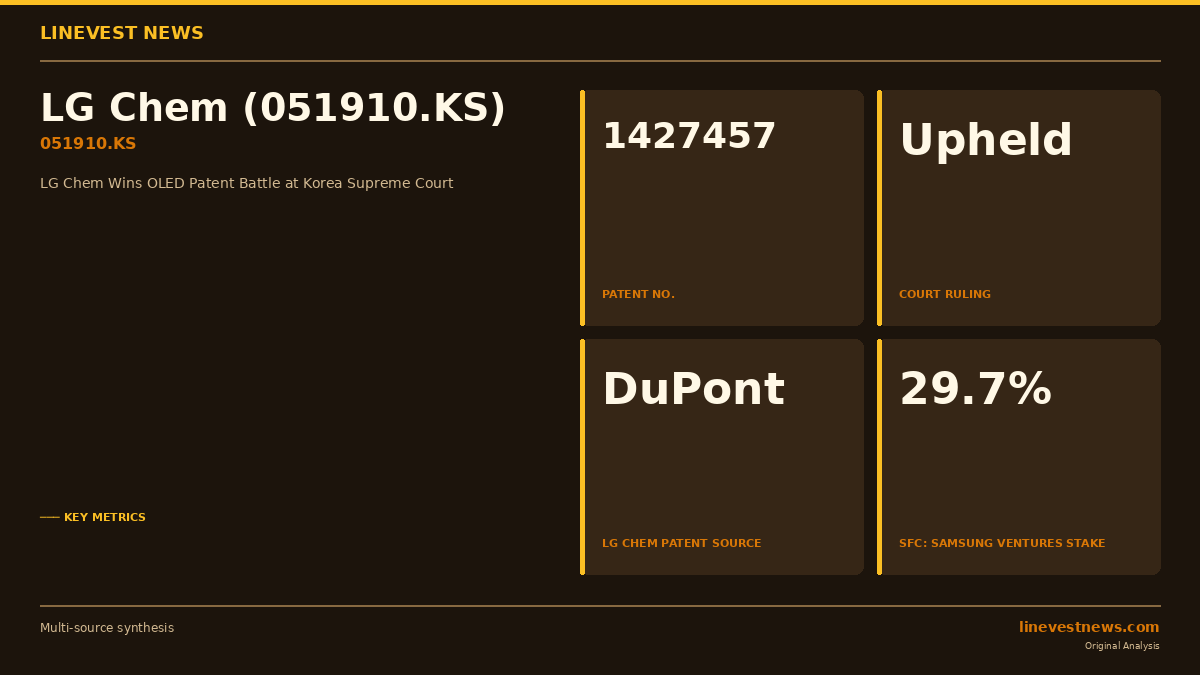
Korea's Supreme Court Division 2 (presiding justice Eom Sang-pil) on May 14, 2026 dismissed a final appeal by SFC (썬화인켐) challenging the validity of LG Chem's Patent No. 1427457, "Deuterated Compounds for Electronic Applications." The ruling was publicly disclosed on July 7.
The patent, which LG Chem acquired from U.S. chemical giant DuPont in 2019, covers deuterium substitution technology in aryl-anthracene compounds used as blue light-emitting materials in organic light-emitting diodes. In practical terms, replacing ordinary hydrogen atoms with deuterium — an isotope that carries one extra neutron — extends OLED device lifetime and improves luminescent efficiency, both critical metrics for smartphone and television display panels.
SFC initiated patent invalidation proceedings at Korea's Intellectual Property Trial and Appeal Board (IPTAB) in 2019, arguing the claims lacked inventive step over prior art. The IPTAB rejected SFC's petition in 2022, finding that the technology was not obvious from combinations of prior disclosures. SFC escalated to the Patent Court, and then to the Supreme Court — losing at each stage. The Supreme Court held that the original ruling on inventive step was legally sound and dismissed the appeal outright.
Part B: Market and Investment Implications
The Samsung Display connection
SFC is far from a neutral actor in this dispute. The company, originally founded in 1998 as Suncheon Fine Chemical, was acquired by Japan's Hodogaya Chemical (52.3% stake) in 2010 and forged a strategic partnership with Samsung Display in 2011. Today, Samsung Ventures — via its SVIC37 technology investment fund — holds 29.7% of SFC's equity. SFC's core products are the blue host and dopant emitter materials that Samsung Display incorporates into its OLED panels, which power the Galaxy smartphone line and premium television sets.
The patent upheld by the Supreme Court directly governs the class of deuterium-modified blue OLED compounds that SFC produces. A final ruling in a parallel civil infringement suit — in which LG Chem is demanding hundreds of billions of KRW in damages plus a full production and sales injunction — will now hinge on the same patent validity standard that the Supreme Court has definitively settled. In short, SFC's exposure has materially increased.
Why blue OLED materials matter
Blue emission is the technical weak link in full-color OLED stacks. Blue organic emitters degrade faster than red and green counterparts, which historically has required more frequent display replacements or workarounds such as area-scaling (making blue sub-pixels larger). Deuterium substitution addresses this decay mechanism at the molecular level: deuterium-carbon bonds have approximately six to ten times greater bond-dissociation energy than protium-carbon bonds, slowing the photochemical degradation that causes color shift and brightness loss. Suppliers that hold defensible deuterium IP are therefore positioned to capture disproportionate margin in a competitive materials market.
LG Chem markets OLED materials through its Advanced Materials business segment, competing globally against Germany's Merck, domestic peer Duksan Neolux (213420.KQ), and SFC itself. The Supreme Court victory reinforces LG Chem's portfolio around the most commercially sensitive part of the OLED stack.
Civil suit: the next milestone
The ongoing civil lawsuit — in which LG Chem seeks an injunction banning SFC from producing and selling the contested materials, inventory destruction, and multi-hundred-billion KRW in compensatory damages — remains pending before Korean courts. Korean civil procedure typically treats a final patent validity ruling as binding precedent for infringement questions; SFC's ability to argue non-infringement now faces a significantly higher threshold.
For Samsung Display, which integrates SFC's blue emitters in its flexible OLED lines, the prospect of a production injunction creates supply chain uncertainty at a pivotal moment. Samsung Display supplies panels to Apple, whose upcoming foldable and next-generation iPhone generations depend on OLED cost competitiveness. Any disruption to the SFC supply relationship — or royalty re-pricing under a licensing agreement — could ripple through display cost structures.
LG Chem's OLED materials strategy
The DuPont acquisition of this patent in 2019 was part of LG Chem's broader push to vertically integrate IP in display materials alongside its existing organic semiconductor research programs. The company has stated publicly that OLED materials represent a high-margin growth avenue as LCD-to-OLED migration accelerates in automotive, wearables, and premium mobile segments. The Supreme Court outcome fortifies that strategy and provides LG Chem with licensing leverage over a domestic competitor that is simultaneously backed by its largest rival in display electronics.
Investors should monitor two near-term catalysts: the civil court's remedies ruling timeline, and any disclosure from Samsung Display regarding alternative blue emitter sourcing arrangements. LG Chem (051910.KS) shares have been under pressure in 2026 due to battery materials margin headwinds; a civil damages award in the hundreds of billions of KRW range would represent a meaningful one-time uplift relative to recent quarterly earnings.
Sources: Chosunbiz · MK Economy