U.S. Solar Manufacturers File Anti-Circumvention Probe Petition Against Hanwha Qcells' Korean Cell Imports
A coalition of U.S.-based solar panel manufacturers has asked the Department of Commerce to investigate whether Hanwha Qcells is evading long-standing anti-dumping duties on Chinese solar products by routing cell production through South Korea, a move that could expose the Korean-owned firm to a fresh round of tariffs even as it ramps up American manufacturing.
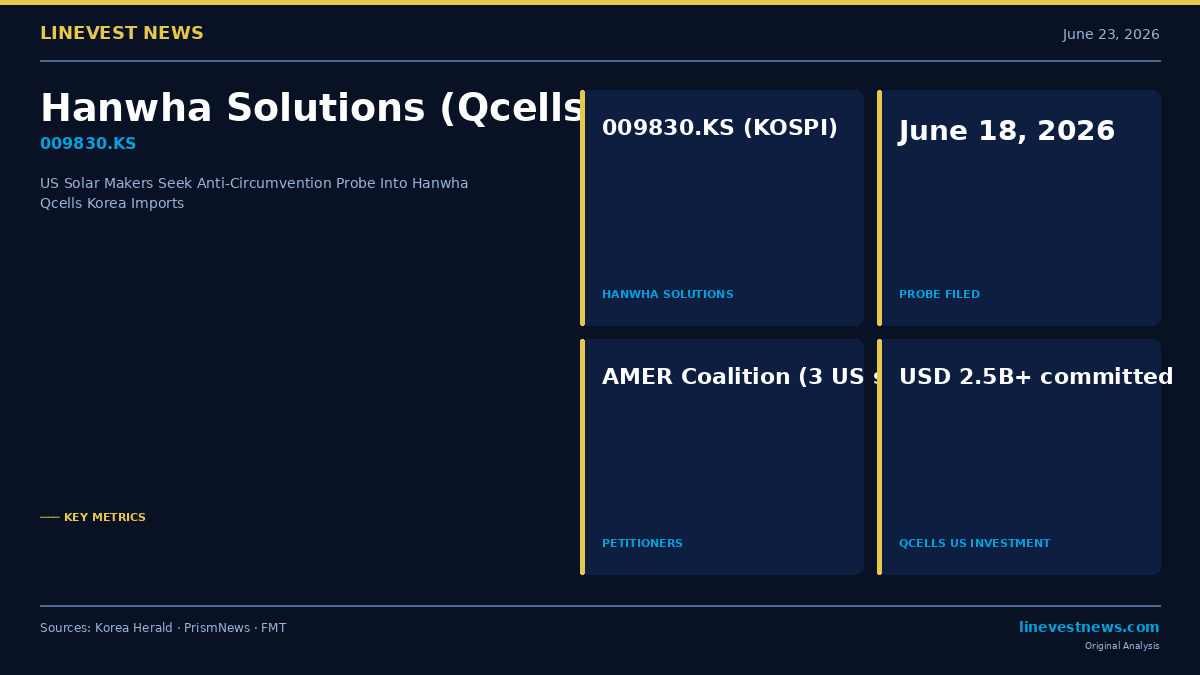
The petition was filed on June 18 by American Manufacturers for Energy Resilience (AMER), a group comprising Canadian Solar, SEG Solar, and Heliene — all of which operate solar panel production facilities on U.S. soil. Under U.S. trade law, the Commerce Department has the authority to extend existing duties to goods processed in third countries if that processing is deemed insufficient to constitute a meaningful transformation from the originally targeted origin.
The Allegation: Korea as a Transit Point for Chinese Tariff Avoidance
AMER contends that Qcells — a subsidiary of South Korea's Hanwha Solutions (009830.KS) — has been importing silicon-based solar cells manufactured in South Korea to supply its U.S. panel assembly operations, in a pattern that effectively sidesteps anti-dumping duties designed to penalize Chinese solar products diverted through third countries.
"Companies like Hanwha Qcells have been allowed to game both sides of U.S. trade law for far too long," an attorney representing the coalition said in a statement accompanying the petition.
Hanwha Qcells pushed back firmly. "We've reviewed this filing and are confident the evidence will show its claims are without merit," the company said. Qcells emphasized its extensive record as an advocate for trade enforcement and its multi-billion-dollar commitment to U.S. solar manufacturing.
Qcells' U.S. Manufacturing Footprint and the Irony of the Probe
Few companies in the solar sector have more visibly championed U.S. manufacturing localization than Hanwha Qcells — which makes the AMER petition particularly pointed in timing and framing.
In 2023, Qcells committed more than USD 2.5 billion to building a fully integrated, silicon-based solar supply chain on U.S. soil, anchored around its facilities in Dalton and Cartersville, Georgia. The Department of Energy followed up in August 2024 with a USD 1.45 billion loan to support Qcells' planned facility north of Atlanta — one of the largest DOE clean-energy lending commitments to a single manufacturing project.
The company has also secured a 12-gigawatt panel supply agreement with Microsoft running through 2032, providing demand visibility that underpins its U.S. capex case. Critically, Qcells only began manufacturing solar cells — not just panels — at its Cartersville facility on June 9, 2026, just nine days before the AMER petition landed at the Commerce Department.
That timing suggests the petitioners see a closing window: if Qcells' U.S. cell production scales to meet domestic panel assembly demand, the grounds for an anti-circumvention finding may narrow. Filing now, before domestic cell output can displace Korean-origin cells, maximizes the prospect of an affirmative determination.
What an Anti-Circumvention Investigation Means
If the Commerce Department agrees to open a formal anti-circumvention inquiry, the process typically takes several months and can result in the extension of existing Chinese anti-dumping and countervailing duties to Korean-origin solar cells used by the named company. An affirmative determination would apply retroactively to imports during the investigation period and would raise per-watt costs on panels assembled with affected cells.
The probe would not automatically impose tariffs; Commerce must first establish that the Korean processing is insufficient to constitute a new country of origin under the applicable merchandise scope, and the International Trade Commission would also weigh in on injury questions.
Hanwha Solutions (009830.KS): What Investors Should Watch
Hanwha Solutions is a Hanwha Group subsidiary that houses both its solar energy operations (via Qcells) and its chemicals and advanced materials businesses. The company's KOSPI-listed shares (009830.KS) have been sensitive to U.S. solar trade policy shifts given Qcells' deep dependence on the American market.
An adverse ruling — while not certain and likely months away — could structurally increase the cost of supplying U.S. panel operations from Korean cells, reduce Qcells' margin buffer during the transition to full U.S. cell self-sufficiency, and add regulatory uncertainty to Hanwha Solutions' already complex capex cycle.
Conversely, if Commerce declines to open a probe or Qcells prevails in the investigation, the company's status as a U.S. manufacturing anchor — backed by federal loan support and a scaled Georgia footprint — would be reaffirmed, potentially strengthening its competitive position against rival filers.
Part B — Broader Context
The Role Reversal: Hanwha Qcells was itself one of the most aggressive petitioners in recent U.S. solar trade enforcement actions. The company previously sought Section 301 probes targeting Chinese and Indian solar products before calling off those requests in April 2026, according to the Korea Times. That reversal, combined with competitors' decision to file the current petition, underscores how rapidly alliances in U.S. solar trade disputes can shift as domestic manufacturing capacity changes.
Korea's Solar Exposure: South Korea's solar cell and panel export sector — while smaller than semiconductors or batteries in revenue terms — has become more exposed to U.S. trade scrutiny as the domestic supply chain argument (companies manufacturing in the U.S. to avoid tariffs) has grown harder to sustain when cell-level production remains offshore. Hanwha Qcells' June 9 Cartersville cell start-up was framed as a strategic milestone; the AMER petition tests whether it came late enough to create legal exposure.
The BIO International and Korea Market Context: Today's Korean market has been dominated by the broader KOSPI sell-off (-9.99%, circuit breaker triggered) driven by semiconductor profit-taking. Hanwha Solutions trades within a broader industrial conglomerate structure, and this trade probe development adds a sector-specific overhang distinct from the macro-driven sell-off shaping the broader index.
Sources: Korea Herald, Prism News, Free Malaysia Today, StrategicNewsGlobal — June 23, 2026