
Analog DevicesADI
About Analog Devices
Analog Devices designs, manufactures and markets high-performance analog, mixed-signal and digital signal processing integrated circuits, sitting at the interface between the physical world and digital computation. Its catalogue spans data converters, amplifiers, power management, radio-frequency and microwave components, interface products and processors, sold across industrial automation, automotive, communications infrastructure and consumer end markets. The industrial segment is the largest revenue contributor and the most profitable, drawing on tens of thousands of long-lived designs sold to a fragmented base of customers at high gross margins. Automotive has become the second pillar, driven by content in battery management, in-cabin connectivity and advanced driver assistance. Communications and consumer round out the mix, with the latter more volatile and tied heavily to a small number of large device makers.
Serious holders track the balance between industrial breadth and consumer concentration, since a handful of smartphone-adjacent customers can swing quarterly revenue disproportionately even though industrial anchors long-run profitability. The stock's cyclicality is that of the broader analog cycle: bookings, lead times and distributor inventory levels are the leading indicators to watch. Capital allocation is a defining feature — management targets returning the great majority of free cash flow to shareholders through a growing dividend and buybacks, alongside a hybrid manufacturing model that blends internal fabs with foundry partners. Governance is conventional for a large-cap semiconductor issuer, with S&P 500 membership drawing substantial passive ownership and index-linked flows.
The company was founded in 1965 in Cambridge, Massachusetts by Ray Stata and Matthew Lorber, initially producing operational amplifiers before expanding into data converters, where it established durable technology leadership. Its modern shape has been forged by acquisition: the purchase of Linear Technology, completed in 2017, roughly doubled the business and deepened its power-management franchise, and the subsequent acquisition of Maxim Integrated, closed in 2021, added further scale in automotive and data centre analog. The corporation is headquartered in Wilmington, Massachusetts and operates as a single integrated public company listed on Nasdaq under the ticker ADI, with design centres and manufacturing sites spread across North America, Europe and Asia.
Revenue flows from selling proprietary chips to original equipment manufacturers and, in large volume, through global electronics distributors that serve the long tail of industrial customers. Contracts are typically short-form purchase orders rather than long fixed commitments, but designs win their way into customer products and can remain in production for a decade or more, creating high switching costs and pricing power once designed in. Competitive position rests on analog design talent, deep process know-how and the breadth of a catalogue that few rivals can match, its principal competitors being Texas Instruments in broad analog and firms such as NXP, Infineon and STMicroelectronics in automotive and industrial power. Sales are geographically diverse, with meaningful exposure to Asia, the Americas and Europe.
Company profile by LineVest editorial. Journalism, not investment advice.
Order a report on Analog Devices — $15Analog Devices coverage
2 articles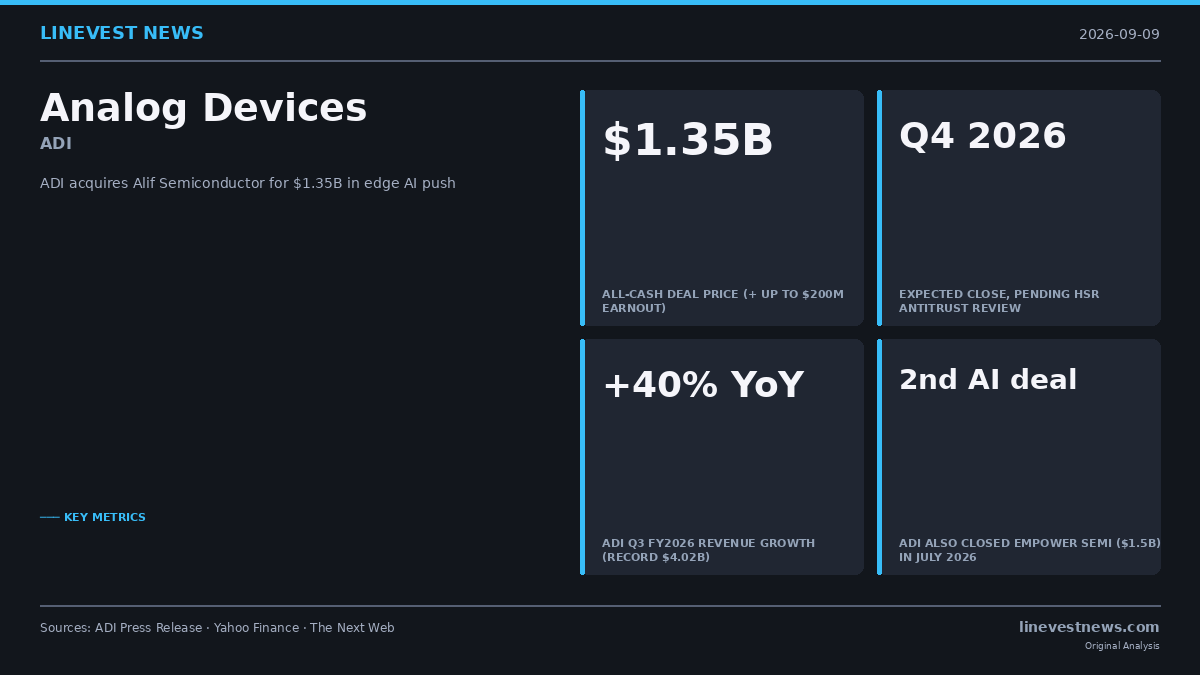
ADI's $1.35 Billion Edge AI Bet: Analog Devices Acquires Alif Semiconductor — Three Watch Points for Investors
ADI agreed to acquire Alif Semiconductor for $1.35 billion on Sept. 9, 2026 — its second AI chip deal this year after Empower Semi. Three watch points for ADI investors.
Analog Devices (ADI) FY26 Q2: Revenue +37% to Record, GAAP EPS +111%, Stock Falls
Analog Devices (NASDAQ: ADI) posted fiscal Q2 2026 (February 1–May 2, 2026) revenue of $3,623.5 million and net income of $1,176.4 million, up +37.2% and +106.5
Go deeper than the headline
You just read what happened. Here's how to read what it means.
The day's reports, every morning — free
LineVest Daily lands in your inbox before the opening bell with the reports we published that day — what each company's latest 10-K or 10-Q actually says about the numbers, in plain English. Free, no card required.
This report, on any company you name
What you just read on Analog Devices is the format. Name any U.S.-listed company and we do the same for it — its latest SEC filing read in full, financials under US GAAP, governance, and what it means for the stock. PDF in your inbox within 3 hours.
Which company should we read?
$15 · one-time · PDF within 3 hours
Pick a company to continueIndependent journalism based on primary SEC filings — not investment advice. No brokerage affiliation.