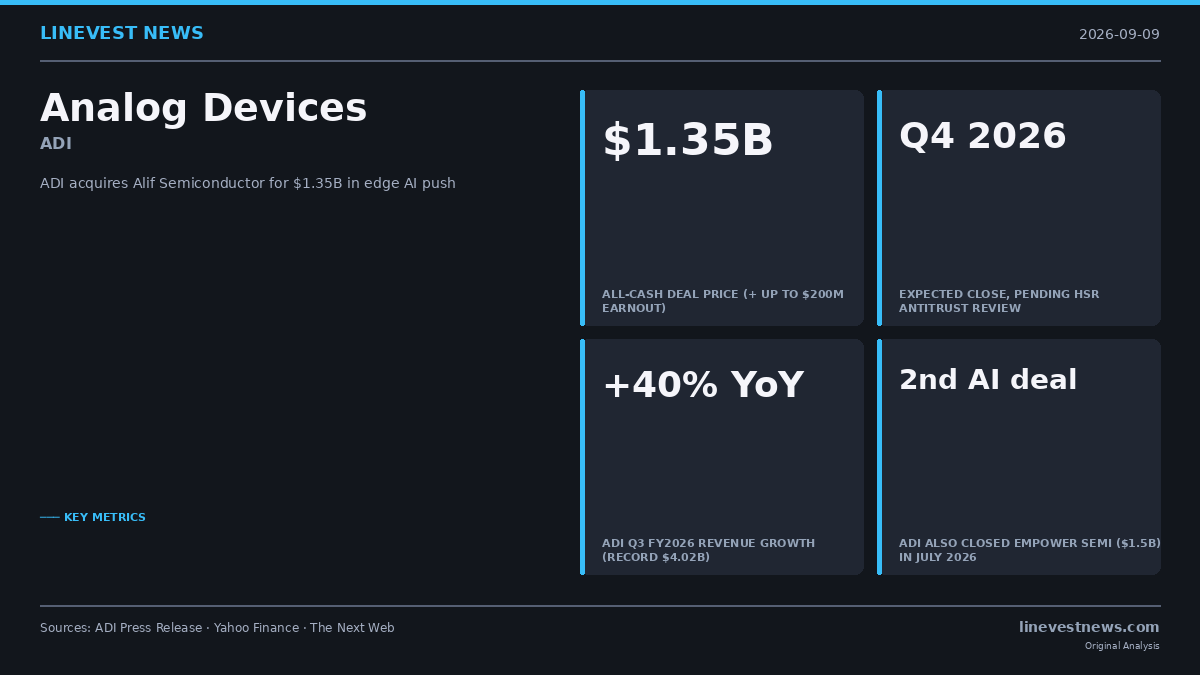
Analog DevicesADI
本公司簡介的中文翻譯準備中。以下為英文原文。
關於Analog Devices
Analog Devices designs, manufactures and markets high-performance analog, mixed-signal and digital signal processing integrated circuits, sitting at the interface between the physical world and digital computation. Its catalogue spans data converters, amplifiers, power management, radio-frequency and microwave components, interface products and processors, sold across industrial automation, automotive, communications infrastructure and consumer end markets. The industrial segment is the largest revenue contributor and the most profitable, drawing on tens of thousands of long-lived designs sold to a fragmented base of customers at high gross margins. Automotive has become the second pillar, driven by content in battery management, in-cabin connectivity and advanced driver assistance. Communications and consumer round out the mix, with the latter more volatile and tied heavily to a small number of large device makers.
Serious holders track the balance between industrial breadth and consumer concentration, since a handful of smartphone-adjacent customers can swing quarterly revenue disproportionately even though industrial anchors long-run profitability. The stock's cyclicality is that of the broader analog cycle: bookings, lead times and distributor inventory levels are the leading indicators to watch. Capital allocation is a defining feature — management targets returning the great majority of free cash flow to shareholders through a growing dividend and buybacks, alongside a hybrid manufacturing model that blends internal fabs with foundry partners. Governance is conventional for a large-cap semiconductor issuer, with S&P 500 membership drawing substantial passive ownership and index-linked flows.
The company was founded in 1965 in Cambridge, Massachusetts by Ray Stata and Matthew Lorber, initially producing operational amplifiers before expanding into data converters, where it established durable technology leadership. Its modern shape has been forged by acquisition: the purchase of Linear Technology, completed in 2017, roughly doubled the business and deepened its power-management franchise, and the subsequent acquisition of Maxim Integrated, closed in 2021, added further scale in automotive and data centre analog. The corporation is headquartered in Wilmington, Massachusetts and operates as a single integrated public company listed on Nasdaq under the ticker ADI, with design centres and manufacturing sites spread across North America, Europe and Asia.
Revenue flows from selling proprietary chips to original equipment manufacturers and, in large volume, through global electronics distributors that serve the long tail of industrial customers. Contracts are typically short-form purchase orders rather than long fixed commitments, but designs win their way into customer products and can remain in production for a decade or more, creating high switching costs and pricing power once designed in. Competitive position rests on analog design talent, deep process know-how and the breadth of a catalogue that few rivals can match, its principal competitors being Texas Instruments in broad analog and firms such as NXP, Infineon and STMicroelectronics in automotive and industrial power. Sales are geographically diverse, with meaningful exposure to Asia, the Americas and Europe.
公司簡介由LineVest編輯部撰寫。屬新聞報導,非投資建議。 委託撰寫Analog Devices的SEC完整報告 →
Analog Devices相關報導
1篇文章深入標題背後
您剛讀到發生了什麼。接下來,讀懂它意味著什麼。
每天早晨的美國市場 — 免費
LineVest Daily在開盤前送達您的信箱:美股關鍵報導、財報、披露與外資流向 — 以簡明英文呈現。免費,無需信用卡。
Analog Devices完整報告
我們完整閱讀Analog Devices的最新SEC披露 — US GAAP財務、公司治理,以及對股價的意義。3小時內PDF送達您的信箱。
$12 · 單次
獲取Analog Devices報告基於SEC原始披露的獨立新聞報導 — 非投資建議。與任何券商無關。