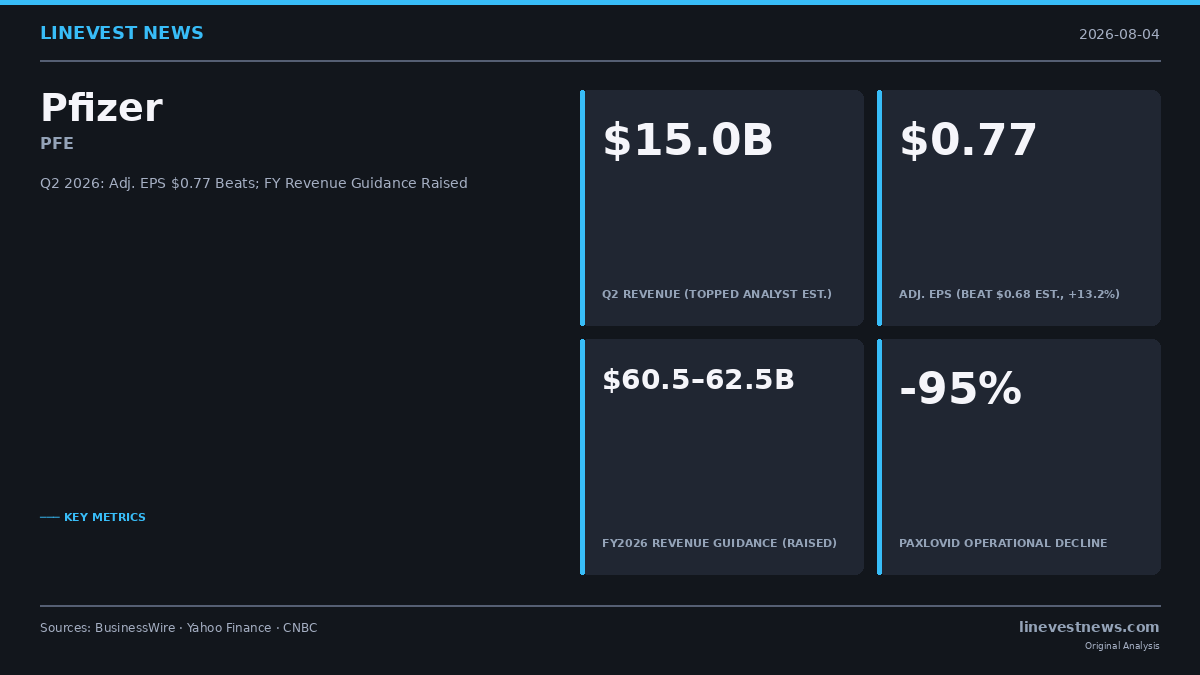
PfizerPFE
本公司簡介的中文翻譯準備中。以下為英文原文。
關於Pfizer
Pfizer Inc. is one of the world's largest research-based biopharmaceutical companies, developing, manufacturing, and marketing prescription medicines and vaccines across a broad set of therapeutic areas. Its portfolio spans oncology, internal medicine, vaccines, inflammation and immunology, rare disease, and anti-infectives, with well-known franchises including the Prevnar pneumococcal vaccine family, the Comirnaty COVID-19 vaccine partnered with BioNTech, the Paxlovid oral antiviral, the Eliquis anticoagulant co-owned with Bristol-Myers Squibb, and a growing oncology stable that expanded materially with the Seagen acquisition. End markets are almost entirely human healthcare, sold through wholesalers, hospital systems, retail pharmacies, and government purchasers. Innovative branded therapeutics — particularly vaccines and oncology — drive the bulk of profit.
Investors track a familiar set of structural questions for a large-cap pharmaceutical: the shape and timing of the patent cliff facing several major products later this decade, the productivity of an R&D pipeline expected to backfill those losses, and the returns being generated on a heavily debt-funded acquisition program. Regulatory exposure runs from FDA approval risk to U.S. drug-pricing reform under the Inflation Reduction Act's Medicare negotiation provisions. Concentration risk sits with government payers, large pharmacy benefit managers, and a handful of wholesaler distributors. Capital allocation weighs a long-standing dividend commitment against deleveraging and continued business-development spending. Governance is conventional for a S&P 500 constituent, with a single-class share structure and broad institutional ownership.
Pfizer traces its founding to 1849, when cousins Charles Pfizer and Charles Erhart opened a fine-chemicals business in Brooklyn, New York, later scaling through wartime penicillin production in the 1940s. The modern company was assembled through a series of large mergers: Warner-Lambert in 2000, Pharmacia in 2003, and Wyeth in 2009, each bringing major franchises and consolidating the industry. Subsequent portfolio reshaping included divesting the animal-health business as Zoetis in 2013, combining the off-patent established-medicines unit with Mylan to form Viatris in 2020, and separating the consumer health joint venture Haleon from GSK in 2022. The 2023 acquisition of Seagen substantially deepened the oncology franchise. It is incorporated in Delaware and headquartered in New York City.
Mechanically, Pfizer earns revenue by selling patent-protected prescription products at negotiated prices to a concentrated set of intermediaries: pharmaceutical wholesalers such as McKesson, Cencora, and Cardinal Health in the United States, alongside national health systems, hospital groups, and government tender programs internationally. Net pricing is shaped heavily by rebates and discounts to pharmacy benefit managers, Medicare and Medicaid, and the 340B program. Competitive position rests on patent life, clinical differentiation, manufacturing scale — particularly in sterile injectables and mRNA — and a global commercial footprint. Principal peers include Merck, Johnson & Johnson, AbbVie, Bristol-Myers Squibb, Eli Lilly, Novartis, Roche, AstraZeneca, and GSK. The United States generates roughly half of revenue, with the remainder spread across Europe, emerging markets, and Asia.
公司簡介由LineVest編輯部撰寫。屬新聞報導,非投資建議。 委託撰寫Pfizer的SEC完整報告 →
Pfizer相關報導
1篇文章深入標題背後
您剛讀到發生了什麼。接下來,讀懂它意味著什麼。
每天早晨的美國市場 — 免費
LineVest Daily在開盤前送達您的信箱:美股關鍵報導、財報、披露與外資流向 — 以簡明英文呈現。免費,無需信用卡。
基於SEC原始披露的獨立新聞報導 — 非投資建議。與任何券商無關。