
PfizerPFE
About Pfizer
Pfizer Inc. is one of the world's largest research-based biopharmaceutical companies, developing, manufacturing, and marketing prescription medicines and vaccines across a broad set of therapeutic areas. Its portfolio spans oncology, internal medicine, vaccines, inflammation and immunology, rare disease, and anti-infectives, with well-known franchises including the Prevnar pneumococcal vaccine family, the Comirnaty COVID-19 vaccine partnered with BioNTech, the Paxlovid oral antiviral, the Eliquis anticoagulant co-owned with Bristol-Myers Squibb, and a growing oncology stable that expanded materially with the Seagen acquisition. End markets are almost entirely human healthcare, sold through wholesalers, hospital systems, retail pharmacies, and government purchasers. Innovative branded therapeutics — particularly vaccines and oncology — drive the bulk of profit.
Investors track a familiar set of structural questions for a large-cap pharmaceutical: the shape and timing of the patent cliff facing several major products later this decade, the productivity of an R&D pipeline expected to backfill those losses, and the returns being generated on a heavily debt-funded acquisition program. Regulatory exposure runs from FDA approval risk to U.S. drug-pricing reform under the Inflation Reduction Act's Medicare negotiation provisions. Concentration risk sits with government payers, large pharmacy benefit managers, and a handful of wholesaler distributors. Capital allocation weighs a long-standing dividend commitment against deleveraging and continued business-development spending. Governance is conventional for a S&P 500 constituent, with a single-class share structure and broad institutional ownership.
Pfizer traces its founding to 1849, when cousins Charles Pfizer and Charles Erhart opened a fine-chemicals business in Brooklyn, New York, later scaling through wartime penicillin production in the 1940s. The modern company was assembled through a series of large mergers: Warner-Lambert in 2000, Pharmacia in 2003, and Wyeth in 2009, each bringing major franchises and consolidating the industry. Subsequent portfolio reshaping included divesting the animal-health business as Zoetis in 2013, combining the off-patent established-medicines unit with Mylan to form Viatris in 2020, and separating the consumer health joint venture Haleon from GSK in 2022. The 2023 acquisition of Seagen substantially deepened the oncology franchise. It is incorporated in Delaware and headquartered in New York City.
Mechanically, Pfizer earns revenue by selling patent-protected prescription products at negotiated prices to a concentrated set of intermediaries: pharmaceutical wholesalers such as McKesson, Cencora, and Cardinal Health in the United States, alongside national health systems, hospital groups, and government tender programs internationally. Net pricing is shaped heavily by rebates and discounts to pharmacy benefit managers, Medicare and Medicaid, and the 340B program. Competitive position rests on patent life, clinical differentiation, manufacturing scale — particularly in sterile injectables and mRNA — and a global commercial footprint. Principal peers include Merck, Johnson & Johnson, AbbVie, Bristol-Myers Squibb, Eli Lilly, Novartis, Roche, AstraZeneca, and GSK. The United States generates roughly half of revenue, with the remainder spread across Europe, emerging markets, and Asia.
Company profile by LineVest editorial. Journalism, not investment advice.
Order a report on Pfizer — $15Pfizer coverage
2 articlesPfizer (PFE) Q2 2026: $4.3B Write-Off Flips Profit to Loss
Pfizer's second-quarter net loss of $248 million is an accounting event, not an operating one. Revenue rose 2.6% to $15,034 million and first-half operating cas
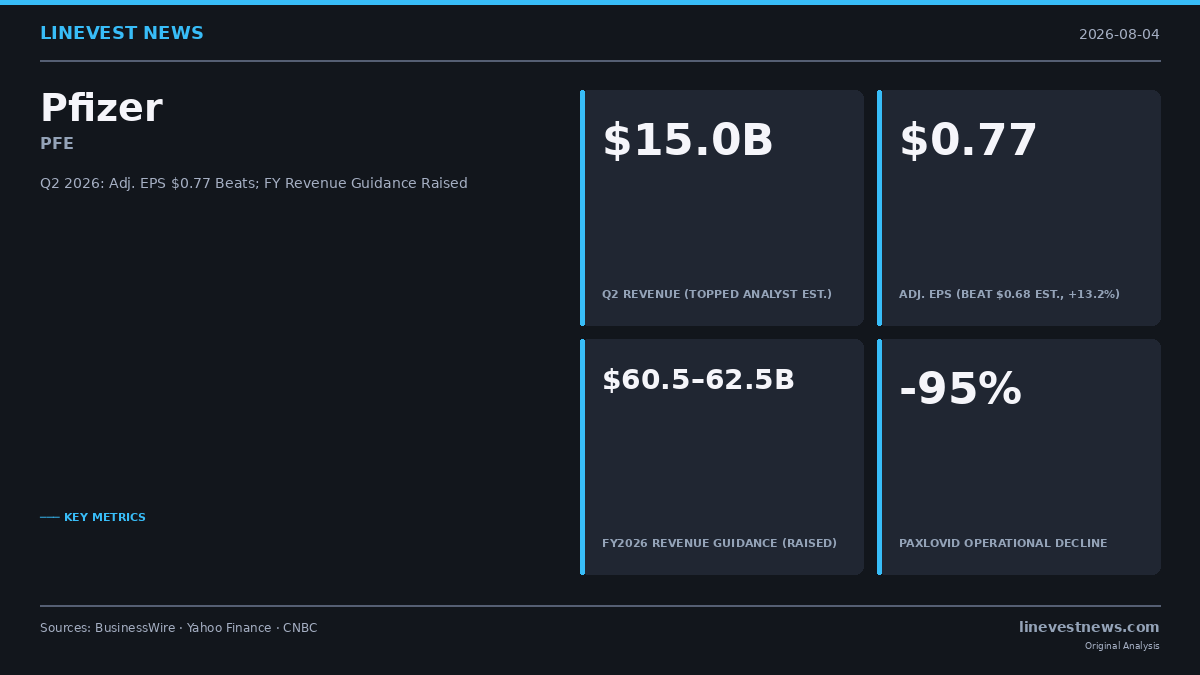
Pfizer (PFE) Q2 2026: Non-COVID Portfolio Beats Estimates as Paxlovid Collapses 95%
Pfizer Q2 2026: adj. EPS $0.77 beat $0.68 est. (+13.2%); revenue $15.0B topped consensus. Eliquis +19%, Padcev +23%. FY2026 revenue guidance raised to $60.5–$62.5B.
Go deeper than the headline
You just read what happened. Here's how to read what it means.
The day's reports, every morning — free
LineVest Daily lands in your inbox before the opening bell with the reports we published that day — what each company's latest 10-K or 10-Q actually says about the numbers, in plain English. Free, no card required.
This report, on any company you name
What you just read on Pfizer is the format. Name any U.S.-listed company and we do the same for it — its latest SEC filing read in full, financials under US GAAP, governance, and what it means for the stock. PDF in your inbox within 3 hours.
Which company should we read?
$15 · one-time · PDF within 3 hours
Pick a company to continueIndependent journalism based on primary SEC filings — not investment advice. No brokerage affiliation.