Emart139480.KS
이 기업 소개의 한국어 번역이 준비 중입니다. 아래는 영어 원문입니다.
Emart 소개
Emart is Korea's largest hypermarket operator and the retail workhorse of the Shinsegae group, running big-box stores, the warehouse club Traders, specialty formats built around its No Brand private label, and the Emart24 convenience chain. Its consolidated reach extends to e-commerce through SSG.com and Gmarket, to food service and hotels, and to a controlling interest in the company that operates Starbucks in Korea. The group shares Samsung founding-family roots, and Emart is led by one sibling of the controlling Chung family while department-store operator Shinsegae is separately listed. Grocery-led store sales remain the cash engine funding the broader portfolio.
Investors approach Emart as a sum of parts under repair: a mature hypermarket core defending against online grocery rivals, e-commerce ventures whose path to profitability shapes group value, and steady contributors like the Starbucks operation. Structural questions include leverage taken on for acquisitions, potential asset sales or listings within the portfolio, and regulation that restricts large-store operating days to protect small merchants. The family division of retail assets between siblings defines the governance map. Domestic consumption is the overriding macro driver.
Emart's story begins inside Shinsegae: the group opened Korea's first discount store under the Emart name in Seoul's Changdong district in 1993, betting that hypermarkets would follow department stores as the country's dominant retail format. The bet paid off, and in 2011 Shinsegae split itself in two, spinning the discount store division off as a separately listed Emart. The new company then expanded on multiple fronts, building the Traders warehouse club format, lifting its stake in Starbucks' Korean operation to a controlling majority in 2021, buying the Gmarket e-commerce platform that same year, and earlier exiting its store network in China.
Hypermarket economics rest on purchasing scale and traffic: Emart buys grocery volume no domestic store rival can match, layers on private labels such as No Brand and Peacock that capture extra margin, and uses fresh food to draw the visits that sell everything else. The consolidated model routes that traffic advantage into adjacent formats, with Traders offering a low-price warehouse alternative, Emart24 pursuing convenience, and SSG.com and Gmarket extending the franchise online, fulfilled partly from store back rooms. Property ownership beneath many stores anchors the balance sheet, while competitive pressure concentrates in online grocery, where dedicated e-commerce players attack the core basket.
기업 프로필은 LineVest 편집부가 작성했습니다. 저널리즘이며 투자 자문이 아닙니다. Emart DART 기반 전체 리포트 의뢰하기 →
Emart 관련 기사
기사 3건
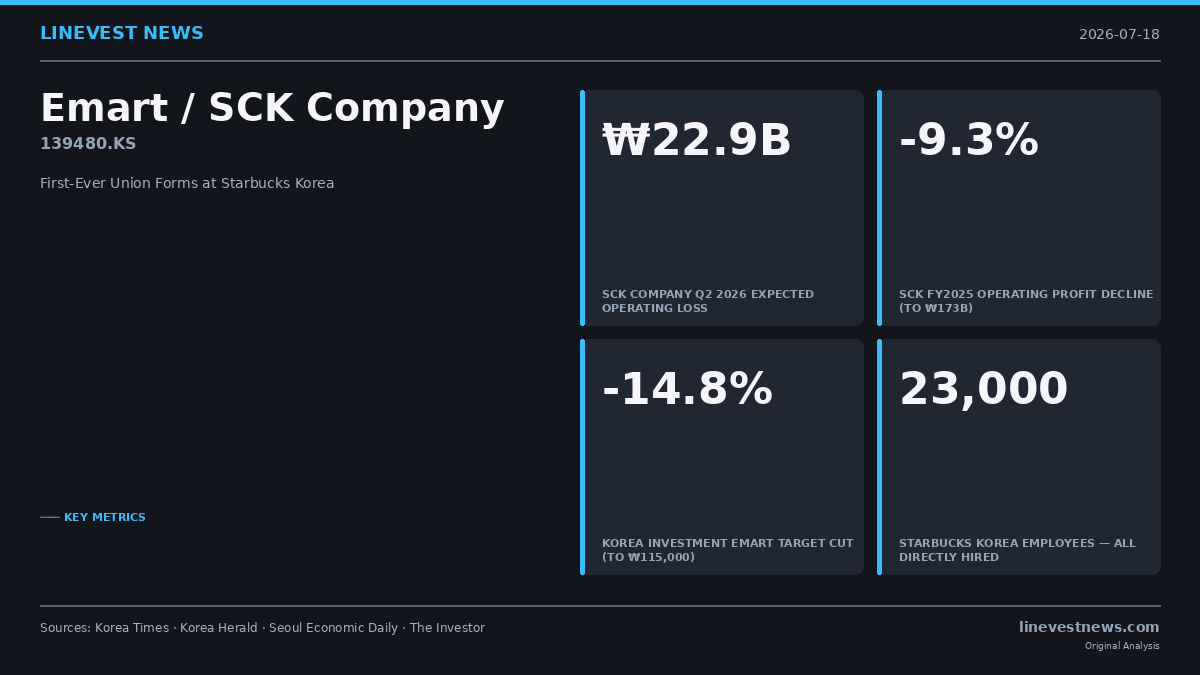
Starbucks Korea's First Union Forms as Q2 Operating Loss Looms — Emart (139480.KS) Faces Compounding Risk
Korea's first coffee-chain union forms at Starbucks Korea as Q2 2026 brings an expected ₩22.9B operating loss — a dual shock for Emart (139480.KS), which owns 67.5% of SCK.
이마트 (139480) Q1 2026: 영업이익 11.9% 개선에도 순이익 뒷걸음 — 지분법·금융비용이 발목
FY2024 대규모 적자에서 벗어난 이마트의 본업은 이번 분기에도 회복 궤도를 지켰다. 2026년 1분기 매출은 7.12조 원으로 전년 동기 대비 1.3% 줄었지만, 판매관리비를 4.2% 덜어내며 연결 영업이익은 1,783억 원으로 11.9% 늘었다. 이 영업이익은 2012년 1분기(1,905억 원) 이후 1분기 기준 14년 만의 최대치로, 국내 유통 부진 속에서 비용 효율화가 만들어낸 성과다. 그러나 순이익은 794억 원으로 오히려 5.0% 감소했다. 회복의 실체가 '본업 체력'이 아니라 '비용 통제'에 기대고 있고, 영업단에서

E-Mart and Lotte Shopping Race to Lock In Homeplus Customers as Korea Hypermarket Shifts to Duopoly
With Homeplus closing 37 stores in June, E-Mart and Lotte Shopping are already posting double-digit nearby-store sales gains. Korea's hypermarket sector is restructuring to a duopoly — and the full benefit has yet to hit Q2 earnings.
자주 묻는 질문
What does Emart do?
Emart is Korea's largest hypermarket chain, selling groceries and general merchandise through big-box stores, the Traders warehouse club, and Emart24 convenience stores. Consolidated operations include the SSG.com and Gmarket e-commerce platforms, the company operating Starbucks in Korea, food service, and hotel interests.
Who controls Emart?
Chung Yong-jin, part of the family that controls the Shinsegae group and a descendant of Samsung's founding family, is the controlling shareholder of Emart. The group's retail assets were divided within the family, with his sibling overseeing the separately listed Shinsegae department store company.
How can foreign investors get exposure to Emart?
Emart lists on the Korea Exchange's KOSPI market under ticker 139480. Foreign investors can purchase shares through brokers providing Korean market access after registering, and the stock appears in Korea retail and large-cap index funds. Its department store counterpart, Shinsegae, trades separately under its own code.
답변은 일반 정보 제공을 위한 편집 요약이며 투자 자문이 아닙니다.
헤드라인 너머를 읽으세요
방금 '무슨 일이 있었는지' 읽으셨습니다. 이제 '그게 무엇을 의미하는지' 읽어보세요.
매일 아침 한국 시장을 — 무료로
LineVest Daily가 서울 개장 전 받은편지함에 도착합니다: KOSPI·KOSDAQ 핵심 스토리, 실적, 공시, 외국인 수급 — 쉬운 영어로. 무료, 카드 등록 불필요.
Emart 전체 리포트
Emart의 최신 DART 공시를 전부 읽고 분석합니다 — K-IFRS 재무, 지배구조, 그리고 주가에 갖는 의미까지. 3시간 이내 PDF로 발송.
$12 · 1회
Emart 리포트 받기시장 전체를 팔로우하세요
매주 여러 한국 종목을 보시나요? 모든 분석 기사를 발행 즉시 읽으세요 — 데일리 KOSPI·KOSDAQ 전체 커버리지와 90일 아카이브까지.
$9.99 · 월
구독하기1차 출처인 DART 공시에 기반한 독립 저널리즘 — 투자 자문이 아닙니다. 어떤 증권사와도 무관합니다.