A new, state-backed competitor lands on Samsung's weakest flank
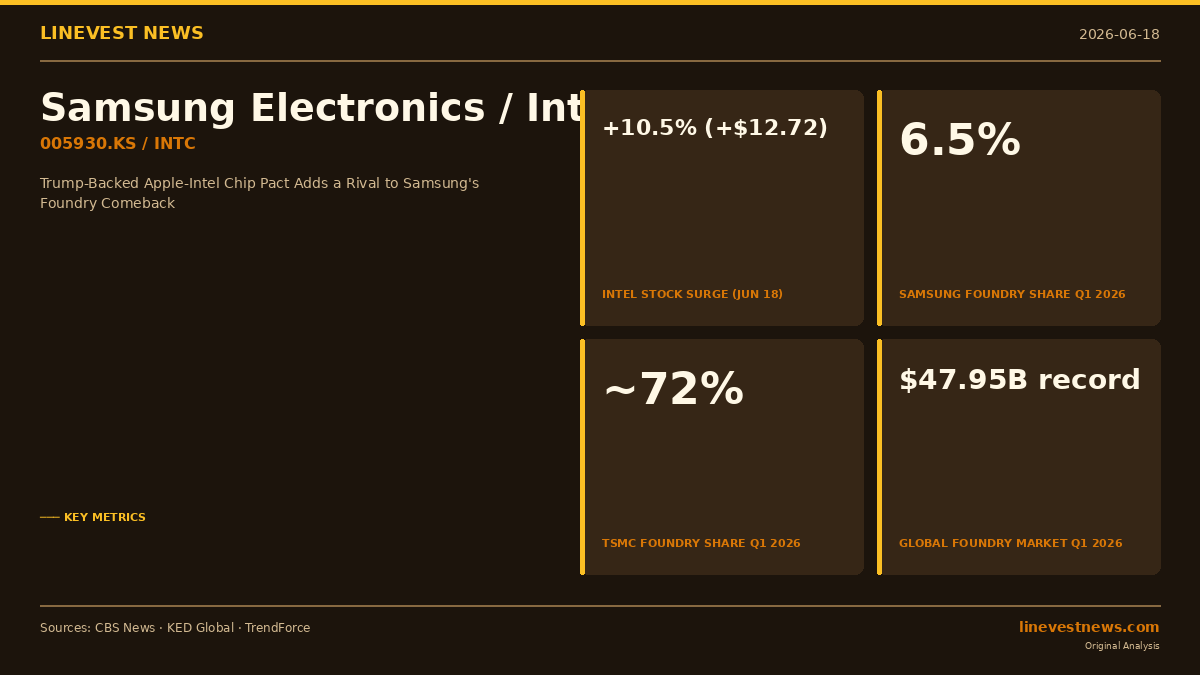
President Donald Trump said on June 18 that Apple has agreed to "design and manufacture chips in the U.S." with Intel, a post on his Truth Social account that sent Intel shares up USD12.72, or 10.5%, to USD133.82 the same day (CBS News). Neither company confirmed the arrangement: Apple did not respond to a request for comment, and Intel said only that it would not comment "about a potential Apple-Intel agreement" (CBS News).
For a Korea-focused investor, the headline is not really about Intel's stock. The question is what an Apple order, blessed by the White House, does to Samsung Electronics (005930.KS), the world's second-largest contract chipmaker, whose foundry division has been trying to claw back share from Taiwan's TSMC. KED Global, the English service of the Korea Economic Daily, framed it bluntly: "Samsung Electronics Co.'s foundry recovery faces a new threat after US President Donald Trump signaled strong White House backing for Intel Corp.'s contract chipmaking ambitions" (KED Global).
## Sizing the threat: Samsung was already a distant No. 2
The foundry market is lopsided. In the first quarter of 2026, TSMC held about 72% of the contract-chip market on roughly USD35.86 billion of revenue, while Samsung sat second at 6.5% share, according to TrendForce data reported by TelecomLead; the world's top 10 foundries booked a record combined USD47.95 billion. By revenue, Samsung's foundry took in about USD3.2 billion in Q1 2026 against TSMC's roughly USD35.8 billion (SammyGuru, citing TrendForce) — a gap of more than ten to one.
Samsung's recovery pitch rests on being the credible "non-TSMC" alternative as customers diversify. It has been winning that argument: Tesla's next-generation A16 chip is to be fabricated exclusively at Samsung's Texas plant, Qualcomm has signed new manufacturing contracts with Samsung, and Samsung Foundry says it has received orders from or is in negotiations with Nvidia, Google, AMD and others as advanced-node demand outstrips TSMC capacity (TechSpot). Samsung is now developing and producing at the 2-nanometer node, with Qualcomm among its 2nm customers, and its Taylor, Texas fab is "springing to life as AI demand surges" (KED Global).
An Apple-Intel pact aims squarely at that pitch. If Intel — already the recipient of a U.S. government equity stake — becomes the politically favored domestic foundry, it competes with Samsung for the same diversification dollars Samsung needs to scale Taylor.
## Why the threat is real but not immediate
Three caveats temper the alarm. First, the deal is unconfirmed by both companies (CBS News). Second, early coverage of the announcement noted Intel is not about to displace TSMC for Apple's most advanced silicon; its near-term role would likely focus on older or lower-end Apple products, with TSMC still leading advanced manufacturing (MacObserver). Third, TSMC, not Samsung, is the share Intel would have to take first.
There is also precedent worth remembering: Apple built its early A-series mobile processors at Samsung before shifting that business to TSMC roughly a decade ago, a reminder that foundry relationships migrate slowly and rarely on a single announcement. Trump's own framing underscored how much of this is political momentum rather than booked orders — he noted Intel's valuation had climbed from about USD100 billion last August to roughly USD600 billion, writing that "America's stake is now over 60 billion dollars" on the government's roughly 10% holding (CBS News).
## SK Hynix sits largely outside the blast radius
The second pillar of Korea's chip complex, SK Hynix (000660.KS), the country's other major memory maker and the leading supplier of high-bandwidth memory, is only indirectly exposed. SK Hynix competes in memory and advanced packaging, not logic foundry; its U.S. build-out centers on a USD3.9 billion Indiana facility for HBM-related production (KED Global). An Apple-Intel logic deal does not touch that demand, which is tied to AI accelerators rather than iPhone or Mac processors. Samsung's chip division (which houses both memory and foundry) reported a record Q4 2025 operating profit of 16.4 trillion won (about USD11.5 billion), driven primarily by AI-fueled memory demand — a memory-side tailwind that an Apple-Intel logic-foundry pact does not directly threaten (Samsung Q4 2025 results).
## What to watch
The thesis confirms or collapses on a few specific signals. First, whether Apple or Intel actually confirms an order — and at which node — rather than leaving Trump's post as the only on-record account. Second, Samsung's next foundry-share print and any update on Taylor's 2nm ramp and customer list, which would show whether the "non-TSMC" narrative is holding. Until an order is signed, the Apple-Intel announcement is a competitive signal for Samsung's foundry strategy, not yet a revenue event.
---
This article is for informational purposes only and does not constitute investment advice. Figures are sourced from the outlets cited inline and were accurate as of publication; the Apple-Intel arrangement had not been confirmed by either company at the time of writing.
Sources
- https://www.cbsnews.com/news/intel-intc-shares-trump-apple-chip-agreement/
- https://www.kedglobal.com/korean-chipmakers/newsView/ked202606190003
- https://telecomlead.com/semiconductor/global-foundry-market-hits-record-47-95-bn-in-q1-2026-as-ai-chip-demand-drives-growth-tsmc-expands-share-to-72-126247
- https://www.techspot.com/news/112800-samsung-foundry-booming-tsmc-struggles-demand-bags-nvidia.html
- https://sammyguru.com/samsung-lags-far-behind-tsmc-in-q1-2026-foundry-market/
- https://www.macobserver.com/news/trump-announces-apple-intel-deal-to-manufacture-chips-in-america/