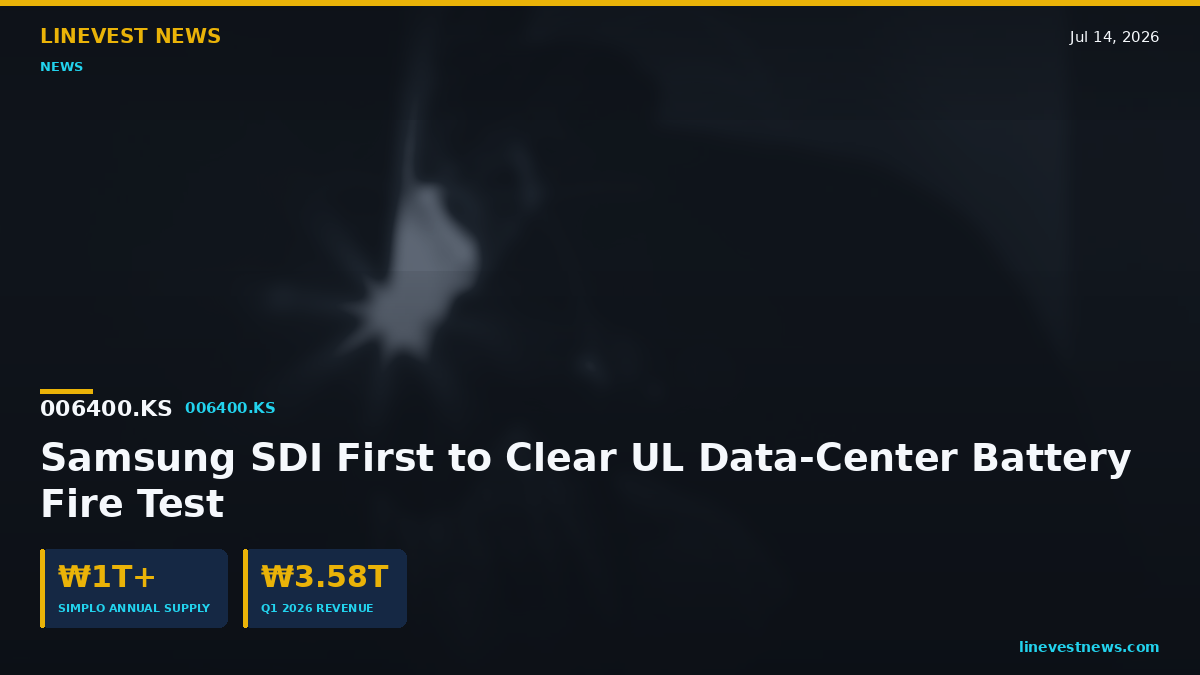
Samsung SDI (006400.KS), the battery arm of the Samsung group and one of Korea's three major lithium-ion cell makers alongside LG Energy Solution and SK On, said on July 14 that its uninterruptible power supply (UPS) battery became the world's first to pass a new indoor fire-safety certification from UL Solutions, the U.S.-based safety-science and certification firm. The milestone concerns the Indoor Large-Scale Fire Test (Indoor LSFT), an assessment UL introduced in 2026 (Korea Herald, Korea Times).
What the test actually proves
A UPS is the bank of backup batteries that keeps servers running through a grid outage — critical infrastructure for AI data centers. In the Indoor LSFT, UL deliberately ignites and forces thermal runaway in a battery module inside a UPS rack, then checks whether the fire jumps to adjacent racks or the wider system. Samsung SDI's module burned out, but there was no fire propagation, no gas release and no explosion, and the blaze self-extinguished without overhead sprinklers activating (Korea Herald). The company attributes the result to lithium manganese oxide (LMO) chemistry, which it says offers high output and thermal stability, packaged in prismatic cells with aluminum casings and gas-venting structures (Korea Herald, Korea Times).
"Meeting the Indoor LSFT requirements validates Samsung SDI's differentiated fire safety technologies," a company official said, adding that the firm will "continue to deliver reliable energy solutions for a wide range of applications, including AI data center energy storage systems" (Korea Times).
Why the certificate matters commercially
Fire-safety credentials are increasingly a procurement gate: hyperscalers and data-center operators want them before awarding contracts (Korea Herald). Samsung SDI already has a foot in that supply chain — a July 6 Tech Times report said it supplies AI data-center battery cells to Taiwan's Simplo, which builds them into rack backup units for U.S. tech firms including Amazon and Meta, with annual volume that could surpass ₩1 trillion (over $730 million). Being first through UL's newest gate is the kind of differentiator that matters when those cells sit inside racks placed indoors, next to servers worth far more than the batteries.
Sizing it against the P&L
The context is a company clawing back toward profitability. In the first quarter of 2026 Samsung SDI reported revenue of ₩3.58 trillion ($2.61 billion) and an operating loss of ₩155.6 billion ($114 million); revenue rose 12.6% year on year while the operating loss narrowed 64.2% (Samsung SDI Q1 2026 results, via samsungsdieurope.com). The battery business alone booked ₩3.35 trillion in revenue and a ₩176.6 billion ($129 million) operating loss, with the company crediting recovering demand across ESS, UPS and battery backup units (BBU) for AI data centers. Management has said it expects to return to profit in 2026 on ESS and premium EV battery orders (Korea JoongAng Daily). A UPS certification that helps convert data-center pipeline into shipped volume feeds directly into that thesis.
The precedent that makes fire tests non-trivial
Korea learned the cost of battery fires the hard way. Between August 2017 and June 2019 at least 23 energy-storage-system fires triggered a national investigation; the government forced roughly 522 systems — about 35% of the market — offline, and a fire-investigation committee delivered its root-cause report in June 2019 (pv-magazine and contemporaneous reporting). That episode set back Korea's ESS industry for years and hard-wired safety verification into how utilities and, now, data centers buy batteries. It is the backdrop against which a "first to pass" claim carries weight.
What to watch next
The certificate is a capability signal, not a booked order. The confirming data points are concrete: Samsung SDI's next quarterly results — whether the promised 2026 swing to profit materializes and how much ESS/UPS revenue accelerates — and any named data-center or hyperscaler UPS contract that cites the Indoor LSFT result. Until then, the test tells the market what Samsung SDI can build, not yet what it has sold.
Sources
This article is journalism, not investment advice. LineVest is not a registered investment adviser. Figures are drawn from the cited sources and Samsung SDI's Q1 2026 disclosures; currency conversions use approximately 1 USD = 1,370 KRW except where a source provided its own figure.