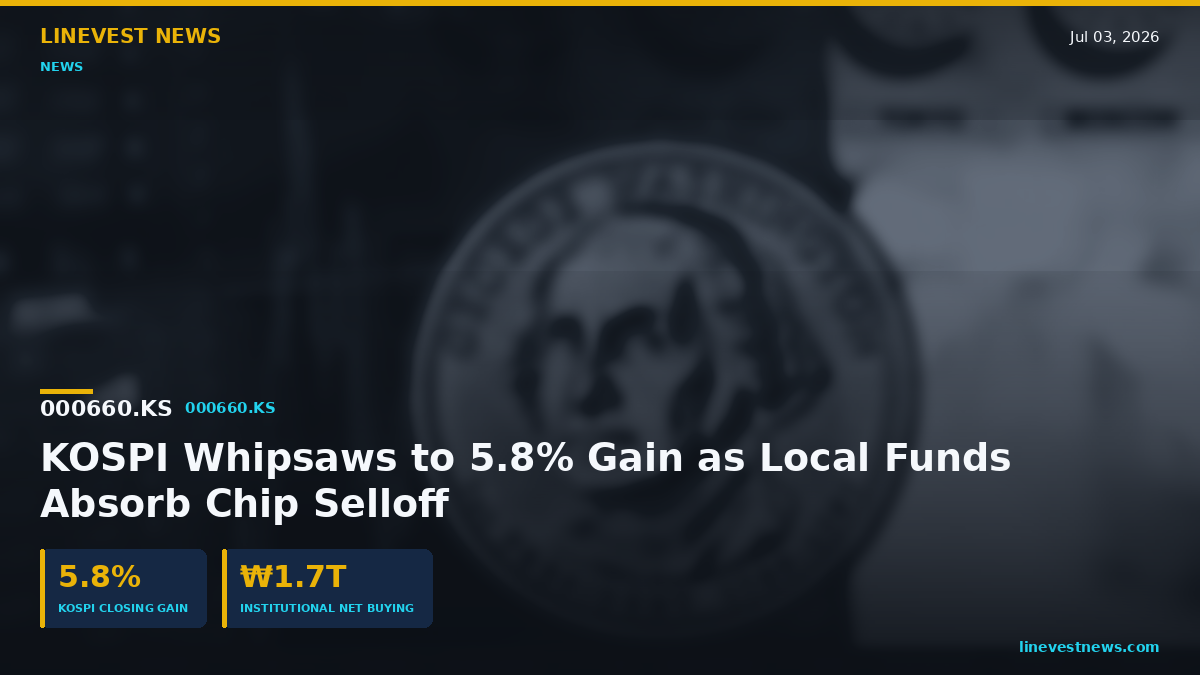
South Korea's benchmark KOSPI index staged one of its wildest sessions of the year on Friday, July 3, swinging from a 3.5% intraday plunge to a sharp "V-shaped" rebound as domestic institutions stepped in front of persistent foreign selling in the country's chip giants.
The index opened at 7,700, fell below 7,400 in early trade, then reversed to clear 7,800; by 11:14 a.m. it stood at 7,769.69, up 121.6 points (1.59%), according to Chosun Biz (the business arm of Korean daily Chosun Ilbo). The rally extended into the close: the KOSPI finished up 5.8% at 8,088.34, with Samsung Electronics (005930.KS, the world's largest memory-chip and smartphone maker) up 8.2% and SK Hynix (000660.KS, the world's second-largest memory maker and lead supplier of high-bandwidth memory to Nvidia) up 10.9%, per Korea Economic Daily (KED Global).
The mechanic: institutions catch the knife
The rebound was almost entirely a domestic-money story. At mid-session, institutions were net buyers of roughly ₩1.6 trillion ($1.17 billion), led by ₩1.2 trillion ($876 million) from the "financial investment" bucket that captures ETF flows, plus ₩160 billion ($117 million) from pension funds, ₩200 billion ($146 million) from investment trusts and ₩49.5 billion ($36 million) from insurers, Chosun Biz reported. On the other side, foreign investors were net sellers of about ₩1.4 trillion ($1.02 billion) and retail investors sold roughly ₩400 billion ($292 million).
Foreign investors remained net sellers on the day — offloading approximately ₩1.3 trillion ($949 million) of Korean shares, broadly in line with the mid-session tally and with domestic institutions absorbing the bulk of it, according to Korea JoongAng Daily. In other words, the record-looking headline gain was built on local funds catching a foreign exit rather than a broad return of global money.
What broke: the AI-memory trade wobbles
The volatility spilled over from Wall Street, where memory and AI-linked chip names sold off overnight. Micron Technology fell 5.49%, Marvell Technology dropped 9.84%, Intel lost 5.25%, AMD slid 4.26% and Broadcom eased 2.41%, per Chosun Biz. The pullback capped a bruising stretch for the sector: independent market coverage (Intellectia) attributed the broader rout to reports that SK Hynix is slowing its HBM (high-bandwidth memory, the chips that feed AI accelerators) capacity expansion, growing skepticism over whether massive AI-infrastructure spending will earn its keep, and a more hawkish U.S. Federal Reserve under new Chair Kevin Warsh.
The episode underscores how concentrated Korea's market has become. Chip stocks now drive roughly half of the KOSPI's value, KED Global noted — meaning a single overnight move in memory prices or AI sentiment can now whip the entire index. That concentration cut the other way on the secondary market: the KOSDAQ (Korea's tech-heavy junior bourse) fell about 3% to the 840 level, with semiconductor-equipment maker Jusung Engineering down 13%, per Chosun Biz.
A split among the retail crowd
Even within the two chip titans, positioning diverged. Maeil Business Newspaper (a leading Korean financial daily) reported that its tracked "top 1%" retail traders were net buyers of SK Hynix on the morning of July 3 while Samsung Electronics topped their net-sell list — a reminder that the market is treating the HBM leader and the broader-line memory maker as distinct bets, not a single trade. At mid-session Samsung had rebounded about 6% to reclaim the ₩300,000 ($219) mark, while SK Hynix rose about 4% toward ₩2.3 million ($1,679), per Chosun Biz.
Context and the open question
This was the third violent session in two weeks. The KOSPI collapsed 9.99% on June 23 — closing at 8,203.84 and triggering a circuit breaker as a global tech selloff and MSCI's Developed Markets watchlist exclusion converged (Bloomberg, Korea Herald) — and dropped 7.89% to close at 7,648 on July 2 — led by Samsung Electronics (-9.06%) and SK Hynix (-14.57%) — before Friday's snap-back (per CNBC and Seoul Economic Daily reporting). Bloomberg framed the July 3 recovery as a bounce "after AI volatility," not a resolution of it.
The unresolved question is whether domestic funds can keep absorbing foreign outflows if global AI-memory sentiment stays fragile. The next concrete test is SK Hynix's second-quarter earnings and any explicit HBM capacity guidance; a confirmation that expansion is being paced down would validate the bears, while a reaffirmed build-out would undercut the thesis behind the sell-off. Continued foreign flow data in the days ahead will show whether Friday's local-money rescue was a one-off or the start of a durable floor.
This article is for informational purposes only and does not constitute investment advice. Figures reflect intraday and closing data reported on July 3, 2026; currency conversions use an approximate rate of 1 USD = 1,370 KRW and are indicative only.
Sources: Chosun Biz · MK Economy · KED Global · Bloomberg · Korea JoongAng Daily · CNBC