TL;DR
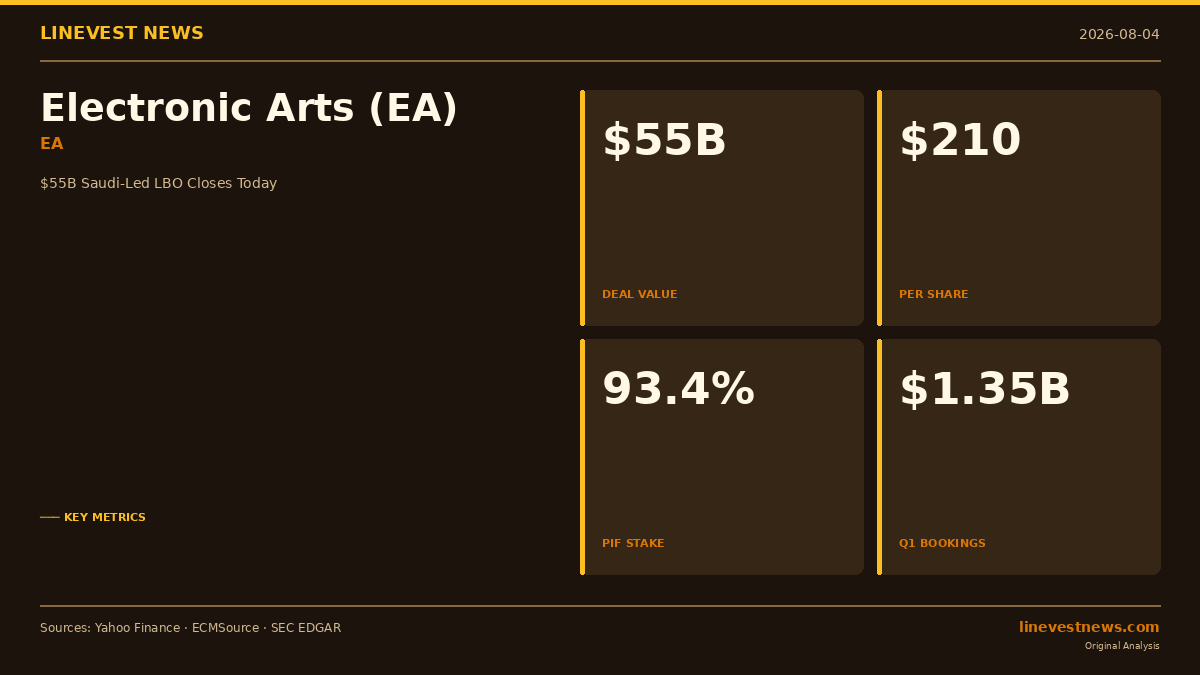
- EA's USD55B go-private deal with Saudi Arabia's PIF closes at market close today (August 4, 2026) — the largest leveraged buyout in corporate history
- USD210 per share all-cash acquisition; PIF holds 93.4% of the buying consortium alongside Silver Lake (5.5%) and Affinity Partners (1.1%)
- Q1 FY2027 net bookings of USD1.35B missed the USD1.48B analyst consensus by 8.8%
- Net profit surged 98% year-over-year to USD397M, aided by a weak prior-year base
- Battlefield 6 post-launch engagement declines flagged; Grand Theft Auto VI looms as a competitive headwind
- EA stock delists from Nasdaq after 37 years as a public company; CEO Andrew Wilson stays on
Part A: The Deal and the Financials
Closing Day: A Historic Exit from Public Markets
Electronic Arts (Nasdaq: EA) ceases to be a publicly traded company on August 4, 2026. At the close of trading today, EA shareholders will receive USD210 per share in cash — the culmination of a USD55 billion buyout announced September 29, 2025 and led by Saudi Arabia's Public Investment Fund (PIF).
The transaction eclipses the 2016 Dell-EMC deal (approximately USD44B) to become the largest leveraged buyout in corporate history. EA's 37-year tenure on public markets — the company has traded on Nasdaq since 1989 — ends with a definitive exit rather than a restructuring or bankruptcy, a testament to the franchise value its gaming portfolio still commands even as the business faces structural headwinds.
| Deal Parameter | Value |
|---|---|
| Enterprise Value | USD55 billion |
| Equity Value | ~USD52.5 billion |
| Price per Share | USD210 (all-cash) |
| Total Equity Contribution | ~USD36 billion |
| Debt Package | USD20+ billion |
| Lead Debt Arranger | JPMorgan Chase |
| High-Yield Bonds (HY) | ~USD8 billion |
| PIF Consortium Share | 93.4% |
| Silver Lake Share | 5.5% |
| Affinity Partners Share | 1.1% |
| Announced | September 29, 2025 |
| EU Clearance | July 23, 2026 |
| Close Date | August 4, 2026 |
Financing Structure
The deal's USD20B+ debt package is arranged primarily by JPMorgan Chase, which committed USD20B at announcement with USD18B expected to fund at close. Approximately USD8B was issued as high-yield bonds marketed in March 2026, with the remainder structured as term loans syndicated among more than 12 additional bank lenders. Leverage is reported to sit below the 7x–8x EBITDA range — a deliberately conservative posture given EA's cash-generative franchise base and the total equity contribution of roughly USD36B from the three consortium partners.
Q1 FY2027: Last Quarter Under Public Scrutiny
EA reported its final quarterly results before going private alongside the closing announcement. The headline figure was a bookings miss: net bookings came in at USD1.35 billion against analyst expectations of USD1.48 billion, an 8.8% shortfall. Management cited a post-launch decline in engagement for Battlefield 6 as the primary driver — the franchise generated strong initial sales but failed to sustain the in-game spending cadence necessary to drive recurring revenue through EA's live-service model.
Net profit, by contrast, surged 98% year-over-year to USD397 million, compared with USD201 million in Q1 FY2026. The expansion reflects both cost discipline implemented ahead of privatization and a favorable year-over-year comparison to a particularly weak prior-year quarter.
| Q1 FY2027 Metric | Reported | Estimate / Prior Year |
|---|---|---|
| Net Bookings | USD1.35B | USD1.48B estimate (miss -8.8%) |
| Net Profit | USD397M | USD201M Q1 FY2026 (+98% YoY) |
Note: EA did not host a Q1 FY2027 earnings conference call, given the pending transaction.
Part B: Strategic Implications and What Investors Should Know
Largest LBO Ever — What It Signals
The USD55B deal marks more than a gaming M&A transaction. It is a signal that sovereign wealth funds — particularly Gulf-state funds like PIF — have reached the scale and confidence to execute direct buyouts of Nasdaq-listed companies in strategic sectors. PIF's gaming portfolio, managed through Savvy Games Group, already includes equity stakes in Nintendo, Activision Blizzard (pre-Microsoft close), Take-Two Interactive, and Capcom. EA is the first major gaming company PIF has taken fully private.
For Saudi Vision 2030, gaming is not a passive investment category. The kingdom aspires to host global esports events, build domestic gaming studios, and establish itself as a regional content hub. EA's IP — EA Sports FC (formerly FIFA), Madden NFL, The Sims, Apex Legends, Battlefield — gives PIF direct ownership over franchises played by hundreds of millions of users globally, a soft-power asset that money alone cannot quickly replicate.
The Debt Load: A Risk Investors No Longer See
Once EA goes private, quarterly transparency disappears. The USD20B debt package and its associated interest burden will no longer appear in public SEC filings. For credit markets, this is a known risk — high-yield buyers priced the bonds with this in mind. For the broader market, the elimination of EA from public indices removes one of the largest US gaming companies from benchmark tracking, with near-term implications for gaming ETFs and sector indices.
The Battlefield 6 bookings miss is the immediate test of the leverage thesis. If live-service engagement recovers in Q2 and Q3 FY2027, the free cash flow needed to service the debt should be achievable. If the franchise fails to regain momentum — especially against a GTA VI release — debt service coverage could tighten, creating refinancing risk when bond maturities arrive.
The GTA VI Overhang
Grand Theft Auto VI, Take-Two Interactive's flagship title, is widely anticipated as the dominant gaming event of the next 12–18 months. When it launches, it is expected to absorb significant consumer spending across the 18–35 male demographic — the same audience EA targets with Battlefield, Apex Legends, and EA Sports FC. GTA VI's release has historically compressed engagement and revenue at competing studios, and EA's management will have no public forum to address investor concerns about the impact.
Post-Private EA: What Changes
Private ownership offers EA's management a structurally different operating environment:
- No quarterly earnings pressure: Management can invest in multi-year development cycles without defending every quarter's bookings figure to equity analysts or index funds.
- Faster capital allocation: Acquisitions, studio investments, and platform pivots can move at deal speed rather than at a pace constrained by public shareholder approval.
- PIF's regional network: Savvy Games Group relationships across the Middle East's fast-growing gaming market — one of the world's highest per-capita gaming spending regions — could open content distribution and co-development opportunities not available to a standalone public company.
Against these advantages, the USD20B debt service obligation constrains financial flexibility in ways that a debt-free public company does not face. EA's private owners will need Battlefield, EA Sports FC, and Apex Legends to perform consistently to maintain the cash generation required.
Investor Takeaways
For shareholders who held EA through the 10-month merger process from announcement (September 29, 2025) to close (August 4, 2026), the USD210 per share represents a clean exit at a defined premium. The stock had traded well below USD210 in the months before the announcement, meaning long-term holders received meaningful value crystallization.
For observers of the broader US market, the EA transaction underscores three durable trends: (1) sovereign wealth funds are now direct acquirers of US strategic assets, not passive LP investors; (2) gaming sector M&A consolidation has entered a private-equity phase following the strategic consolidation wave (Microsoft-Activision, Sony-Bungie); and (3) live-service revenue durability — the ability to keep players engaged and spending long after launch — is the single most critical valuation variable for gaming companies in the current capital cycle.
This article is for informational purposes only and does not constitute investment advice.
Sources: Yahoo Finance, ECMSource, Kotaku, PC Gamer, Mergersight, Shacknews, Screen Rant