Samsung Pulls Forward Yongin Chip Hub's First Fab to 2029, Racing to Meet AI Demand
TL;DR - Samsung Electronics is accelerating its first Yongin fab opening to 2029, one to two years ahead of the original schedule - The Yongin National Industrial Complex will host six semiconductor fabs, part of a combined ₩2,030 trillion ($1.35 trillion) investment alongside Pyeongtaek - An additional ₩400 trillion has been committed for two new chip plants in Gwangju, 270 km south of Seoul - Site preparation must begin by H2 2026 and fab construction by 2027 to meet the 2029 target - The government is expediting complex development, with President-chaired "Mega-Project" review held July 6; a 3GW LNG power plant to support the cluster is also being fast-tracked
Part A: Accelerated Timeline and Cluster Overview
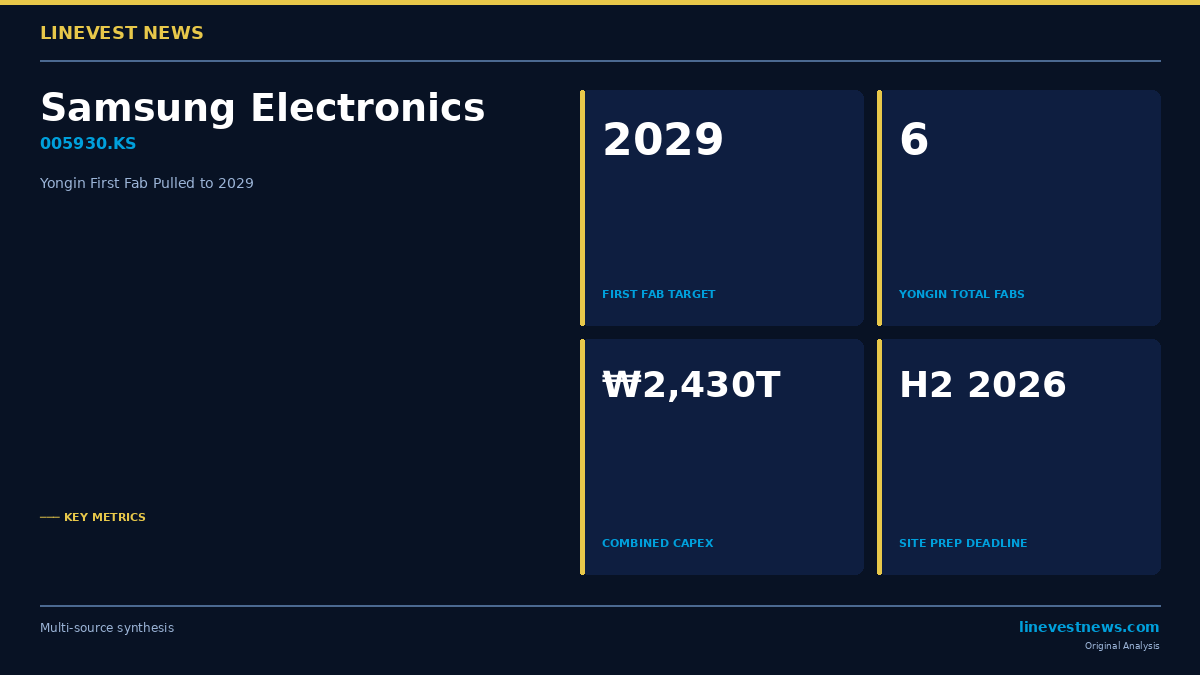
Samsung Electronics is moving to bring forward the opening of the first fabrication plant at its Yongin Advanced System Semiconductor Cluster to 2029, according to industry sources cited by Korea Times and Chosunbiz on July 12. The revised target is one to two years earlier than the company's previously disclosed schedule.
The Yongin complex, designated a national strategic industrial complex by the Korean government, is planned to eventually host six semiconductor fabrication plants. The cluster serves as Samsung's next-generation manufacturing hub and sits at the center of South Korea's broader "Mega-Project" semiconductor industrial policy.
The acceleration comes with strict timeline requirements. Industry officials say site preparation work must commence no later than the second half of 2026, with actual fab construction beginning by 2027 to achieve a 2029 operational start. The government, which on July 6 hosted a presidential-chaired joint public-private review meeting focused on mega-projects, has signaled it is expediting land development and infrastructure permitting.
Capital Commitment at Scale
| Cluster | Location | Total Investment | Fabs |
|---|---|---|---|
| Pyeongtaek + Yongin | Gyeonggi Province | ₩2,030T (~$1.35T) | Multiple |
| Gwangju (new) | South Jeolla | ₩400T | 2 fabs |
The combined capex commitment — ₩2,430 trillion across all sites — represents one of the largest single-company semiconductor infrastructure pledges in history.
Part B: Market Impact and Investor Analysis
AI Demand Dictates the Pace
Samsung's rationale is straightforward. An industry official cited by the Korea Times stated that "an earlier start of operations at the first plant will enable Samsung to respond more quickly to rapidly growing global demand for artificial intelligence chips." With AI accelerators now consuming HBM and advanced logic at record rates — Samsung's Q2 2026 operating profit reached ₩89.4 trillion, fueled by AI memory demand — the company is choosing to compress its capex timeline rather than wait for market clarity.
The acceleration mirrors a broader industry pattern. TSMC has similarly fast-tracked advanced-node capacity in Arizona and Kumamoto in response to AI customer pull. For Samsung, maintaining fab density relative to TSMC matters not only for market share but for process learning curves in 2nm and 1.4nm logic nodes.
Policy Alignment: The Government as Accelerant
The July 6 presidential mega-project review underscores that South Korea is treating semiconductor infrastructure as national economic security. The government has pledged to streamline environmental approvals and utility connections — including a 3GW LNG power plant specifically earmarked to supply the Yongin cluster.
This public-private coordination reduces Samsung's execution risk on two fronts: land clearance and power supply. Both have historically been bottlenecks for greenfield semiconductor fabs in South Korea.
Supplier and Adjacent-Sector Beneficiaries
The accelerated construction timeline has near-term implications for Samsung's upstream supply chain:
- Semiconductor equipment: Applied Materials, Lam Research, ASML and local players (Jusung Engineering 036890.KS, Wonik IPS 240810.KQ) typically receive equipment orders 18–24 months before fab production start. A 2027 fab-construction start implies purchase orders could begin entering the pipeline by H1 2026.
- Construction/EPC: SK Ecoplant, GS건설 (006360.KS), and POSCO E&C are among the contractors typically involved in large semiconductor complex builds.
- Materials: Silicon wafers, ultra-pure chemicals, and specialty gases. Hansol Chemical (014680.KS) and OCI (010060.KS) benefit from any domestic-first sourcing preference.
Risks: Execution, Demand Timing, and Power
Three risks warrant investor attention.
First, Samsung's foundry business remains under competitive pressure. TSMC holds an estimated 60%+ advanced logic market share, and Samsung has faced yield challenges on its 3nm gate-all-around process. Capital committed to Yongin is only value-accretive if Samsung can win and execute advanced-node orders — which requires improving customer confidence in yield.
Second, demand timing. AI chip demand is currently robust, but semiconductor cycles are notoriously difficult to forecast three to five years out. Samsung's leadership acknowledges this by framing the acceleration as a response to current demand, not a guarantee of future revenue.
Third, power infrastructure. The 3GW LNG plant is in planning, not execution. Delays in power delivery could force Samsung to sequence fab starts more conservatively than the 2029 target implies.
Balance Sheet Capacity
Samsung entered 2026 with a net cash position after several years of capital returns. Operating profit in Q2 2026 alone reached ₩89.4 trillion, providing substantial internal funding capacity. The company does not need external financing to fund the Yongin acceleration — but sustaining the capex program across six fabs over a decade will require consistent cash generation from its AI memory and logic businesses.
Investment Perspective
The Yongin timeline acceleration is a positive signal that Samsung's management is choosing offense over caution, betting that AI infrastructure investment will remain robust through 2029. For investors in Samsung Electronics (005930.KS), the near-term implication is confirmation of elevated capex — tempering free cash flow in the 2026–2028 window — in exchange for production capacity that management believes will be needed by late decade.
For Korea's semiconductor ecosystem more broadly, a 2029 first-fab target at Yongin reinforces South Korea's positioning as an advanced-node manufacturing hub, competitive with Taiwan and the U.S. CHIPS Act-supported facilities now under construction.
This article is for informational purposes only and does not constitute investment advice. LineVest News is an independent publication and is not a registered investment adviser.
Sources: Korea Times · Chosunbiz