KakaoBank Signs Strategic Stake in Mongolia's M Bank to Export AI Credit Model
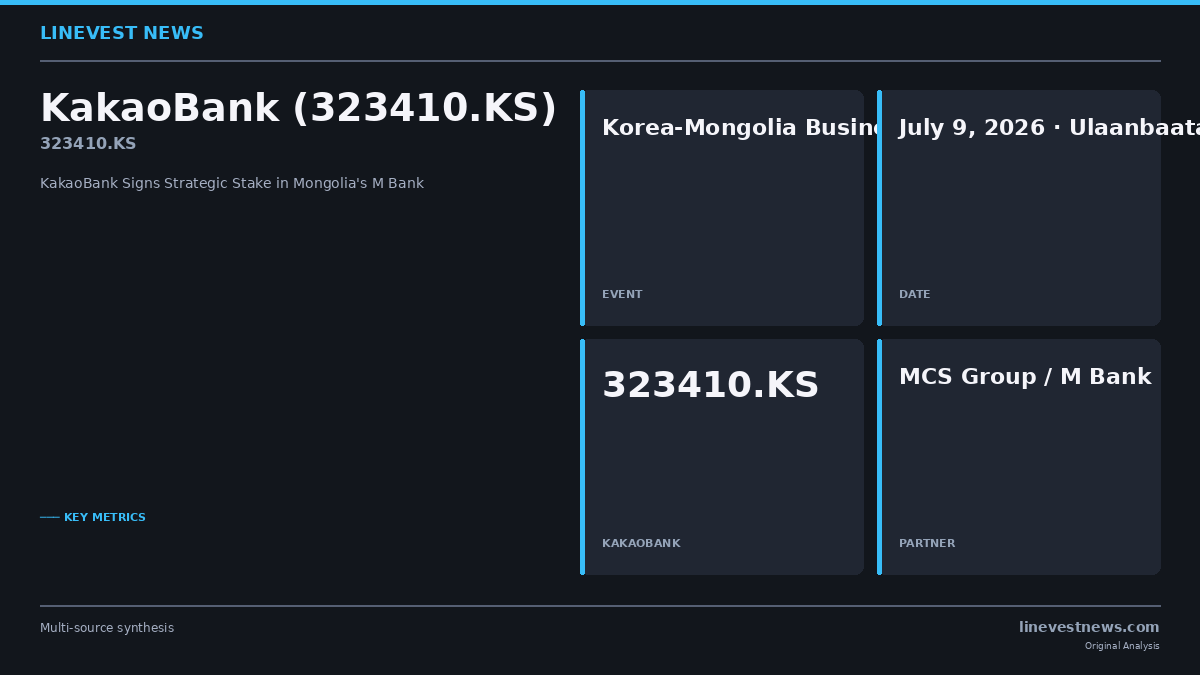
South Korea's largest digital-only bank, KakaoBank (323410.KS), announced a strategic equity investment in Mongolia's MCS Group and its digital banking subsidiary M Bank on July 9, 2026, at the Korea-Mongolia Business Forum in Ulaanbaatar. The agreement — reached while CEO Yoon Ho-young joined South Korea's presidential economic delegation — marks the first overseas equity stake in the eight-year-old bank's history and signals an ambitious push to monetize its AI-driven credit infrastructure beyond its home market.
The investment is expected to close within 2026, pending final contractual procedures. No financial terms were disclosed.
Part A — What Was Agreed
The forum and the principals. President Yoon Suk-yeol's economic delegation included a broad cross-section of Korean corporate leaders. Yoon Ho-young used the platform to present KakaoBank's model for compressing the time, cost, and credit barriers of retail finance through technology. The bank's showcase centered on two capabilities: its proprietary alternative credit-scoring model — built from transaction-behavior and repayment data rather than traditional bureau scores — and its AI-powered financial inclusion programs that have extended credit to Korea's underserved borrower segments since 2017.
MCS Group and M Bank. MCS Group is Mongolia's largest privately held conglomerate, with holdings spanning retail distribution, financial services, logistics, and natural resources. M Bank functions as its digital banking arm and is one of Mongolia's fastest-growing financial institutions by mobile user count.
Four cooperation pillars. The agreement covers: 1. Alternative credit evaluation model development — transferring KakaoBank's AI scoring methodology for use in Mongolia's credit environment 2. Joint product and service design — co-developing deposit, loan, and payment products suited to Mongolian consumers 3. Credit assessment system upgrades — technical integration to enhance M Bank's underwriting capabilities 4. Global digital banking network — a longer-term framework that positions M Bank as a potential node in KakaoBank's future multinational ecosystem
Part B — Korean Market Implications
Why Mongolia, and Why Now?
Yoon described Mongolia as "a market with very high AI finance growth potential, given its young demographic structure and excellent digital infrastructure." The characterization is accurate on both counts.
Mongolia's median age is approximately 29, one of Asia's youngest populations. Smartphone penetration exceeds 80%, and the country has invested heavily in 4G and 5G rural rollout, partly to support its nomadic population. Yet formal credit access remains structurally limited: banks depend heavily on collateral-based underwriting, leaving large segments of young urban consumers and rural herders effectively credit-invisible.
That gap is precisely the white space that KakaoBank's alternative scoring engine was designed to fill. The model — trained on thousands of behavioral and transactional signals rather than credit-bureau history — has enabled KakaoBank to extend loans to borrowers who would otherwise be declined by conventional banks. In Korea, this translated into a loan book weighted toward self-employed, gig-economy, and thin-file borrowers. In Mongolia, the same logic applies at a market-wide level.
The Domestic Earnings Backdrop
KakaoBank is navigating a familiar challenge for Korean deposit banks: compressed net interest margins as the Bank of Korea has moved through a rate-cutting cycle since late 2024. When domestic spread income narrows, the strategic value of non-interest revenue streams — technology licensing, fintech services fees, equity stakes in fast-growing offshore entities — rises materially.
The Mongolia deal offers three potential return streams: equity appreciation as M Bank grows its user base, recurring technology licensing and system-maintenance fees, and data insights from a distinct credit environment that can improve KakaoBank's global model generalizability. None of these earnings are material in 2026, but they are additive to a cost-light P&L that already runs among the highest return-on-equity ratios in Korean banking.
International Expansion: Proof-of-Concept or Platform?
Korea's big-four banks (KB Financial 105560.KS, Shinhan 055550.KS, Hana 086790.KS, Woori 316140.KS) have pursued overseas retail banking for decades, mostly through branch acquisitions in Southeast Asia and the United States. KakaoBank's approach is structurally different: rather than setting up a deposit-taking subsidiary abroad, it exports its credit infrastructure through an equity stake in a local partner that already holds the banking license, the customer base, and the local regulatory relationships.
This asset-light model has three advantages. It requires far less upfront capital than a greenfield or acquisition entry. It avoids the local-management complexity and regulatory risk of operating a foreign bank directly. And it creates a replicable template that can be applied in Vietnam, Indonesia, Kazakhstan, or other markets where a digitally agile local partner can deploy KakaoBank's technology at speed.
For KakaoBank's investor base, the Mongolia move is best read as the first documented test of this template. If M Bank improves its credit approval rate and loan performance within 12–18 months of deploying the alternative scoring model, the proof-of-concept will open the door to more substantial partnerships in larger markets.
Competitive Signal to the Korean Banking Sector
The deal reinforces the competitive asymmetry between digital-native banks and legacy lenders. KakaoBank's AI credit engine can be exported as software — it does not require shipping ATMs, training branch staff, or navigating host-country real-estate markets. For KB Financial or Shinhan, replicating this model abroad means rebuilding core-banking stacks that were designed for a pre-mobile era.
That asymmetry is most visible in the talent market: KakaoBank recruits AI and data-science engineers; traditional banks recruit compliance and relationship managers. As more emerging markets seek not just capital but credit technology, KakaoBank's positioning as a B2B fintech exporter — in addition to a domestic retail lender — represents the clearest differentiation play in Korea's listed banking sector.
Sources: Electronic Times (etnews)