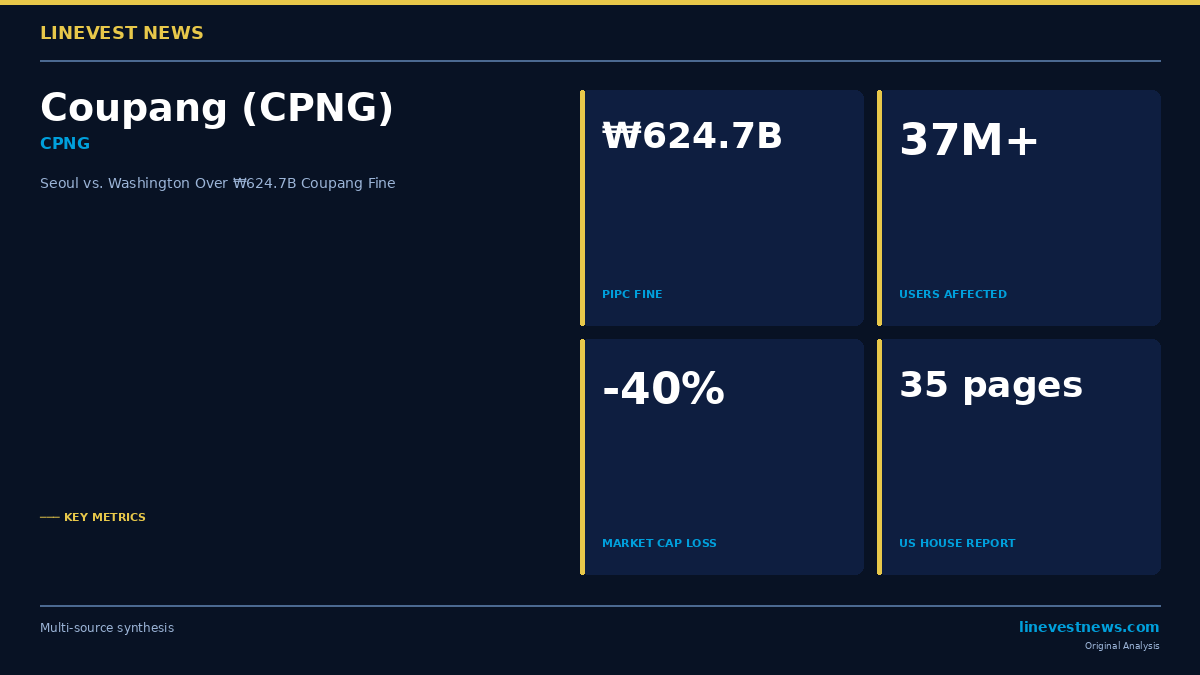
Seoul and Washington are trading sharp words over South Korea's record ₩624.7 billion ($403 million) privacy fine against Coupang (CPNG), the NYSE-listed e-commerce giant, after the US House Judiciary Committee released a 35-page report on July 1 (local time) accusing Korean authorities of targeting American-owned companies.
The committee's interim staff report, titled "Closed for Competition: Korea's Discriminatory Attacks on American-owned Businesses," alleged that Seoul "weaponized digital laws," employed "coercive investigation tactics," and imposed "massive fines" disproportionately against US firms. The document centres on how Korean regulators handled a data breach at Coupang that exposed the personal information of more than 37 million customers — the largest data theft in Korean corporate history.
How the breach unfolded
The breach was discovered in November 2025, when investigators determined that a Chinese employee at Coupang had exfiltrated customer records — names, addresses, and payment details — belonging to more than 37 million users in Korea, roughly 70% of the country's adult population.
South Korea's Personal Information Protection Commission (PIPC) launched a formal investigation and, in June 2026, levied a fine of ₩624.7 billion ($403 million) — the largest privacy penalty in Korean history. Coupang has pledged to challenge the ruling vigorously in Seoul Administrative Court.
Washington weighs in
Coupang CEO Harold Rogers testified before the US House Judiciary Committee in February 2026, triggering a broader congressional investigation into what the committee describes as discriminatory treatment of US businesses in Korea.
The resulting July 1 report accuses the National Intelligence Service (NIS) of overstepping by directing Coupang's internal response to the breach — placing an intelligence agency, not just a privacy regulator, at the centre of the controversy.
Coupang's stock has shed roughly 40% of its market capitalisation since the breach became public. Rogers separately faces a perjury investigation by Korean police over testimony he gave to South Korea's National Assembly — a case Coupang views as further evidence of regulatory overreach.
Seoul fires back
South Korea's Foreign Ministry rejected the committee's framing on July 2. Spokesperson Park Il stated: "Claims that the government has subjected Coupang to discriminatory investigations or unfair regulations are not true," adding that Seoul would continue diplomatic engagement with US lawmakers.
The NIS called the report's depiction of its role "Coupang's one-sided false claims," explaining it had only requested information sharing in line with its statutory mandate to counter threats involving foreign nationals.
Korea's Foreign Ministry noted that the committee's report appeared to "reflect only Coupang's claims in a one-sided manner" and that Coupang had "clearly violated Korean law" regardless of its ownership nationality.
Why the fine scale matters
The PIPC has escalated privacy enforcement steadily since 2023. The ₩624.7 billion penalty — equivalent to more than a full year of Coupang's Korean operating profit — reflects the commission's view that 37 million exposed records warrants proportional consequence, not symbolic enforcement. For comparison, the EU's GDPR has produced nine-figure fines in Europe; Korea's new benchmark puts it among the most aggressive data-protection regimes in Asia.
Coupang operates the Rocket Delivery platform and serves tens of millions of Korean households. The company has not disclosed a legal timeline but expects judicial review to materially reduce the final amount.
The trade dimension
The committee's report explicitly frames the Coupang case as a trade violation, arguing that Korea's enforcement approach conflicts with commitments under the Korea-US Free Trade Agreement (KORUS FTA). Seoul has rejected that framing, maintaining it applies domestic law equally to all firms regardless of nationality.
The dispute adds a digital-trade flashpoint to a bilateral relationship already navigating tariff friction in steel, semiconductors, and autos, as the Trump administration pursues reciprocal tariff negotiations with Seoul.
This article is for informational purposes only and does not constitute investment advice.
Sources: Korea Times · The Korea Herald · Chosun Biz · Maeil Business · Yonhap