US Consumers File 'Chipflation' Antitrust Suit Against Samsung, SK Hynix and Micron in California Federal Court
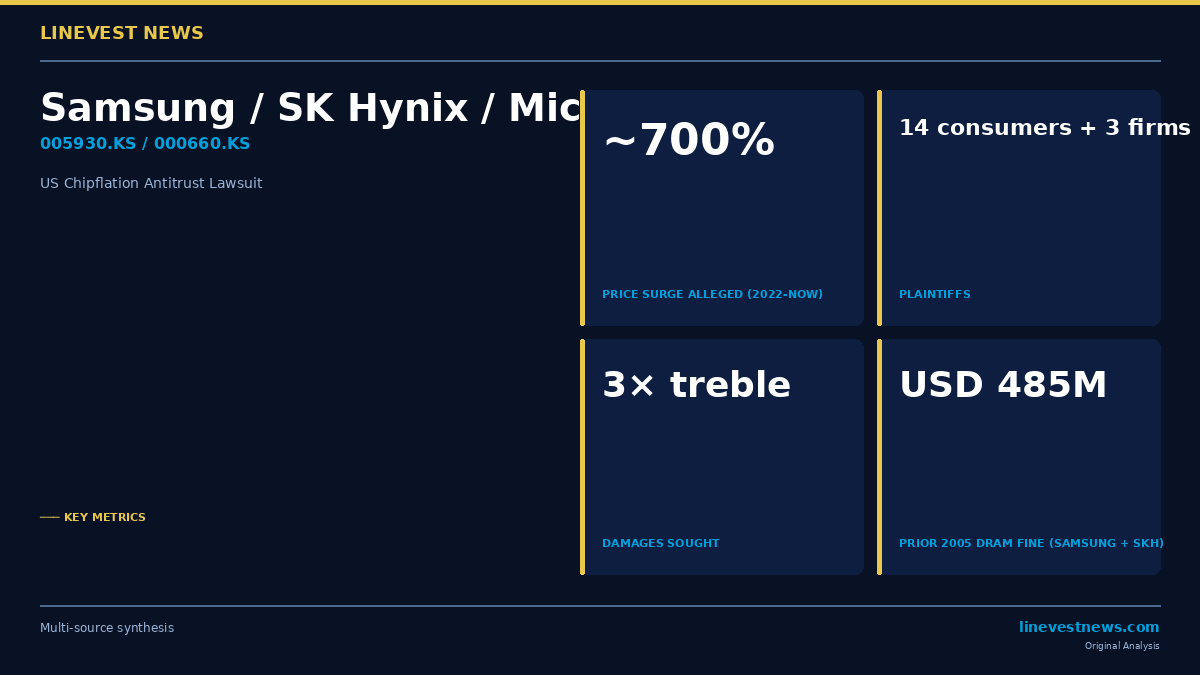
Fourteen US consumers and three small PC assembly and distribution companies have sued Samsung Electronics (005930.KS), SK Hynix (000660.KS) and Micron Technology in a class action filed June 25 in the US District Court for the Northern District of California, alleging the three DRAM makers coordinated to restrict standard memory supply and inflate consumer prices by roughly 700% over the past four years. The case has been assigned to Judge Noel Wise.
The Core Allegation: HBM as a Pretext
The plaintiffs argue that the world's three dominant DRAM producers — which together command an oligopolistic share of global output — used the pivot to high-bandwidth memory (HBM) for AI data centers as cover for a deliberate supply squeeze on legacy commodity DRAM formats, including DDR3 and DDR4.
In a normally competitive market, the complaint argues, when one supplier cuts production, rivals typically expand to capture share. Instead, the plaintiffs contend that Samsung, SK Hynix and Micron moved "in parallel" — all simultaneously scaling back standard DRAM production lines and investment, producing an outcome that economics alone cannot explain without some degree of coordination.
The filing names several corroborating actions: - Micron's exit from its "Crucial" consumer brand, which the complaint treats as evidence of deliberate retreat from commodity DRAM. - Apple's broad price increases on iPads and Mac computers, offered as a real-world illustration of how the alleged supply restriction passed through to end consumers. - Prior convictions: The complaint invokes the 2005 US Department of Justice DRAM price-fixing prosecution. Samsung paid a USD 300 million criminal fine; Hynix Semiconductor — SK Hynix's predecessor — paid USD 185 million. Executives from both companies received jail terms. Micron cooperated with investigators and avoided penalties at the time.
Market Structure Underpins the Case
The plaintiffs lean heavily on the oligopoly structure of DRAM supply. Samsung, SK Hynix and Micron account for approximately 90–95% of global DRAM revenue. In this environment, the complaint argues, even tacit coordination — without explicit back-channel agreements — could produce cartel-like outcomes if the three firms observe each other's capacity signals and respond symmetrically.
The case will likely hinge on two questions: first, whether the plaintiffs can establish that the production cuts represent "concerted action" under the Sherman Antitrust Act rather than rational, independent responses to a genuine AI-driven demand shift for HBM; and second, whether standard DRAM prices would have risen roughly 700% anyway, given surging AI infrastructure investment globally.
The mainstream industry view holds that the commodity DRAM price spike reflects genuine HBM demand substitution, capacity conversion costs and inventory destocking — not collusion. Samsung and SK Hynix said in separate statements that they are aware of the filing and will respond through proper legal channels.
Remedies Sought
If certified as a class action and successful on the merits, US antitrust law allows for treble damages — three times proven losses — which could expose the defendants to substantial liability given the scale of consumer DRAM purchases. Plaintiffs are also asking the court to enjoin any further supply-restriction conduct.
What Investors Should Watch
For portfolio managers with exposure to Samsung or SK Hynix, the lawsuit introduces a tail risk that has historically been manageable but not trivial. The 2005 fines — combined USD 485 million between Samsung and SKH's predecessor — were absorbed without lasting damage to share performance. However, a certified class action in the current environment, covering sales to millions of US consumers over four years of elevated prices, could produce a substantially larger damages figure if liability is found.
Near-term, the case does not create an immediate earnings headwind. Class action antitrust proceedings in the US routinely take five to ten years to reach trial or settlement. The more immediate question is whether the filing triggers parallel investigations by the US Department of Justice or the Federal Trade Commission, which would carry more direct regulatory weight.
South Korean financial regulators and the Korea Fair Trade Commission are unlikely to act on a US civil complaint alone, but any DOJ probe would require direct engagement by the companies' legal teams.
Sources: Chosun Biz · Maeil Business News · Newsis