Samsung is preparing to unveil what Korean media describe as the largest investment program in its history, spanning the country's Honam (southwestern Jeolla), Chungcheong (central) and Yeongnam (southeastern) regions, according to Yonhap (Korea's national news agency). The plan reaches well beyond Samsung Electronics' chip business to mobilize affiliates including Samsung Display, Samsung's OLED panel maker, and Samsung SDI (006400.KS), Samsung's battery and electronic-materials affiliate, according to Yonhap and Financial News reporting on June 27–28.
For a fund manager looking at the Samsung SDI ticker on this headline, the first question is concrete: how much of this group-wide spend actually lands on the battery business, and how firm is any of it? The answer, for now, is that the bulk of the capital is semiconductors — and most figures are reported expectations ahead of an official announcement, not confirmed commitments.
The headline numbers, and who they belong to
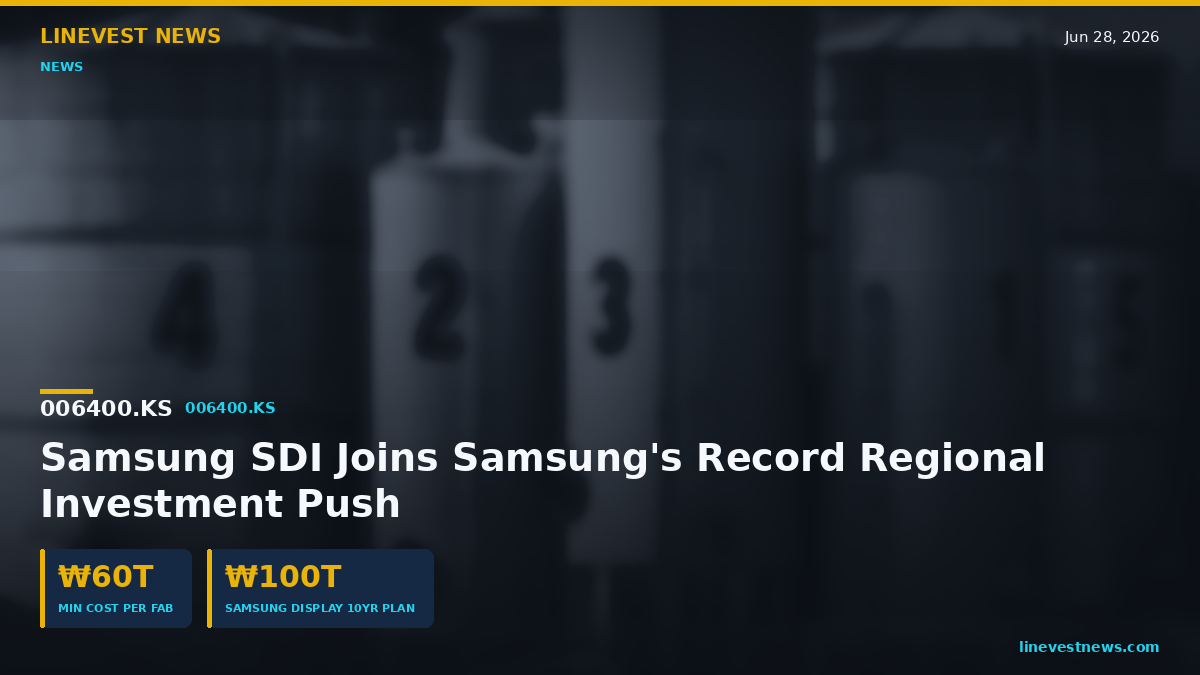
The single largest piece sits with Samsung Electronics in Honam, where the company is expected to build a semiconductor cluster combining front-end fabrication and back-end packaging. Yonhap and Financial News report that each fab is estimated to cost a minimum of ₩60 trillion (about $43.8 billion) to build, with up to five facilities possible — a footprint that, if fully realized, would approach ₩300 trillion ($219 billion). That scale aligns with separate reporting that combined Samsung and SK hynix semiconductor commitments under discussion could reach ₩300–400 trillion (Digital Today).
In Chungcheong, Samsung Display is reported to be planning roughly ₩100 trillion ($73 billion) over 10 years, anchored at its Asan and Cheonan campuses, for OLED and next-generation display production, according to Financial News.
Across all group initiatives, Financial News cites projections of hundreds of trillions of won over five to six years and more than ₩1,000 trillion (about $730 billion) within a decade — a figure that should be read as an aggregate ceiling of expected plans rather than a signed budget.
What it means for Samsung SDI specifically
Samsung SDI's role is real but smaller in scale than the chip and display commitments. Yonhap reports that the company's Cheonan site would expand small-format and automotive battery output to track growth in next-generation mobility and physical AI, while its Ulsan plant would add capacity for energy storage systems (ESS). Samsung SDI operates manufacturing facilities across Cheonan, Ulsan and Gumi in Korea.
The ESS emphasis fits the company's recent direction. Samsung SDI's own newsroom disclosed an LFP-cell ESS supply agreement with an unnamed U.S. energy infrastructure developer valued at more than ₩2 trillion (about $1.46 billion), running three years from 2027 — a deal struck as lithium-ion demand recovered on ESS and data-center appetite even as EV battery demand stayed soft (Korea Herald). An Ulsan expansion would feed that pipeline, though the source reporting attaches no specific won figure to the Samsung SDI portion of the regional plan.
Why the timing matters
The announcement is being staged around government policy. Yonhap and Financial News report that Samsung will present its medium- to long-term blueprint at the "Korea's Great Leap 3 Mega Projects" national report conference on June 29, 2026, presided over by President Lee Jae-myung. The framing follows a June 25 meeting between President Lee and Samsung Chairman Lee Jae-yong on regional cluster investment (Korea Times). Financial News adds that Chairman Lee is expected to visit Samsung Display's Asan campus on July 2 to detail the Chungcheong vision.
That political backdrop is the reason to treat the headline figures with care. Korea has seen large, government-aligned investment pledges before: the Yongin chip cluster south of Seoul, announced in 2023 with a headline of roughly ₩300 trillion, remains a multi-decade build-out whose annual capital outlays depend on memory-market conditions. Pledged ceilings and deployed capital are different things, and the conversion from one to the other plays out over years.
The open question
The June 29 conference and the July 2 Asan visit are the next concrete checkpoints. They should clarify which figures Samsung itself confirms, how spending is phased, and — for Samsung SDI holders specifically — whether the Cheonan battery and Ulsan ESS expansions come with their own committed numbers or remain folded into a group aggregate. Until then, the only firm Samsung SDI data point tied to this theme is the company's own disclosed ESS contract; the rest is reported expectation.
Sources: Yonhap News · Financial News · Korea Times · Korea Herald · Samsung SDI
This article is for informational purposes only and does not constitute investment advice. Figures attributed to news reports reflect expected plans ahead of Samsung's official announcement and may change.