onsemi's $7 Billion Synaptics Takeover Redraws the Edge-AI Chip Map for Samsung, LG and Hyundai Suppliers
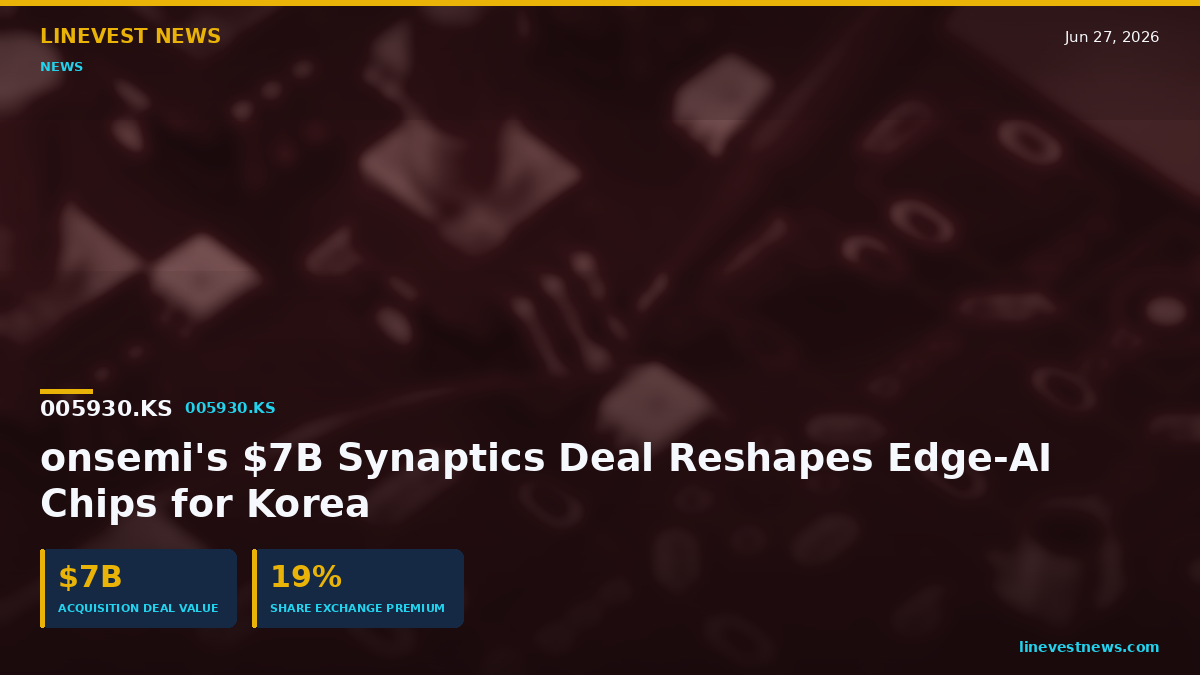
US power-and-sensing chipmaker onsemi has agreed to buy Synaptics, a US edge-AI and human-machine-interface chip designer, in an all-stock deal valued at about $7 billion (₩10.77 trillion), the companies announced on June 25 (US time). It is onsemi's largest acquisition ever. Neither party is Korean, but the combination lands squarely on two supply chains that matter to Seoul: the chips inside Samsung and LG smart TVs and home appliances, and the power semiconductors inside Hyundai and Kia vehicles. That is why this US deal carries a Korean ticker.
The deal in numbers
Synaptics shareholders will receive 1.350 onsemi common shares for each Synaptics share — a premium of roughly 19% to the two stocks' 10-day volume-weighted average prices, according to the deal terms reported by Chosun Biz, a Korean business daily. They will own about 12% of the combined company on a fully diluted basis. Both boards approved the transaction unanimously, one Synaptics director will join onsemi's board, and the deal is expected to close in mid-2027 pending Synaptics shareholder and regulatory approvals.
The market split on the news. onsemi shares fell more than 8% to $108.85 in extended trading — still up about 119% year-to-date — while Synaptics rose about 11% to $140, per SiliconANGLE. The gap reflects the classic all-stock dynamic: the target pockets the premium while the acquirer's holders absorb the dilution and integration risk.
Why a Korea market desk cares
The immediate question for a fund manager watching Korean tech is not the headline price but the supply-chain ripple. onsemi sells automotive power and sensing chips to carmakers including Hyundai Motor and Kia, Korea's dominant automaking group, while Synaptics has supplied touch, display-driver and wireless-connectivity chips into smart TVs and appliances made by Samsung Electronics (005930.KS), one of the world's largest memory-chip and TV makers, and LG Electronics, one of the world's largest home-appliance makers, Chosun Biz reported.
Bundling onsemi's power and sensing silicon with Synaptics' edge-AI compute, human-machine interface and connectivity portfolio creates a single vendor pitching integrated "physical AI" chipsets for cars, robots and connected consumer devices — the categories where Korean set makers and automakers buy. The practical effect, per Chosun Biz, is intensifying competition in automotive and consumer edge-AI chips for the suppliers Samsung, LG, Hyundai and Kia already work with, rather than a direct threat to the Korean firms themselves.
Sizing the ambition
onsemi said the deal lifts its 2030 total addressable market — the full market it can target — by $30 billion to $243 billion. It expects the acquisition to add to non-GAAP earnings per share within 18 months of closing and to deliver about $200 million in annual synergies. CEO Hassane El-Khoury framed the logic around AI leaving the data center: as artificial intelligence "moves beyond the cloud and into the physical world," he said, the next wave of value lies in systems that sense, decide, act and adapt in real time. Synaptics CEO Rahul Patel said the two companies would pair AI-native compute, connectivity and human-machine interface with onsemi's intelligent power and sensing to offer integrated edge-AI platforms.
A step-change for a serial deal buyer
At about $7 billion, the Synaptics deal dwarfs onsemi's previous largest acquisition — its roughly $2.4 billion cash purchase of Fairchild Semiconductor in 2016 — along with subsequent bolt-on transactions such as the $1.07 billion pickup of Wi-Fi chipmaker Quantenna Communications in 2019 and the $415 million acquisition of silicon-carbide supplier GT Advanced Technologies in 2021. Those were narrower, technology-extension deals; the Synaptics transaction, at roughly three times onsemi's prior record, is a portfolio-defining bet that signals a strategic shift from component supplier toward integrated-systems vendor.
The open question
The thesis hinges on execution that won't be visible for over a year. The next concrete checkpoints are onsemi's upcoming quarterly results — where management will be pressed on integration detail behind the $200 million synergy target — and the regulatory review that must clear before the targeted mid-2027 close. Until those land, the impact on Korean set makers' and automakers' chip-sourcing remains a forecast, not a fact.
This article is for informational purposes only and does not constitute investment advice. All figures are sourced from company statements and the cited reporting as of June 2026; deal terms remain subject to shareholder and regulatory approval.