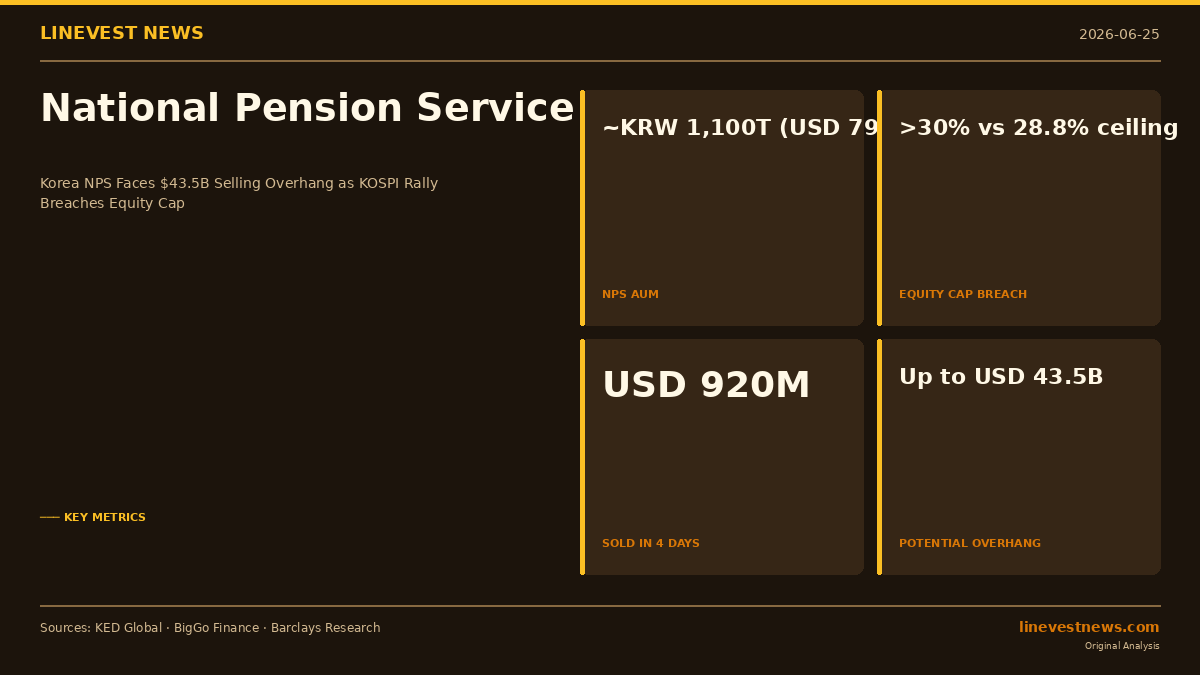
South Korea's National Pension Service (NPS), the world's third-largest pension fund with roughly KRW 1,100 trillion (USD 793 billion) in assets under management, has become an urgent seller in the domestic equity market as the KOSPI's historic rally has pushed its Korean stock holdings well above regulatory limits — with analysts warning the overhang could reach USD 43.5 billion.
Rally Victim: How KOSPI's Surge Trapped the NPS
The NPS suspended active portfolio rebalancing in January 2026, a decision that allowed it to ride the KOSPI's subsequent 94% surge without counterbalancing sells. The windfall was substantial: through May, NPS domestic equity returns reached 21.7%, compared with 11.1% had normal rebalancing been maintained, according to Barclays economist Bum Ki Son.
But the ride came at a structural cost. With the KOSPI crossing 8,800 for the first time — and touching an intraday high of 8,874 — the fund's domestic equity weighting ballooned above 30%, overshooting even the newly expanded ceiling.
The NPS had already raised its domestic equity target from 14.9% to 20.8% in early 2026 and widened its Strategic Asset Allocation band from ±3% to ±6%. Combined with a 2% Tactical Asset Allocation buffer, the effective ceiling stood at 28.8%. Regulatory officials noted the fund can remain in compliance "only up to the high 8,800s on the KOSPI" — a threshold that has already been breached.
USD 920 Million Down, Up to USD 43.5 Billion to Go
With the grace period expiring June 30, the NPS has begun mandatory selling. Over four consecutive trading sessions, it offloaded approximately USD 920 million in equities, taking profits in names such as Samsung Electro-Mechanics (009150.KS) while rotating into Naver (035420.KS) and SK Hynix (000660.KS).
Analysts estimate the total required selling could reach USD 43.5 billion if KOSPI remains elevated. From July, normal asset-allocation rules will be strictly reapplied. The NPS has indicated it will restart rebalancing in July but has pre-announced reduced daily execution caps — a move designed to limit single-day market shocks but that could extend the selling pressure well into H2 2026.
Barclays: From Stabilizer to Volatility Amplifier
In a research note cited widely by market participants, Barclays warned that the NPS's rebalancing pause transformed it "from a stabilizer into a volatility amplifier." The fund, which holds 8% to 9% of total KOSPI market capitalization, historically served as a countercyclical buyer during corrections and seller during overheating — a mechanical dampener of swings.
By pausing, the NPS removed that shock absorber precisely when the market needed it most. The KOSPI 200 volatility index recently hit all-time highs, and on June 23 the benchmark suffered its biggest-ever single-day drop — a session already dubbed "Black Tuesday" — in part due to the structural absence of the NPS as a buyer.
Currency Pressure Compounds the Picture
The selling dynamic has spilled into the foreign-exchange market. Global investors net-sold USD 78.7 billion of South Korean equities this year, generating excess dollar demand that pushed the KRW to its weakest level since 2009. Although the won has partially recovered, analysts note that reduced NPS rebalancing intensity in H2 — meaning fewer sell-KRW/buy-USD conversions reversed — could sustain downward pressure on the currency.
What to Watch
With June 30 as the critical inflection point, market participants will scrutinize three metrics: daily NPS selling volumes reported via the KRX disclosure portal; KOSPI price relative to the 8,800–8,900 compliance corridor; and the pace of foreign-fund re-entry. Samsung Electro-Mechanics (009150.KS), a confirmed NPS target, could face continued headwinds even as broader large-caps benefit from global AI demand.
The episode underscores a structural paradox in Korea's equity market: the very success of the KOSPI rally that lifted national savings has now armed its largest domestic shareholder with a mandatory mandate to sell into further gains.
Sources: KED Global, BigGo Finance, Barclays Research (Bum Ki Son), Futunn Finance
"