Record revenue, red ink anyway
The head of Samsung Electronics' (005930.KS) System LSI division — the unit that designs the company's logic chips, including Exynos mobile processors and ISOCELL image sensors — told employees the business will post a full-year operating loss in 2026 even after a record first quarter.
Speaking at an internal management briefing on June 18, Park Yong-in, president of the System LSI Business within Samsung's DS (Device Solutions, the semiconductor arm), said the division "achieved record sales in the first quarter this year" but that "an annual operating loss is unavoidable due to market changes and shrinking demand," according to Seoul Economic Daily (en.sedaily.com) and Korean-language reports from Yonhap and Chosun Biz.
For a fund manager, the immediate question is whether this matters against a chip division that just printed a historic profit — and the answer turns on the gap between Samsung's memory and logic businesses.
Sizing the drag against a memory windfall
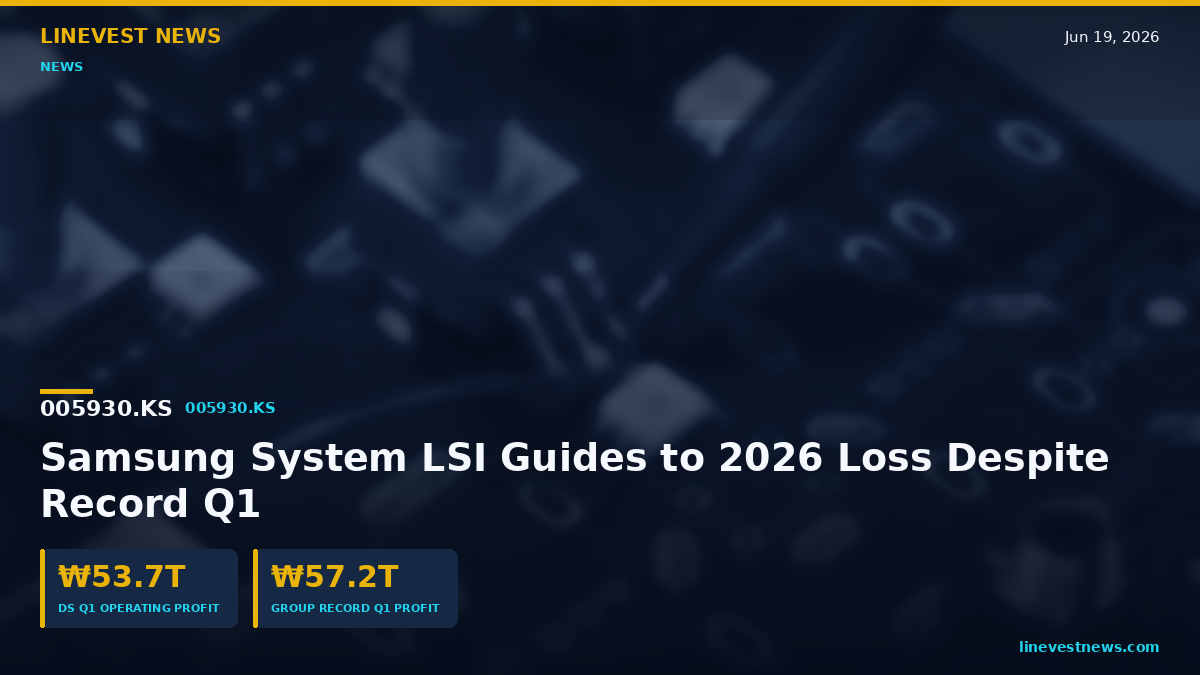
The loss guidance lands in the same quarter that Samsung's broader chip operations set records. The DS Division posted KRW 81.7 trillion in revenue and KRW 53.7 trillion (about USD39 billion) in operating profit in Q1 2026, with group operating profit reaching a company-record KRW 57.2 trillion (USD41.6 billion) on revenue of KRW 133.9 trillion (about USD97 billion), per coverage of Samsung's results by DataCenterDynamics (datacenterdynamics.com). That profit was driven almost entirely by the Memory Business, which set all-time highs on AI-driven demand and higher average selling prices.
System LSI sits on the opposite side of that ledger. It is part of Samsung's non-memory logic operations, where image sensors and parts of the LSI portfolio are profitable but the system-on-chip (SoC) business is loss-making, Chosun Biz reported, citing Park's briefing. The division designs image sensors, display driver ICs (DDI), power management chips (PMIC) and mobile application processors. "Sensors and the LSI business are turning a large surplus, but SoC losses are expected to push the whole division into the red this year," Chosun Biz reported, paraphrasing Park.
The scale of the logic drag has been persistent. Samsung's combined non-memory operations — Foundry and System LSI together — posted an operating loss of roughly KRW 4-5 trillion (USD2.7-3.45 billion) in 2024, according to SamMobile (sammobile.com); a standalone System LSI figure was not disclosed. The combined deficit has since narrowed: the two divisions ran a first-half 2025 operating loss of as much as KRW 4.96 trillion (about USD3.4 billion), before improving to a KRW 448 billion (about USD310 million) loss in the third quarter and a KRW 165 billion (about USD114 million) loss in the fourth quarter, per Design & Reuse (design-reuse.com). Those are combined Foundry-plus-System LSI figures, not standalone System LSI numbers.
The turnaround levers, and what's missing
Park framed the loss as a transition rather than a retreat. He said the SoC business is "difficult to convert into a surplus in the short term" but that management is reviewing measures to improve it, per Seoul Economic Daily. He pointed to a new portfolio built around securing sensor orders from major clients, expanding a custom SoC business, and — as a medium-to-long-term goal — entering the AI data center chip market.
The nearer-term catalyst is Exynos. Park said development of the next-generation Exynos 2700 application processor is "being developed without setbacks, with the goal of being installed in flagship models," per Seoul Economic Daily and Chosun Biz. Outside reporting suggests the chip is built on a 2nm process; analysts cited by Wccftech (wccftech.com) and SamMobile expect it to enter mass production in the second half of 2026 and to power a larger share of the Galaxy S27 lineup expected in early 2027. Those production and adoption figures are analyst and supply-chain estimates, not company disclosures.
That history is why the loss guidance carries weight: Samsung's logic ambitions have stumbled before. Through 2025, multiple outlets including SamMobile and GSMArena reported that Samsung was studying a reorganization that could move Exynos design out of System LSI and closer to the mobile (MX) division after repeated performance disappointments — a sign of how unsettled the unit's structure has been. Samsung has not confirmed such a move in the latest briefing.
Notably, Park's briefing followed a similar session on June 12 by Han Jin-man, president of Samsung's Foundry Business, who shared business issues with staff, per Chosun Biz — underscoring that both halves of Samsung's non-memory franchise are managing employees through a loss-making stretch even as memory booms.
The data point to watch
The cleanest near-term test of whether the logic turnaround is real is Exynos 2700's mass-production ramp in the second half of 2026 and its design-in rate on the Galaxy S27. Higher in-house AP adoption would lift System LSI revenue and reduce Samsung's reliance on external SoC suppliers; a limited ramp would leave the SoC loss — the unit's stated drag — largely intact into 2027. Samsung's Q2 2026 results, due in late July, will be the next checkpoint on the non-memory trajectory.
This article is for informational purposes only and does not constitute investment advice. Figures are sourced from company briefings and external reporting as cited; where numbers reflect analyst estimates rather than company disclosures, this is noted in the text.
Sources
- https://en.sedaily.com/finance/2026/06/18/samsung-system-lsi-posts-record-q1-sales-vows-profitability
- https://biz.chosun.com/it-science/ict/2026/06/18/ZQVSUOE6ZRBLPBJ7GC75V3JYGY/
- https://www.yna.co.kr/view/AKR20260618087600003
- https://www.etnews.com/20260618000261
- https://www.datacenterdynamics.com/en/news/samsung-electronics-q1-26-operating-profit-exceeds-companys-fy25-full-year-total/
- https://www.sammobile.com/news/samsung-analyze-chip-business-constant-disappointments/
- https://www.design-reuse.com/news/202529950-samsung-s-non-memory-chip-business-signals-return-to-profitability-this-year/
- https://wccftech.com/exynos-2700-enter-mass-production-h2-2026-increased-adopting-in-galaxy-s27/