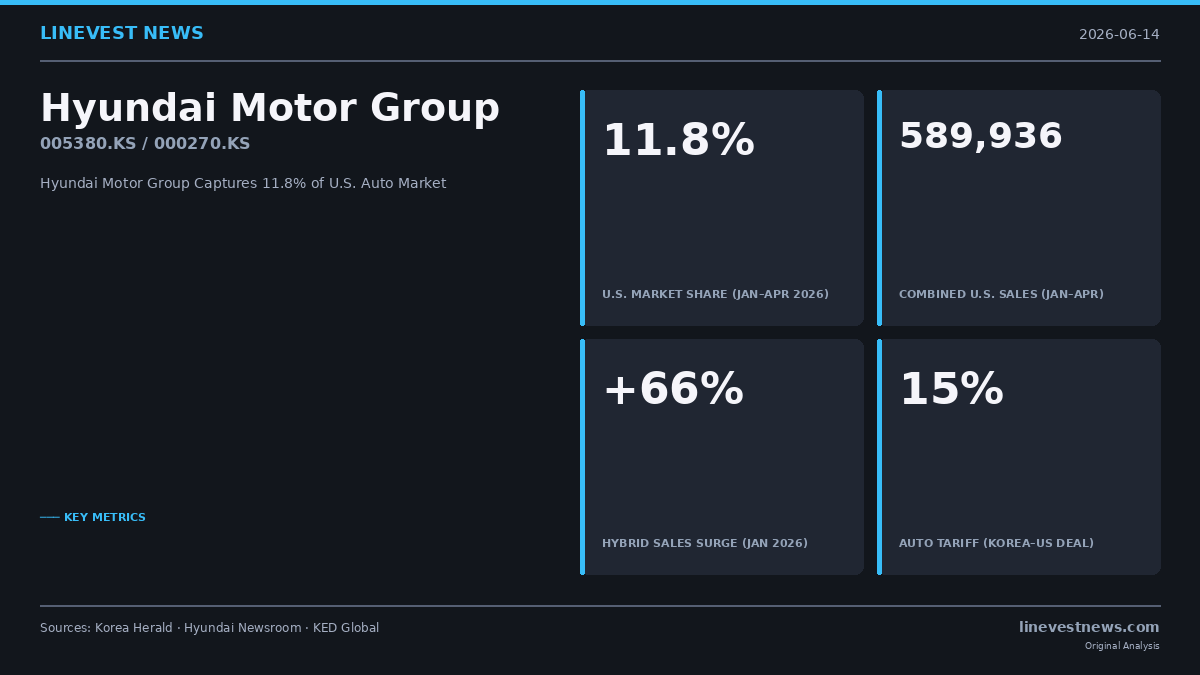
Hyundai Motor Group claimed 11.8 percent of the United States automobile market in the first four months of 2026, a one-percentage-point gain over the same period a year earlier, as surging hybrid sales and a freshly negotiated tariff reduction helped the South Korean automaker close the gap with the three American and Japanese rivals that still rank ahead of it.
The group — which combines Hyundai Motor, Kia, and the Genesis luxury brand — sold 589,936 vehicles in the United States from January through April, a 1.3 percent increase year-on-year, according to data compiled by Omdia and reported by the Korea Herald. The four-month result places the conglomerate fourth in the U.S. market behind General Motors, Toyota Motor, and Ford, and leaves it within reach of a 12 percent threshold that industry analysts had been watching as the benchmark for the year.
Hybrid Demand Drives the Opening Quarter
January alone illustrated how dramatically the group's electrified lineup has reshaped its U.S. standing. Kia posted 64,502 deliveries that month, a 13.1 percent year-on-year increase and a January record; Hyundai Motor, including Genesis, added 60,794 units, up 2.4 percent. The combined January tally of 125,296 vehicles represented a 7.7 percent rise and was the strongest start to a year in the group's U.S. history. Hybrid models surged 66 percent in January to 27,489 units — a figure that shows consumers trading into electrified powertrains at a pace that outstrips the broader market.
Hyundai Motor's stand-alone first-quarter results deepened the picture. The company's U.S. sales reached 243,572 units in Q1, up 0.3 percent, lifting its individual U.S. market share to 6.0 percent from 5.6 percent a year earlier. Electrified vehicle sales group-wide surged 14.2 percent to 242,612 units in Q1, accounting for nearly one in four vehicles sold globally. Of those, 173,977 were hybrid-electric vehicles — a proportion that management has flagged as a deliberate buffer against the volatility of full-EV demand and battery raw-material costs.
Tariffs Weigh on Margins, but Trade Deal Cuts the Rate
The market-share advance has come at a cost to profitability. Hyundai Motor's Q1 2026 operating profit fell 30.8 percent year-on-year to KRW 2.51 trillion (USD 1.8 billion), shrinking its operating margin to 5.5 percent even as revenue rose 3.4 percent to a record Q1 high of KRW 45.94 trillion (USD 33 billion). The company attributed the margin compression primarily to the 25 percent tariff levied on Korean-assembled vehicles entering the United States, a levy that erased KRW 4.11 trillion (USD 3 billion) from its 2025 operating profit.
The tariff environment has since improved. The rate on Korean-made passenger vehicles was reduced to 15 percent under a bilateral trade framework agreed between Washington and Seoul — a reduction that Hyundai expects to provide partial relief in the second half of the year, though management cautioned that the overall 2026 tariff burden is likely to remain "broadly similar" to last year given the timing of the rate change.
To offset the tariff drag, Hyundai has leaned heavily into its higher-margin segments. Sport-utility vehicles represented 57.9 percent of the group's total global sales in 2025, while Genesis accounted for 5.4 percent — a combined 63.3 percent share of a portfolio that industry estimates credit with 30 to 40 percent premium margins over standard sedans. For 2026, the company has planned major launches including a redesigned Avante and Tucson, new hybrid variants of the Genesis GV80 and G80, and the Genesis GV90, a large electric SUV.
April Sales: A Base-Effect Dip
April sales showed a modest year-on-year decline for both Hyundai and Kia, which both companies attributed to a high base: April 2025 saw an unusual pre-tariff buying rush as consumers accelerated purchases ahead of the levy's introduction. The dip obscures the underlying demand trajectory, which the January and February records — Hyundai sold 65,677 units in February (+6 percent), Kia 66,005 (+4 percent) — suggest remains intact.
Hyundai guided 2026 global sales at 4.16 million vehicles, with revenue targeted at KRW 189.98 trillion, and has committed to a 22.8 percent increase in capital expenditures to KRW 17.8 trillion to fund next-generation model development and electrification infrastructure.
Sources: Korea Herald · Hyundai Motor Newsroom Q1 2026 · KED Global · Electrek · Omdia / NewKerala