A labor dispute over who counts as an employee—a classification fight that began in construction trucks and has since reached South Korea's appellate courts—is threatening to halt concrete deliveries to Samsung Electronics' Pyeongtaek campus and SK Hynix's Yongin Semiconductor Cluster as early as June 8.
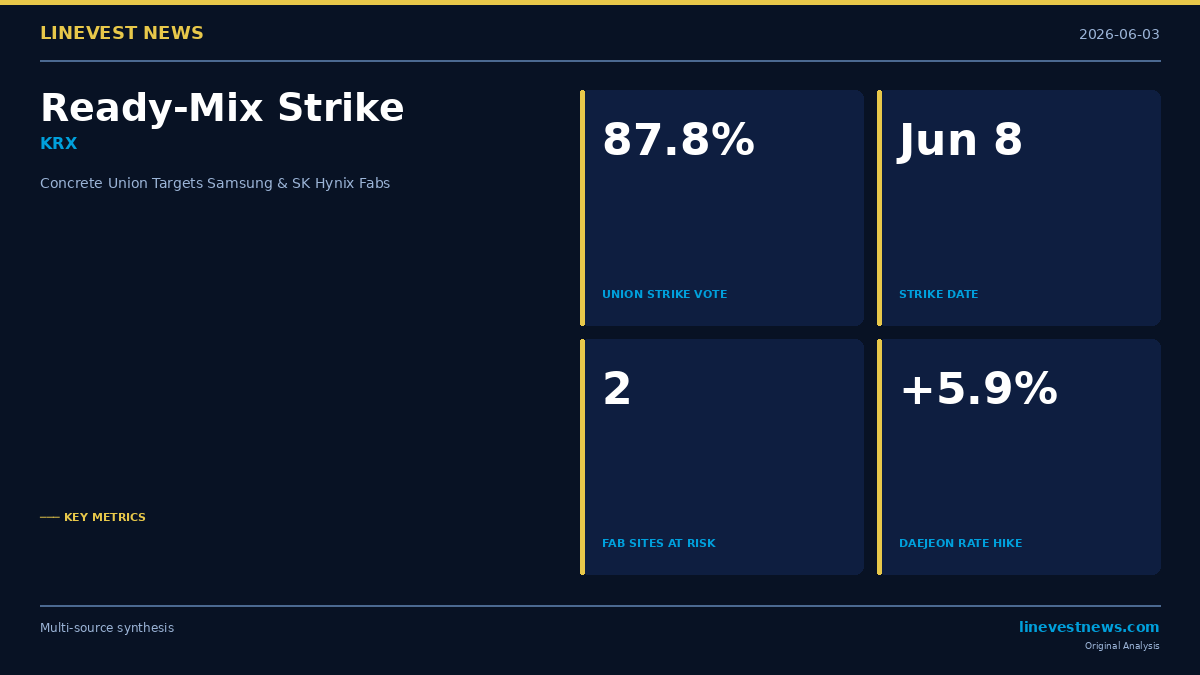
The National Ready-mix Concrete Delivery Workers' Union, known as Jeon-un-ryeon, put the question to a vote last week. Of 7,517 eligible members in the Seoul metropolitan region, 7,326 cast ballots—a 97.5% turnout—and 6,603 voted yes for a full work stoppage. The result: an 87.8% mandate for a strike that would cut concrete supply to some of the most capital-intensive construction projects in the global chip industry.
At stake are two multi-trillion-won fab campuses in the early stages of multi-year build-outs. Samsung Electronics is expanding its Pyeongtaek complex, which anchors its advanced NAND and DRAM roadmap through the decade. SK Hynix is simultaneously constructing the Yongin Semiconductor Cluster, a government-designated national project designed to house four HBM and DRAM fabs and eventually employ tens of thousands of workers. Both sites depend on a continuous flow of ready-mix concrete—and both could go quiet on June 8 if talks remain deadlocked.
The core dispute is not over wages but over bargaining rights. Union leaders are demanding that concrete manufacturers engage in unified collective negotiations to set transport rates across the Seoul metropolitan area. Manufacturers have refused, arguing that the truck drivers are legally self-employed contractors and that accepting collective bargaining would set a binding legal precedent recognizing them as employees. The argument carries weight: South Korea's 2024 National Labor Relations Commission ruled the drivers were not covered by labor law. A February 2026 Seoul Administrative Court ruling went the other way, finding they qualified as employees. That case is now under appeal, leaving both sides in legal limbo.
The regional picture offers mixed signals. In Daejeon, both sides agreed to a 5.9% rate increase—lifting the per-delivery fee from KRW 76,500 to KRW 81,000—and the threat of a strike was averted. In Busan, a favorable strike vote was also resolved before action began. In the Seoul metropolitan region, however, negotiations have broken down, and the union has set June 8 as the line.
Drivers working the Samsung Pyeongtaek site have demanded KRW 1.5 million per day under a schedule that calls for four delivery runs on Saturdays—a figure that remains unaccepted. Industry observers note that the underlying arithmetic dispute is partly about fuel cost calculations: at Samsung's Pyeongtaek distance profile, union data puts the actual diesel consumption at 0.45 liters per kilometer rather than the 0.58 liters used in the manufacturers' formula, creating a monthly gap that the union estimates at KRW 490,000 to 560,000 per driver.
For semiconductor construction, the timing and cost sensitivity differs sharply from conventional real estate projects. Fab timelines are calculated in months, not weeks, and a single concrete pour postponed can cascade across structural, mechanical, and cleanroom installation schedules. The cost of delay, measured against the depreciation of equipment procured in advance and the competitive window for leading-edge nodes, makes fab builders the most exposed buyers in any concrete supply disruption.
Industry sources described the pattern as an annual occurrence, with the dispute recurring each spring as construction activity peaks. Whether the government will intervene—as it has in past construction supply disputes—has not yet been signaled publicly. Both parties are expected to hold a final round of talks in the days before June 8.
Sources: Herald Economy (biz.heraldcorp.com), Hankyung (hankyung.com), Maeil Business Newspaper (mk.co.kr), edaily.co.kr, Newspim (newspim.com)