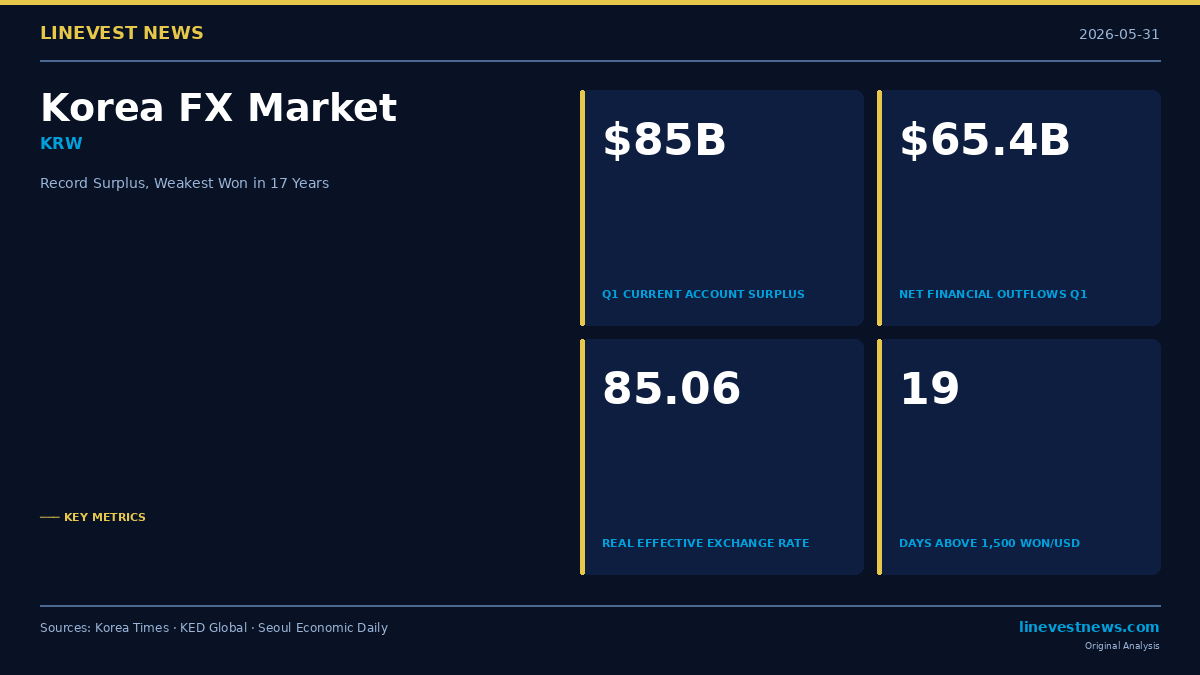
South Korea's AI chip boom has delivered an $85 billion first-quarter current account surplus — a record — yet the won has stubbornly refused to strengthen, hovering above 1,500 per dollar on 19 trading days in 2026 and touching a 17-year low in real effective terms. Economists say three structural capital-flight forces are almost perfectly canceling out what Samsung Electronics and SK hynix are earning abroad.
Dollars Earned Abroad, Kept Abroad
When South Korea's chipmakers ship semiconductors overseas, the export proceeds technically arrive as dollars. But amid persistent expectations that the won's weakness will endure, exporters are increasingly opting to hold their dollar earnings rather than convert them — suppressing the dollar supply that would normally strengthen the currency.
This behavior compounds two other outflow pressures. Korean pension funds and retail investors, including the so-called "Seohak Ants," are channeling record sums into overseas assets, particularly U.S. dollar-denominated equities. In Q1 2026, net financial account outflows reached $65.4 billion — nearly erasing the record $85 billion current account surplus. The net effect on the currency has been minimal.
"The forces pushing dollars out of Korea are currently stronger than the forces bringing them in," said Professor Kang Sung-jin of Korea University.
Bond Buyers Go AWOL
Foreign bond buyers — traditionally a buffer in Korea's capital account — have also pulled back. Foreign investors have shed more than 110 trillion won ($74 billion) in Korean equities year-to-date, yet that outflow has not been offset by fresh bond purchases. "Korea's foreign exchange market is relatively small for the size of its economy, so those shifts can have an outsized impact," said Professor Yang Jun-sok of Catholic University.
The result is a currency that sits at levels associated with financial crises, not records. Korea's real effective exchange rate fell to 85.06 in April — its lowest since March 2009, the nadir of the global financial crisis — while the nominal rate closed at 1,504 per dollar as recently as May 27.
"The biggest problem is that foreigners are not buying won-denominated assets in the first place," said Professor Choi Jae-won of Seoul National University.
A Quiet Tax on Recovery
For chipmakers, a weaker won provides a translation boost when converting dollar revenues back to won, amplifying already-strong earnings. But for the broader economy, the persistent weakness acts as a quiet inflation tax: import costs rise, household purchasing power erodes, and the cost of overseas investment climbs.
Economists broadly agree that intervention alone cannot fix the underlying problem. Structural fixes — restoring Korea's potential growth rate above U.S. levels (a benchmark reversed since 2023), reforming capital markets to attract sustained foreign bond investment, and rebuilding confidence in won-denominated assets — represent the longer-term prescription.
For now, South Korea's most prolific export era on record is delivering a paradox: a record surplus and a weakening currency advancing in tandem.
Sources: Korea Times · KED Global · Seoul Economic Daily