South Korea's cabinet has aired an unusually public disagreement over what should happen to the record profits its memory-chip makers are reaping from the artificial-intelligence boom — a split that, for now, amounts to competing rhetoric rather than any policy on the table.
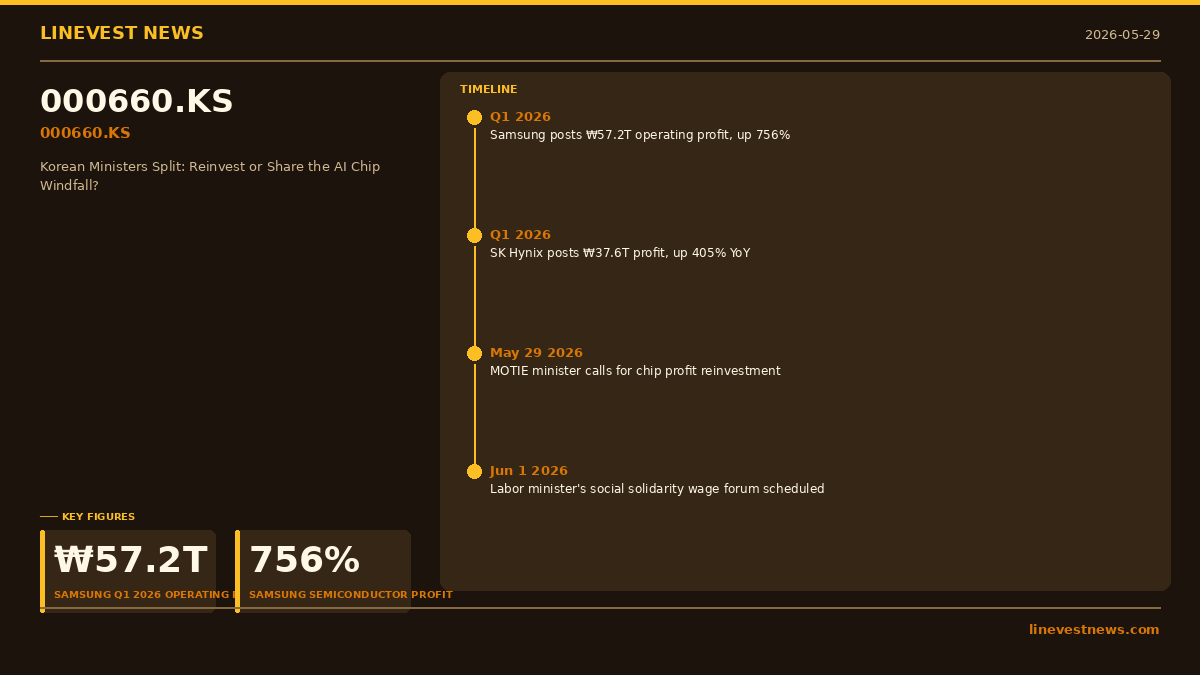
On May 29, Kim Jung-kwan, head of MOTIE (Korea's Ministry of Trade, Industry and Energy), wrote on social media that semiconductor profits must flow into "productive reinvestment" for future competitiveness, arguing that "what is needed now is concentration, not dispersion" (Chosun Biz; Newsis). The post was widely read as the industry ministry braking on a proposal floated days earlier by Kim Young-hoon, Korea's Minister of Employment and Labor, to discuss the "social redistribution" of large companies' excess profits (Chosun Biz; Newsis).
Why two ministers are fighting over chip profits
The backdrop is a profit surge with few precedents in Korean corporate history. Samsung Electronics (005930.KS), the world's largest memory-chip maker, reported first-quarter 2026 operating profit of ₩57.2 trillion ($38.2 billion), up 756% year-on-year, with its Device Solutions semiconductor division supplying roughly 94% of that figure — about ₩53.8 trillion ($35.9 billion) (TradingKey). SK Hynix (000660.KS), the leading supplier of high-bandwidth memory (HBM) for AI servers, posted first-quarter operating profit of ₩37.6 trillion ($25.1 billion), up 405% year-on-year on a 72% operating margin (TradingKey). (USD conversions use ₩1,497 per dollar, the won's level on May 29 per Chosun Biz.)
Profits of that magnitude, concentrated in two firms, are what turned a labor-market debate into front-page politics. The immediate trigger, per Newsis, was a recent performance-bonus agreement between Samsung's management and its union — Samsung runs an Overall Performance Incentive (OPI) scheme — which Kim Young-hoon argued benefits prime-contractor regular employees while leaving subcontractor workers behind.
What is — and isn't — actually proposed
Crucially, no redistribution mechanism exists. Kim Young-hoon announced a forum, which he scheduled for June 1, to explore what he called a "Korean-style social solidarity wage" through "social dialogue" (Newsis). After critics labeled the idea quasi-socialist, he explicitly walked back any coercive reading: "The government has neither the authority nor the intention" to seize and redistribute corporate profits, he said, calling forced redistribution "a wild conjecture" (Seoul Economic Daily). He framed the goal as prime-subcontractor shared growth rather than confiscation — "not cutting open the goose," but "making a bigger goose" (Newsis).
Kim Jung-kwan, for his part, paired his reinvestment message with a promise of state support — power, water, and a "package" of tax, financing and regulatory measures — if companies commit to bold capital spending (Chosun Biz; Newsis).
A debate Korea has had before
The episode closely echoes 2011, when economist Chung Un-chan's Commission on Shared Growth proposed a "cooperative profit-sharing system" that would have large conglomerates share excess profits with subcontractors. Then-Samsung chairman Lee Kun-hee dismissed it in March 2011, saying he could not tell whether the term came from "a socialist, capitalist or communist" economy (Kyunghyang Shinmun; SBS). That proposal was never institutionalized as a mandate; it was diluted into a voluntary "shared-growth index." Kim Young-hoon invoked Lee directly this week, noting that Lee once called suppliers "another family" (Chosun Biz).
The signal to watch
For those tracking Korea's chip giants, the near-term reality is that this is a rhetorical clash, not a legislative one: no bill, no tax and no levy has been proposed, and the labor minister has disowned any intent to compel sharing. The first concrete data point is the June 1 forum — specifically, whether it produces a formal policy track or remains a discussion. Until then, the dispute speaks more to Korea's political appetite around chip windfalls than to any imminent change in how Samsung Electronics or SK Hynix deploy their cash.
This article is for informational purposes only and does not constitute investment advice.