Korea's F4 Warns Samsung Strike Poses Significant Risk to Growth, Exports, Markets
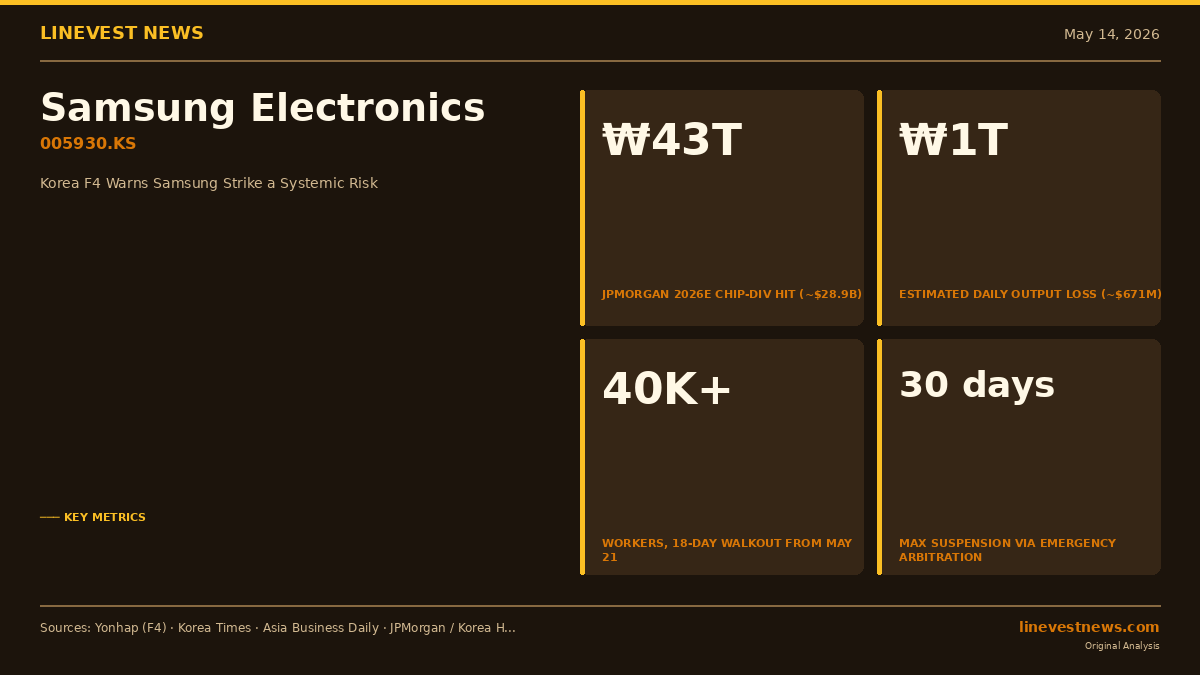
TL;DR - Korea's four top economic policymakers issued a joint warning that a planned May 21 Samsung Electronics walkout could threaten growth, exports and financial markets. - JPMorgan estimates that meeting the union demands and the planned strike could subtract up to ₩43 trillion ($28.9 billion) from Samsung's chip-division 2026 operating profit, with industry officials pegging daily losses near ₩1 trillion ($671 million). - Watch whether Seoul invokes its emergency arbitration power before the 18-day strike begins on May 21.
Lead
Korea's so-called F4 — the country's four most senior economic and financial officials — convened in Seoul on Thursday and warned in unusually direct language that a planned strike at Samsung Electronics (005930.KS) could pose "a significant risk to economic growth, exports and the financial market." The joint statement, issued one week before the union's scheduled May 21 walkout, marks the first time Seoul's macro-policy leadership has publicly cast a single corporate labor dispute as a systemic risk to the national economy.
What Happened
Finance Minister Koo Yun-cheol chaired a market-conditions review meeting on May 14 with the country's top financial officials, joined by Bank of Korea Governor Shin Hyun-song, Financial Services Commission (FSC, Korea's top financial regulator) Chairman Lee Eog-weon, and Financial Supervisory Service (FSS, Korea's financial conduct watchdog) Governor Lee Chan-jin. The grouping is informally known in Korea as the "F4."
According to a release from the Ministry of Finance and Economy cited by The Korea Times, the four officials "expressed concern that a strike by Samsung Electronics workers could pose a significant risk to economic growth, exports and the financial market" and "highlighted that there should never be a strike and that the issue should be promptly settled through principle-based negotiations."
The meeting followed the May 13 collapse of pay talks between Samsung Electronics and its largest union, led by Choi Seung-ho. According to Nikkei Asia and The Korea Times, the union is demanding that 15% of operating profit be legally institutionalized as the source of performance bonuses and that the existing payout cap be removed. Management has countered with an allocation of 10% of operating profit and a one-time special compensation package.
More than 40,000 workers have indicated they will participate, according to The Korea Times; CNBC put the figure at roughly 41,000. The walkout is planned to last 18 days, per Tom's Hardware.
Why It Matters
This is the first concrete signal that Seoul views the Samsung dispute as a macroeconomic event rather than a corporate one. The F4 format is normally reserved for cross-border financial shocks — the FX market, sovereign yields, capital outflows. Hauling a single private-sector wage dispute into that forum, with the central bank governor seated alongside the finance minister, signals that the government is preparing the public — and possibly itself — for the use of stronger policy levers.
The most consequential of those levers is the emergency arbitration power (긴급조정권) under Korea's Trade Union Act, which can suspend a strike for up to 30 days. The Asia Business Daily reported on May 14 that the government is weighing the option, while noting that constitutional protections for collective action set a high bar for invocation.
Business Impact
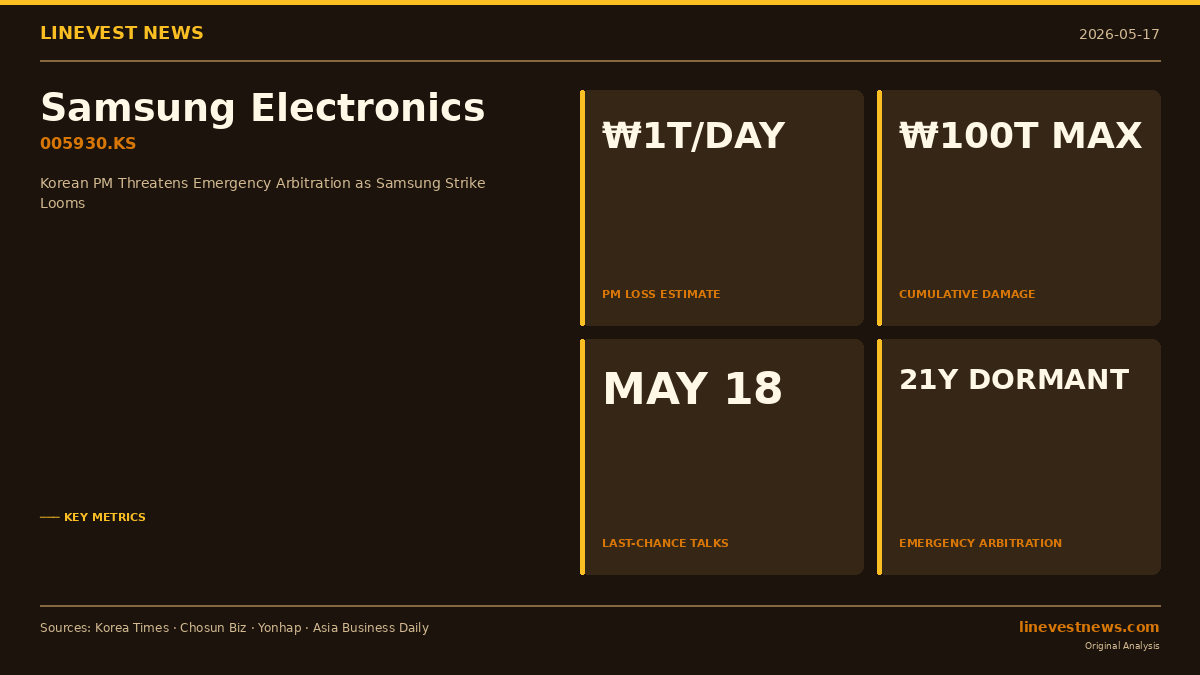
The scale of the potential disruption is what justifies the F4's intervention. JPMorgan estimated in a May 6 report that meeting the union demands and the planned strike could subtract up to ₩43 trillion ($28.9 billion at the May 13 reference rate of roughly ₩1,490 per US dollar) from the chip division's 2026 operating profit, according to The Korea Herald. Industry officials cited by The Korea Times estimated daily losses at around ₩1 trillion ($671 million), with up to ₩30 trillion ($20.1 billion) in long-term fallout.
The market has already begun to price the risk. CNBC reported that Samsung Electronics shares pared an intraday $66 billion market-capitalization loss on May 13 after Seoul moved to calm strike fears. The won has weakened from around ₩1,440 against the dollar at end-February to roughly ₩1,490 on May 13, according to Newsis, while the 10-year Korean Treasury Bond yield has crossed 4% from 3.45% before the recent Middle East conflict — a backdrop that makes additional shocks less welcome.
Industry & Historical Context
The dispute centers on how Samsung shares the upside of the AI memory boom. The union points to memory rival SK hynix, which Tom's Hardware reports is offering bonuses of roughly $477,000 this year and almost $900,000 next year, as the benchmark for Samsung's compensation. The average bonus the Samsung union is seeking is around $400,000 per worker, per the same outlet.
The Korea Times framed the F4 statement as a warning that the strike could "threaten the country's economy amid a semiconductor supercycle," a phrase that captures the asymmetry: chip demand is once-in-a-decade strong, and any voluntary supply outage at the world's largest memory maker hits export earnings, the won and the KOSPI — which the finance ministry meeting itself noted has reached the late-7,000 range.
What to Watch
- Whether the government formally invokes emergency arbitration before May 21.
- Any return to the negotiating table by Samsung Electronics and the union, after talks broke down on May 13.
- Daily moves in 005930.KS, the won and the 10-year KTB yield, which the F4 explicitly flagged as transmission channels for any disruption.
Sources: - The Korea Times — https://www.koreatimes.co.kr/business/companies/20260514/top-policymakers-call-for-prompt-settlement-of-samsung-labor-dispute - The Korea Times — https://www.koreatimes.co.kr/business/companies/20260513/samsung-electronics-labor-talks-break-down-general-strike-looms - The Korea Herald — https://www.koreaherald.com/article/10737664 - CNBC — https://www.cnbc.com/2026/05/13/samsung-electronics-pares-66-billion-rout-as-seoul-moves-to-calm-strike-fears-involving-41000-workers.html - Tom's Hardware — https://www.tomshardware.com/tech-industry/samsungs-last-ditch-union-talks-collapse-eight-days-before-planned-18-day-chip-factory-strike - Yahoo Finance / Reuters — https://finance.yahoo.com/economy/articles/threatened-samsung-strike-poses-significant-012408271.html - Nikkei Asia — https://asia.nikkei.com/spotlight/work/samsung-union-open-to-averting-strike-wants-pay-transparency - Newsis — https://www.newsis.com/view/NISX20260514_0003629007 - Asia Business Daily — https://www.asiae.co.kr/article/2026051410280349474
By LineVest Markets Desk — May 14, 2026
This article is for informational purposes only and does not constitute investment advice.