Korean bank stocks opened higher on July 8, 2026, extending a run that has made the sector one of the year's most reliable havens whenever the KOSPI wobbles. By 9:55 a.m. in Seoul, JB Financial Group (175330.KS, a regional-bank holding company centered on the Jeonbuk and Gwangju franchises) led the move, up 450 won, or 1.61%, at 28,450 won (about $19, at roughly 1,500 won to the dollar). KB Financial Group (105560.KS, Korea's largest banking group by assets) rose 1.15% and Shinhan Financial Group (055550.KS, the No. 2 group) added 0.92%, according to Chosun Biz. Woori Financial Group (316140.KS, the No. 4 group by assets) gained 0.63%, Industrial Bank of Korea (024110.KS, a state-owned policy lender) 0.47%, Jeju Bank (006220.KS, a small regional lender) 0.21% and Hana Financial Group (086790.KS, the No. 3 group by assets) 0.16%.
For a fund manager watching from New York or London, the immediate question is whether this is a durable re-rating built on capital returns and margins, or simply money rotating out of a soft semiconductor sector for a session. The proximate trigger looks like rotation: Chosun Biz attributed the bid to funds leaving a weak chip complex and gravitating toward banks, where earnings momentum and shareholder-return policy are converging.
Sizing the earnings and capital-return case
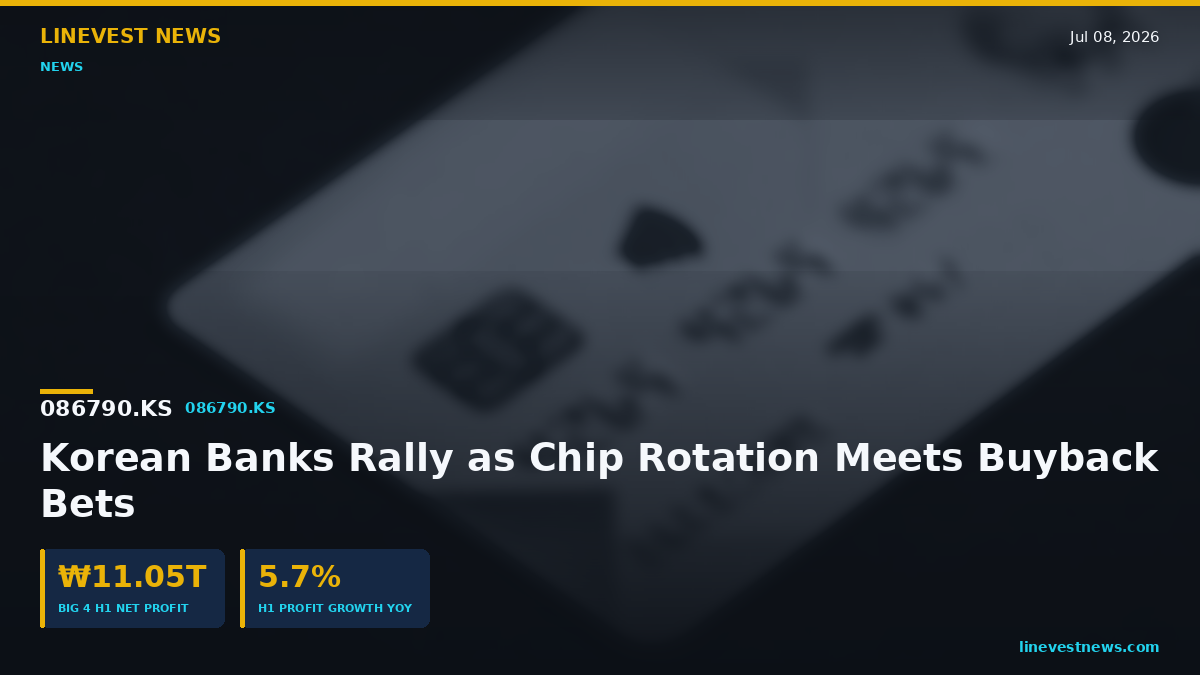
The fundamentals behind the trade are concrete. Combined first-half 2026 net profit at the four big holding groups—KB, Shinhan, Hana and Woori—is projected at an all-time high of 11.05 trillion won (about $7.4 billion), up 5.6% from 10.46 trillion won (about $7.0 billion) a year earlier, per The Korea Times. KB's second-quarter net profit alone is projected at 1.92 trillion won (about $1.3 billion), up 10.2% year on year, on an estimate from Daishin Securities (a Seoul-based brokerage) cited by Seoul Economic Daily.
Margins are the swing factor. Cho Ah-hae, an analyst at Meritz Securities (a Korean brokerage), said in the Chosun Biz report that banks' net interest margins (NIM) should keep improving quarter on quarter as market rates rise, with "rate-sensitive banks showing the larger improvement." Cho added that expectations for aggressive shareholder returns remain intact, tied to rising Common Equity Tier 1 (CET1) capital ratios—the core regulatory gauge of a bank's loss-absorbing equity—and the rationalization of capital rules. KB has put numbers to that thesis: Seoul Economic Daily reports analysts expect more than 800 billion won (about $530 million) in share buybacks and cancellations from KB in the second half. Shinhan, for its part, has been marketing a "Value-Up 2.0" plan that ties shareholder returns to return on equity (ROE) and commits to raising dividend per share by at least 10% annually, according to Seoul Economic Daily.
A recent precedent for the haven trade
The defensive appeal is not theoretical. On July 2, 2026—four trading sessions earlier—the KOSPI plunged 7.9%, yet financial holding shares surged: KB jumped 8.64% to 172,200 won and Shinhan rose 8.61% to 104,700 won by late morning, with Hana up 6.79% and Woori up 4.26%, per Seoul Economic Daily, while BigGo Finance noted the group broadly outperformed a collapsing index. That episode reinforced the banks' reputation as ballast when growth names sell off—the same dynamic visible in Wednesday's chip-to-bank rotation.
What could break the thesis
The counter-case is currency and regulation. The won has traded above 1,500 to the dollar for more than a month, inflating risk-weighted assets—the four major banks' combined RWA reached 886.46 trillion won (about $591 billion) by the first quarter, up 2.9% year on year—which mechanically pressures the very CET1 ratios the buyback story depends on, The Korea Times reports. A revised banking law taking effect this month also bars lenders from folding administrative expenses into loan-pricing spreads, squeezing the margin lift that analysts are counting on.
The data point that settles it
The confirming—or refuting—evidence arrives soon. Second-quarter results from the major groups are due late this month, per Seoul Economic Daily. Whether reported NIM, CET1 ratios and buyback guidance validate the 11.05 trillion won first-half projection will determine if July's rallies mark a re-rating or a rotation that fades once chips stabilize.
This article is journalism, not investment advice. LineVest is not a registered investment adviser. Figures are drawn from the cited sources and were current as of publication; currency conversions use an approximate rate of 1,500 won per U.S. dollar.