SKHY ADR Premium Swings From 3% to 26% in First Week: What Investors Must Know
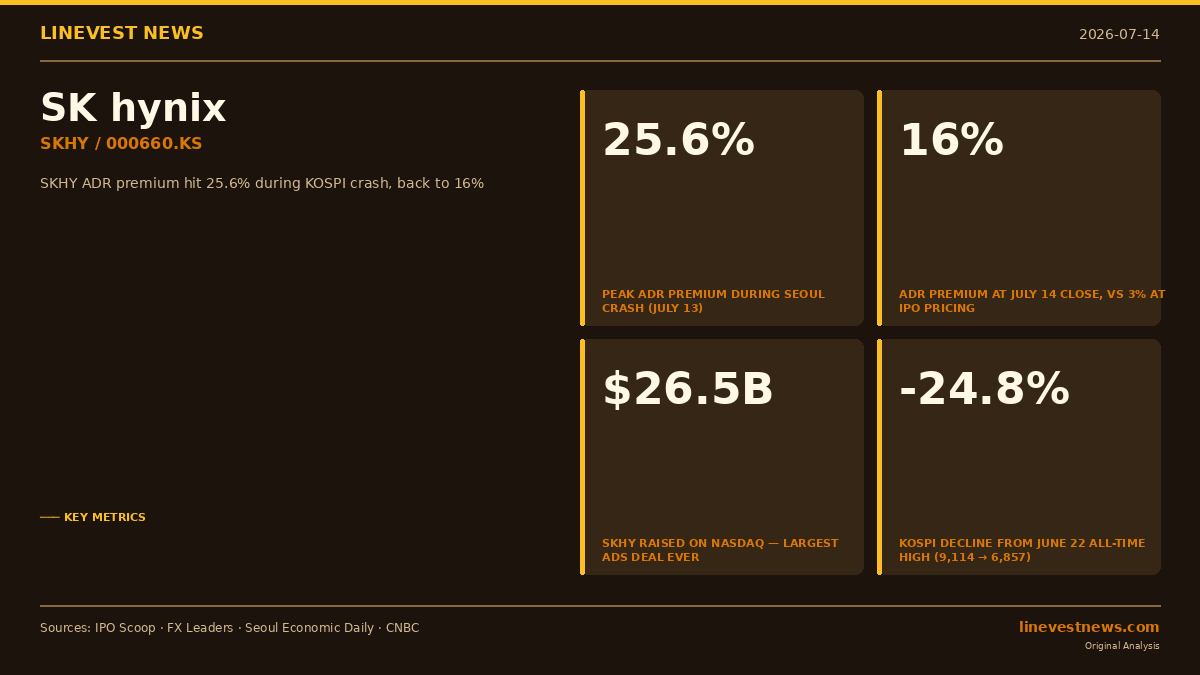
TL;DR - SKHY priced at $149 on July 9 (3% above Korean equivalent), surged to $168.01 at debut — locking in a 16% premium over 000660.KS from day one - When Seoul crashed 15.4% on July 13 (SK Hynix's worst single-session in nearly two decades), the ADR premium spiked to 25.6% before settling back to ~16% as of July 14's close - SK Hynix (000660.KS) recovered +3.69% to ₩1,913,000 on July 14 after an intraday low of ₩1,678,000; SKHY tested $150 support, last at ~$152 - KOSPI has fallen 24.8% from its June 22 all-time high of 9,114.55 in just 16 trading sessions
Part A: SKHY's First Three Trading Sessions on Nasdaq
A Record Debut
On July 9, 2026, SK Hynix priced its US listing at $149 per American Depositary Share, and on July 10 the stock began trading on Nasdaq — marking the largest ADS offering in stock market history. The company sold 177.9 million ADS to raise $26.51 billion, eclipsing Alibaba's $25 billion IPO in 2014. Each SKHY ADS represents one-tenth of one ordinary SK Hynix share trading on the Korea Stock Exchange.
The $149 offering price carried a 3% premium above the USD-equivalent closing price of 000660.KS on July 9 ($144.50 per ADS-equivalent). By the close of debut day (July 10), SKHY had surged to $168.01 — up 13% from the offering price and now trading at a 16% premium to the underlying Korean shares.
| Date | Event | SKHY (USD) | ADR Premium vs 000660.KS |
|---|---|---|---|
| July 9 | IPO Pricing | $149.00 | +3.1% |
| July 10 | Debut Close | $168.01 | ~+16% |
| July 13 | Intraday Peak Premium | ~$152 | ~+25.6% (Reuters est.) |
| July 14 | Recovery Close | ~$152.35 | ~+16% |
All ADR premium figures are approximate, sourced from Reuters and Seoul Economic Daily. Secondary-market premiums are calculated as (SKHY × 10 × KRW/USD ÷ 000660.KS closing price − 1); intraday premium peaks reflect the moment when local shares were at their session trough.
The Seoul Crash
The euphoria ended quickly. On July 13, SK Hynix's Seoul-listed shares fell 15.4% in a single session — their worst one-day decline in nearly two decades. The sell-off was driven by a confluence of factors:
- Peak-out fears: Investor concern that AI memory semiconductor demand may have peaked after years of outsized growth
- Middle East escalation: Renewed US-Iran geopolitical tensions rattled risk assets globally
- Leveraged ETF forced selling: Sixteen Samsung Electronics and SK Hynix-tracking leveraged ETFs listed on the KRX in late May 2026 triggered cascading margin calls as prices fell, amplifying the decline
The KOSPI, which had reached an all-time high of 9,114.55 on June 22, closed July 14 at 6,856.83 — a decline of 24.8% in 16 sessions.
The Recovery
July 14 brought a partial rebound. SK Hynix (000660.KS) closed at ₩1,913,000 (+3.69%), recovering from an intraday low of ₩1,678,000. Foreign and institutional investors net-bought approximately ₩4.2 trillion in Korean equities during the session, concentrated in Samsung Electronics and SK Hynix.
Part B: The ADR Premium — Mechanics, Risks, and What It Means for You
Why Does a 16% Premium Persist?
For investors new to cross-listed securities, a 16% premium may seem like an obvious arbitrage opportunity. It is not. Several structural forces keep it in place:
1. Settlement friction SKHY settles T+2 in US dollars via DTCC. 000660.KS settles T+2 in Korean won via KSD. Converting one into the other requires cross-border custody, FX conversion, and — critically — a 2–5 business day ADR creation window for investors holding 000660 who wish to convert into SKHY and sell. This lag prevents the premium from being instantly arbitraged away.
2. Trading hours asymmetry The KRX closes at 15:30 KST (02:30 ET), roughly 7 hours before Nasdaq's regular 9:30 ET open. US investors buying SKHY during the New York session are reacting to events — Federal Reserve commentary, Middle East headlines, Nasdaq tech price action — that occurred after Seoul closed. This time-zone gap creates persistent valuation differences that same-day arbitrage cannot fully close.
3. US dollar liquidity premium US retail and institutional investors can buy SKHY through any US broker, in USD, with no Korean brokerage account, no FINI registration, and no FX management. This simplicity commands a price. Historically, major Korean ADRs — including Korea Electric Power (KEP) and KT Corp (KT) — have maintained 5–15% premiums over their KRX-listed counterparts.
4. Options availability SKHY options became available to US investors in the week of July 14. The availability of derivatives increases institutional demand for SKHY as the preferred hedging vehicle, supporting a premium that 000660.KS — which has no equivalent US-listed options — cannot command.
The Volatility Lesson: Why SKHY Fell Less Than Seoul
When Seoul crashed 15.4% on July 13, SKHY fell approximately 9.5% from its July 10 debut close — roughly three-fifths the Seoul decline. This is not coincidence:
- US investor composition: SKHY's initial US investor base skews toward institutional long-only funds and retail growth investors who do not margin-trade or hold leveraged ETFs. The forced selling that devastated Seoul on July 13 did not have a direct Nasdaq equivalent.
- Premium expansion absorbed the drop: Because US buyers were willing to pay an elevated premium during the panic (premium widened from 16% to 25.6%), SKHY's USD price fell by a smaller percentage than the KRW-denominated 000660.KS. The wider premium cushioned SKHY holders even as the underlying Korean share price collapsed.
- No leveraged ETF cascade in the US: The 16 Samsung/SK Hynix leveraged ETFs that triggered forced selling on the KRX do not have direct Nasdaq equivalents for SKHY (options just launched; leveraged ETFs on SKHY have not yet been created).
The flip side: when the ADR premium hit 25.6% intraday and Seoul was at its worst single-session loss in nearly two decades, US investors buying SKHY at $152 were implicitly betting that Seoul would recover. It did — 000660.KS bounced +3.69% from its July 13 close the next session. But at 25.6% intraday-peak premium, the entry cost was steep relative to the underlying.
SKHY vs. 000660.KS: Side-by-Side
| Factor | SKHY (Nasdaq) | 000660.KS (KRX) |
|---|---|---|
| Currency | USD | KRW |
| Current premium/discount | +16% premium | Baseline |
| Brokerage required | Any US broker | Korean brokerage or IBKR KRX Direct (launched May 2026) |
| Trading hours | US ET (pre/post + regular) | KST 09:00–15:30 |
| Volatility during KRX panic | Lower (as seen July 13) | Higher |
| Options available | Yes (as of July 2026) | No US equivalent |
| Dividend withholding | 15% (Korea-US treaty) | 22% standard (treaty may apply) |
Practical implication: Investors with access to Korean brokerage or IBKR's KRX direct-access platform (launched May 2026) can buy 000660.KS at no premium. Those who prefer US-dollar simplicity and options access pay the 16% premium for SKHY — a price that has proven stable since the debut, ranging from 16% to 26% in secondary-market trading across the first three sessions (versus 3.1% at IPO pricing on July 9).
Key Risk: Premium Compression
A 16% premium is not guaranteed to persist. Premium can compress — sometimes rapidly — if:
- Seoul outperforms Nasdaq: If 000660.KS rebounds more sharply than SKHY (as on July 14, when Seoul rose 3.69% while SKHY remained near $152), the premium narrows
- ADR arbitrage volume increases: As custodians process more 000660 → SKHY conversion requests, new ADR supply rises and premium fades
- US retail interest fades: If SKHY volume drops and US investors rotate away, the liquidity premium dissipates
Investors buying SKHY at a 16% premium face the scenario where SK Hynix fundamentals improve but the premium compresses simultaneously, capping or even negating USD-denominated returns.
This article is journalistic reporting, not investment advice. LineVest News is not a registered investment adviser. All prices are approximate and based on publicly available market data as of July 14, 2026 (KST). Consult a licensed financial adviser before making investment decisions.
Sources: - SK Hynix IPO Prices at $149 — IPO Scoop - SKHY ADR Tests $150 as SK Hynix Rout Raises Valuation Concerns — FX Leaders - KOSPI Swings but Holds 6,800; Samsung, SK Hynix Close Up 3% — Seoul Economic Daily - SK Hynix rises 13% in Nasdaq debut — CNBC - SK Hynix Nasdaq debut: $26.5 billion ADR listing sets record — Yahoo Finance - Korean stocks swing wildly as Samsung, SK Hynix reverse course — KED Global