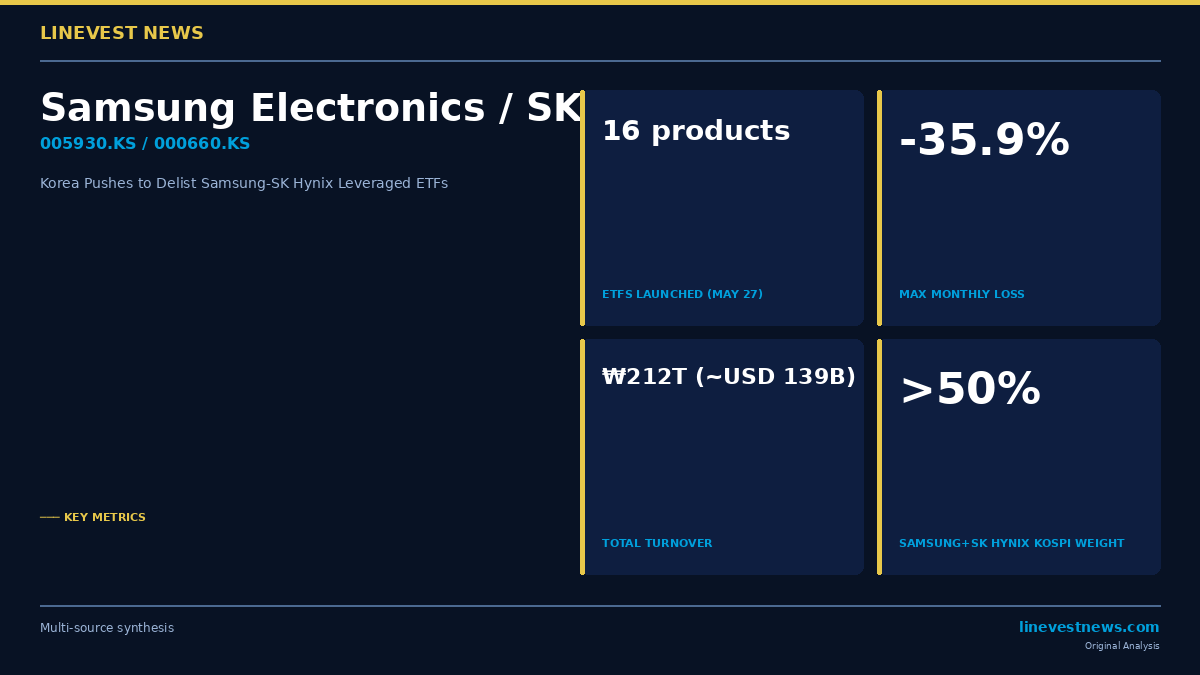
Sixteen single-stock leveraged exchange-traded funds tracking Samsung Electronics (005930.KS) and SK Hynix (000660.KS) — launched just 41 days ago on May 27, 2026 — have become the centre of a regulatory firestorm in Seoul, with legislators and financial authorities calling for their removal from the Korea Exchange.
All 14 leveraged products posted negative returns over the past month, with the worst-performing fund recording a 35.9% loss. The combined trading volume reached \u20a9212 trillion (approximately USD 139 billion), a figure that regulators say is channelling excessive capital into a narrow pair of stocks that together account for more than half of KOSPI's total market capitalization.
Part A: The Regulatory Backlash
Rep. Ahn Cheol-soo of the main opposition People Power Party filed the most pointed demand on Monday. "KOSPI has devolved into a casino," he said, calling for "aggressive regulatory intervention, including their delisting" and demanding the dismissal of the Finance Minister and the Financial Supervisory Service (FSS) governor.
Democratic Party policy chief Rep. Han Jeoung-ae said her caucus would "examine whether additional regulations are warranted before deciding on action" — signalling cross-aisle concern about the products' market impact.
The FSS itself has been unusually candid about its role in approving the funds. Governor Lee Chan-jin acknowledged on June 22 that the agency "rushed the process," adding: "Investing with leverage beyond manageable levels not only exposes investors to significant losses but could also seriously undermine household financial health." Finance Minister Koo Yun-cheol echoed the concern, stating the government "is aware of concerns that leveraged ETFs are contributing to increased swings in the stock market." The Bank of Korea warned separately that the 14 products "draw excessive investment into a small number of stocks and increase market volatility through daily fund rebalancing."
The 16 products — 14 leveraged ETFs and 2 inverse ETFs — were approved and listed in a single batch on May 27, 2026. Within six weeks of launch, all 14 leveraged funds had posted negative returns.
Part B: Korea Market Implications
The political and regulatory backlash arrives on a day when KOSPI itself triggered its sixth circuit breaker of 2026 — a direct consequence of the market's disproportionate exposure to two names. Samsung Electronics and SK Hynix together account for more than 50% of the benchmark index's total market capitalization, making single-stock leveraged instruments on these names a systemic risk multiplier.
The mechanics are straightforward but dangerous at scale. Each leveraged fund must reset its exposure daily: buying additional units during rallies and selling into declines to maintain a fixed multiple. When the underlying stock is already a systemic bellwether — Samsung alone drove a 4.91% KOSPI decline in Monday's circuit-breaker session — the rebalancing pressure from \u20a9212 trillion in turnover adds a structural amplifier that diversified ETFs do not carry.
That dynamic also helps explain FSS Governor Lee's unusually frank admission of error. Regulators rarely acknowledge past approvals as mistakes; the "we rushed the process" statement issued less than six weeks after launch signals that the FSS sees both legal and reputational risk in allowing the products to continue without intervention.
Why forced delisting is harder than it sounds. No existing Korean statute provides a clear pathway for involuntary ETF removal on volatility grounds alone. The preferred exit would require asset managers to wind down the products voluntarily, or legislators to pass new law — both slower routes than the emergency intervention some lawmakers are demanding. In the interim, the FSS is reportedly reviewing alternatives such as tightened margin requirements and daily position limits, which could suppress trading volumes without triggering mass redemptions.
What to watch. For KOSPI investors, the near-term variables are: (1) whether cross-party legislative support emerges before the August recess; (2) the FSS timeline for announcing interim measures; and (3) whether Samsung and SK Hynix management address the ETF-amplified volatility risk in upcoming earnings commentary. Absent forced delisting, the structural feedback loop stays intact — any sustained rally in the two chipmakers would draw renewed leveraged buying, while any sell-off, like today's, accelerates rebalancing-driven selling that overshoots fundamental value.
The sixth circuit breaker of 2026, closing KOSPI at 7,656.31, may prove to be the inflection point that converts political rhetoric into enforceable regulation.
Sources: Korea Times