Korea's foreign-exchange authorities launch a near-continuous won trading session on Monday, extending access from a narrow 9 a.m.–3:30 p.m. window to a near-24-hour daily band — the most significant structural overhaul of the won market in decades.
The Reform: July 7 Launch
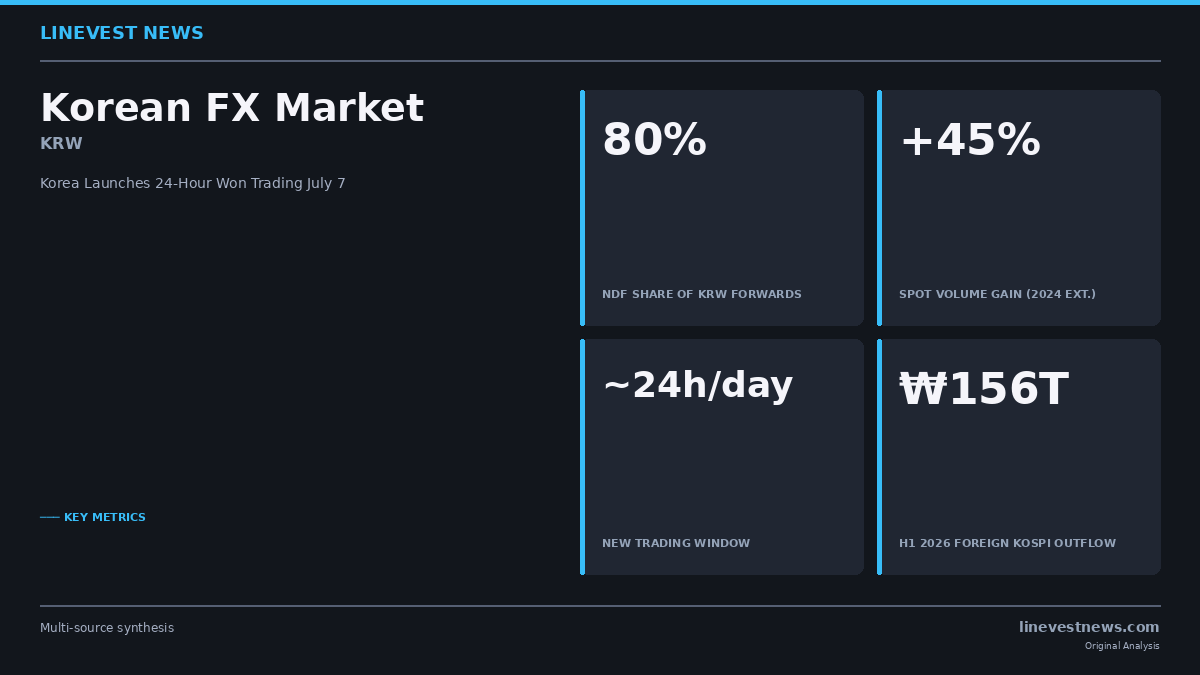
Starting July 7, 2026, the Korean won spot market will operate from 6 a.m. Monday through 6 a.m. Saturday (KST) during U.S. daylight saving time, and from 7 a.m. to 7 a.m. during standard time. The market remains closed on weekends and January 1, though trading is permitted on other domestic holidays.
The reform directly targets the non-deliverable forward (NDF) market, which currently accounts for approximately 80% of all Korean won forward transactions — nearly four times the global average of 21%, according to Hanwha Investment & Securities analyst Choi Gyu-ho. The NDF market, traded in Singapore and London during Korean off-hours, allows foreign investors to hedge won exposure without accessing the domestic spot market. Korean authorities have long identified this NDF concentration as a structural vulnerability: offshore pricing can diverge from domestic rates, amplifying volatility in times of stress.
A first phase extension in 2024 already demonstrated the potential: average daily spot trading volume rose 45% from the prior five-year average following that initial expansion. Second Vice Finance Minister Huh Chang stated authorities would intervene if exchange rates diverge from fundamentals.
KOSPI Implications: Friction Cost for Foreign Investors
The July 7 launch comes at a sensitive moment for Korean financial markets. Foreigners net sold ₩156 trillion in KOSPI holdings during H1 2026 — the sharpest outflow since 1998 — partly because managing overnight won exposure required using Singapore's NDF market rather than Seoul's spot.
By enabling round-the-clock hedging in the domestic spot market, the extended session should reduce friction for foreign holders of Korean equities. When hedge execution builds on NDF pricing rather than Seoul's spot, the effective carry is higher and the timing mismatch larger. Extended domestic hours narrow that gap directly.
Banks and brokerages as market-makers: Korean financial institutions licensed as FX dealers — including KB Financial Group (105560.KS), Shinhan Financial Group (055550.KS), and Hana Financial Group (086790.KS) — stand to gain from wider-window FX flow. KB Securities analyst Oh Jae-young cautions, however, that "the biggest variable is the scale of potential future outflows from foreign investors in the Korean stock market." If macro headwinds intensify, the extended session may simply make capital flight faster, not slower.
Overnight Liquidity Risk
Choi Gyu-ho of Hanwha Investment & Securities flagged that thin overnight liquidity could amplify volatility during macro shocks. The 2024 extension illustrated this: while overall volume rose 45%, after-hours bid-ask spreads widened during risk-off episodes.
For exporters such as Hyundai Motor (005380.KS) and Samsung Electronics (005930.KS), the ability to hedge at the time of contract execution — rather than waiting for Seoul open — reduces basis risk. The counterpart risk of thinner books after midnight remains, however.
Won outlook: Analysts project the won could weaken to ₩1,530 per dollar or beyond if dollar strength persists and foreign portfolio outflows accelerate. The extended trading window does not by itself shore up the won; it shifts settlement from the NDF shadow market to the on-shore record. If underlying demand for dollar assets continues, the won's depreciation trajectory will reflect that demand more transparently — a structural improvement even if it does not immediately arrest currency weakness.
The NDF-to-spot shift also serves a regulatory objective: Korean authorities gain fuller visibility over positioning that previously occurred in offshore venues beyond direct BOK supervision.
Sources: Korea Herald